Where Winds Meet: An Epic Wuxia Adventure Review

▼ Summary
– Where Winds Meet is an ambitious Wuxia-themed open-world RPG set in 10th-century China with vibrant characters, political intrigue, and a combat system that is tactical and MMO-like rather than fast-paced action.
– The game suffers from significant technical issues including poor English localization, voice line problems, model inconsistencies, and menu lag that undermine its storytelling and immersion.
– Combat features seven distinct weapon types with different styles and synergies, but weapon progression is hindered by the difficulty of finding matching combat styles and the resource-heavy upgrade systems.
– The open world offers creative activities like learning mystic arts from wildlife, but is filled with repetitive side content and overwhelming micromanagement of gear, upgrades, and level-gated progression tests.
– Main story pacing is disrupted by late-game level gating requiring grinding, and co-op features were limited pre-launch, though automated party members allowed access to some multiplayer content.
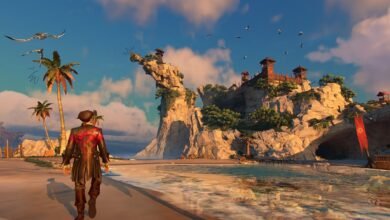
Embarking on the epic journey through Where Winds Meet feels like stepping into a living Wuxia novel, complete with gravity-defying martial arts and a world teeming with ancient beauty and political intrigue. This ambitious open-world RPG captures the spirit of classic martial arts films, inviting players into a breathtaking rendition of 10th-century China. While its combat dazzles with style and its landscape surprises with hidden wonders, the experience is frequently hampered by jarring technical issues and a burdensome level of micromanagement that can test the patience of even the most dedicated adventurers.
Fans of movies such as Crouching Tiger, Hidden Dragon will recognize the hallmarks of Wuxia storytelling, larger-than-life heroes, mystical combat abilities, and a deep sense of honor and destiny. Where Winds Meet faithfully translates these elements into an interactive format, casting you as an orphan raised by a winemaker, eager to trade a simple life for one of purpose and danger. You’ll traverse opulent palaces, shadowy caves, and treacherous dungeons, though the main narrative often feels generic. Memorable moments are unfortunately diluted by poor English localization, resulting in dialogue that feels clunky and sometimes nonsensical.
Technical flaws further disrupt immersion. Characters sometimes speak over each other, subtitles fail to match spoken lines, and audio can cut out entirely during pivotal scenes. In one dramatic confrontation, allies join forces against a formidable foe, only for their voices to vanish, stripping the moment of its emotional weight. Visual bugs also intrude; donning a disguise for a stealth mission does nothing to alter your appearance, making it baffling when guards treat you as one of their own. The main story spans two lengthy chapters, offering around 30 to 40 hours of play with side activities, yet concludes on an abrupt cliffhanger that leaves key threads unresolved.
Side quests often outshine the central plot in creativity and depth. One memorable tale involves guiding ghosts to the afterlife by helping them process the trauma of their monastery’s violent end. Another begins with joining nearly-naked martial arts recruits in what feels like an initiation rite. These smaller stories brim with spontaneity and heart, yet they too suffer from the same technical shortcomings that plague the main campaign.
Combat stands as one of the game’s strongest pillars. Seven distinct weapon types, each with unique styles, allow for varied approaches to battle. You can equip two weapons simultaneously, encouraging strategic combinations. For instance, pairing a spear with a glaive allowed defensive buffs from one to empower offensive capabilities in the other. However, acquiring new weapons and their corresponding combat styles can be a tedious process. Finding a bladed umbrella is one thing; locating the specific skill set needed to wield it is another. This often leaves new gear languishing in your inventory, under-leveled and impractical to upgrade.
The battle system leans more toward MMO mechanics than pure action. Success depends on managing stun meters, chaining abilities, and executing precise sequences rather than pulling off flashy combos. Parrying plays a critical role, with well-timed counters creating openings for devastating strikes. An optional auto-parry system offers a safety net, consuming “insight points” to negate incoming damage, a helpful feature for players facing steep difficulty curves.
Fighting groups of standard enemies provides a satisfying tactical challenge. Identifying priority targets like healers or ranged attackers while maintaining buffs and attack rotations creates an engaging flow. Unfortunately, boss encounters often devolve into repetitive patterns of dodging, parrying, and countering. While a few stand out, such as a spectacular duel against dragon dancers shooting fireworks, others feel like uninspired rehashes of familiar archetypes.
Exploration rewards curiosity. Early on, you might encounter a bear calmly practicing tai chi, an amusing sight that doubles as a learning opportunity. By observing and mastering timing-based minigames, you can acquire mystic arts like tai chi, which lets you manipulate wind, disarm foes, or even launch that same bear into a nearby rock formation. These inventive discoveries highlight the game’s potential, though they are exceptions in a world saturated with generic activities.
Fishing, crafting, duels, and scavenger hunts fill the map but rarely innovate on established formulas. Even a healing minigame framed as a card battler grows repetitive quickly. While these tasks shower you with loot, most rewards feel inconsequential, endless potions, food, or crafting materials that accumulate unused. Gear management proves equally overwhelming, with intricate stat bonuses, set effects, and upgradable equipment slots that offer minimal impact until the late game. A “Quick Advance” option streamlines upgrades, yet its presence hints at how unnecessarily convoluted these systems are.
Progression hits a wall with Breakthrough Tests, challenges that lock leveling until you defeat timed enemy waves. Succeeding raises both your level and the strength of all enemies, negating any sense of forward momentum. Later tests grow brutally difficult, and main quests eventually become level-gated, forcing tedious grinding. Worse still, some Breakthrough Tests impose real-time waits, halting progress until daily server resets. Being told you’re advancing too quickly after jumping through hoops is a frustrating design choice.
Movement should be a highlight, gliding, triple-jumping, and scaling walls bring the world to life, but these mechanics sometimes fail without warning, requiring a full restart to fix. Menu navigation is equally cumbersome, plagued by lag, unresponsive inputs, and broken links. Streamlining these interfaces would have greatly improved the overall experience.
Co-op play was largely inaccessible pre-launch, though AI companions fill roles in raid-style encounters. These automated allies perform basic mechanics adequately but feel immortal rather than skilled. While it’s convenient to access multiplayer content solo, the design clearly anticipates human collaboration.
Where Winds Meet delivers a grand, visually striking Wuxia fantasy brimming with potential. Its combat intrigues, its world captivates, and its side stories often resonate. Yet persistent technical issues, cumbersome RPG systems, and pacing problems prevent it from achieving greatness. For every moment of brilliance, there’s a counterweight of frustration, making this a journey that will appeal most to those willing to overlook its significant flaws in pursuit of martial arts glory.
(Source: IGN)