Valve Unveils Steam Frame: A Streaming-First VR Headset
▼ Summary
– Valve announced Steam Frame, a lightweight standalone VR headset launching in early 2026 with a modular design and SteamOS.
– It features dual 2160×2160 LCD displays, pancake lenses, and a Snapdragon 8 Gen 3 chipset with 16GB RAM for standalone use.
– The headset is “streaming-first,” including a wireless adapter for PC VR and eye tracking for foveated streaming to enhance performance.
– Steam Frame can run Linux, Windows, and Android apps via compatibility layers and replaces the Valve Index, which is no longer in production.
– It uses inside-out tracking with four cameras, supports modular accessories via an expansion port, and Valve aims to price it below $1000.
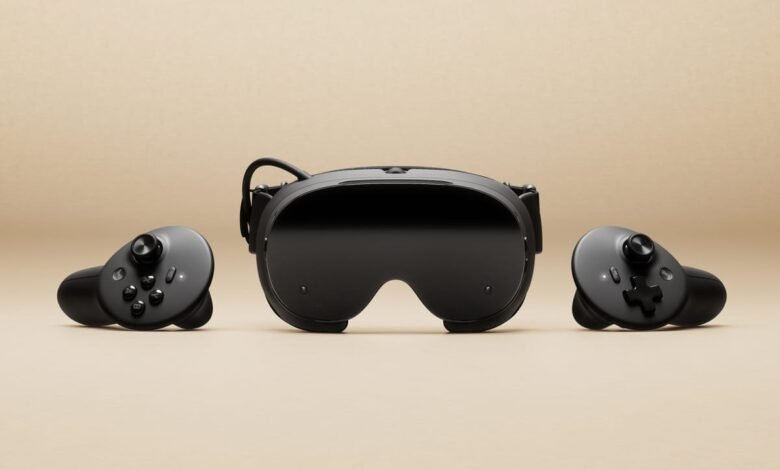
Valve has officially announced its next-generation virtual reality system, Steam Frame, a standalone headset designed with a streaming-first approach scheduled for release in early 2026. This lightweight, modular device runs a specialized VR version of SteamOS and employs advanced compatibility layers to support a vast library of Linux, Windows, and Android applications. While the integrated mobile chipset handles many games, demanding titles are best experienced by wirelessly streaming from a gaming PC using the included wireless adapter.
The headset utilizes four onboard grayscale cameras for inside-out tracking of both the headset and its controllers, eliminating the need for external base stations. Two of these cameras also provide monochrome passthrough capability, and integrated eye tracking enables foveated streaming to optimize performance. Steam Frame will completely replace the Valve Index in the market, as production of the older headset has ceased, and it will join an expanding family of Valve hardware that includes a new Steam Machine and an updated Steam Controller.
Lightweight and Modular Construction
Engineered for comfort during extended use, Steam Frame features a replaceable battery strap that incorporates dual driver speakers and a 21.6 Wh battery at the rear. The fabric strap and softly padded battery unit allow the headset to fold compactly for transport and conform comfortably when leaning back. The core front unit is remarkably light at just 185 grams, with the complete system weighing 440 grams, making it the lightest fully-featured standalone VR headset available. Valve is embracing an open ecosystem by releasing the CAD and electrical specifications, encouraging third-party manufacturers to develop custom facial interfaces and headstraps, ranging from rigid open designs to fully soft straps with tethered power.
High-Resolution Displays and Optics
For visual immersion, Steam Frame is equipped with dual 2160×2160 LCD panels, delivering twice the pixel count of the Valve Index and a resolution comparable to the Meta Quest 3. The refresh rate is configurable from 72Hz to 120Hz, with an experimental 144Hz mode for enthusiasts. Multi-element pancake lenses provide excellent sharpness across the entire field of view, which Valve conservatively estimates at 110 degrees both horizontally and vertically. A manual adjustment wheel on the top of the headset lets users fine-tune the lens separation to match their interpupillary distance.
Dedicated Wireless PC Streaming
Unlike tethered headsets, Steam Frame forgoes physical video inputs entirely, focusing on perfected wireless streaming technology. It contains two separate wireless radios: one for standard home Wi-Fi connectivity and a dedicated 6GHz Wi-Fi 6E radio that creates a direct, point-to-point connection to a user’s PC via the included USB adapter. This setup gives Valve firmware-level control over the network stack, eliminating common issues associated with router-based streaming, such as signal congestion, distance limitations, or poor-quality ISP hardware. Enthusiasts with premium router setups can still use them, but Valve anticipates most will prefer the reliability of the dedicated adapter.
Foveated Streaming and Performance
A key feature enhancing the wireless experience is foveated streaming. The built-in eye tracking continuously identifies the user’s gaze direction, allowing the system to encode the highest video resolution precisely where they are looking, thereby conserving bandwidth and reducing latency. While similar technology exists elsewhere, Valve claims its implementation on Steam Frame achieves lower latency and greater precision due to its control over the entire software and hardware stack.
Standalone Application Support
The headset’s versatility is a major selling point. Through a combination of Proton compatibility layers and FEX emulation software, Steam Frame can run a vast array of Linux, Windows, and Android applications. A significant advantage of its ARM-based architecture is the ability to natively run Android APKs, opening the door for developers to easily port Meta Quest titles to Steam. The performance impact of emulating x86 Windows applications is reported to be minimal, theoretically allowing almost any VR title on Steam to run. However, the integrated mobile chipset, with a thermal design power of around 10 watts, means that graphically intensive games like Half-Life: Alyx will require the power of a connected gaming PC for an optimal experience. A “Steam Frame Verified” program will help users identify titles that run well on the standalone hardware.
Powerful Mobile Hardware
At its core, Steam Frame is powered by the Qualcomm Snapdragon 8 Gen 3 chipset, paired with 16GB of LPDDR5X RAM. It will be available in 256GB and 1TB storage variants, both featuring a microSD card slot for expansion; users can even transfer game libraries directly from a Steam Deck or Steam Machine. The Adreno 750 GPU in this chipset offers a paper specification that is 25% more powerful than the GPU in the Meta Quest 3, a gap that widens when considering Valve does not underclock the component. Combined with eye-tracked foveated rendering, the effective performance in supported titles will be even greater. CPU performance is also a substantial leap, with rough estimates suggesting around 50% better single-threaded and 100% better multi-threaded performance compared to the Quest 3.
Tracking and Passthrough Features
The inside-out tracking system relies on four grayscale fisheye cameras and is supplemented by infrared illuminators, enabling operation even in complete darkness. The monochrome passthrough view, while lower resolution than dedicated mixed reality cameras, shares this advantage of functioning in low-light conditions. A notable feature is a user-accessible front expansion port, which offers a dual 2.5Gbps MIPI camera interface and a PCIe data lane. This port is designed to support future add-ons like color cameras, depth sensors, or face-tracking modules.
Innovative Controllers
The included Steam Frame Controllers feature a ringless design tracked by 18 infrared LEDs each, making them highly resistant to occlusion. Their most distinctive feature is the input layout: the right controller houses all four A/B/X/Y face buttons, while the left has a D-Pad, giving the pair functional parity with a standard gamepad for both VR and traditional flatscreen gaming. The controllers include capacitive finger sensing on all inputs and advanced TMR (tunneling magnetoresistance) thumbsticks, which offer improved precision and are significantly more resistant to drift than traditional potentiometer-based sticks. Powered by a single AA battery, they are rated for approximately 40 hours of use. Unlike the Index controllers, hand straps will be sold as an optional accessory. The system does not currently support controller-free hand tracking.
The Steam Machine Companion
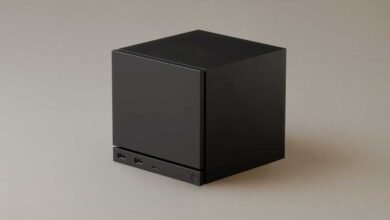
To complement the headset, Valve is introducing a new Steam Machine, a consolized PC running SteamOS. Described as being more than six times more powerful than the Steam Deck, it features a discrete AMD Zen 4 CPU and a custom RDNA 3 GPU. Its specs include 16GB of user-upgradable DDR5 RAM and SSD storage options of 512GB or 2TB. A future software update will allow users to wake the Steam Machine directly from the Steam Frame headset, enabling near-instant access to a high-performance PC VR library without needing a physical monitor.
Pricing and Availability
Valve has not yet announced final pricing for either Steam Frame or the Steam Machine, citing market volatility, but has confirmed it is aiming to sell the Steam Frame for less than the $1000 Valve Index full-kit. The official launch for the headset, Steam Machine, and new Steam Controller is slated for early 2026. Developers can currently apply for limited early access kits.
(Source: Upload VR)