Anno 117: Pax Romana Review – A Stunning Roman City Builder
▼ Summary
– Anno 117: Pax Romana is a more approachable and refined city builder than its predecessor, featuring numerous quality-of-life improvements but less depth and complexity.
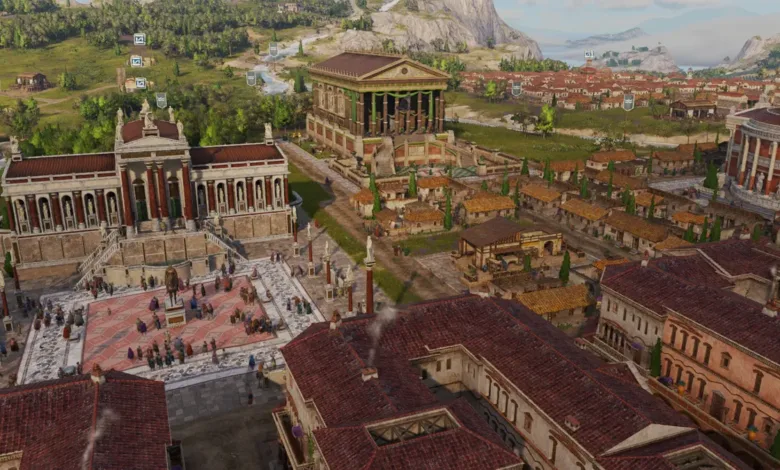
– The game is set in beautifully recreated Roman and Celtic England regions, with intricate historical details that appeal to history enthusiasts.
– Its campaign is engaging and serves as an effective tutorial, lasting about six hours and preparing players for sandbox and multiplayer modes.
– Players manage simplified supply chains and can progress without fulfilling all citizen needs, reducing complexity compared to Anno 1800.
– The game includes major features from past DLC for free, such as land combat and a planning mode, though combat remains a weaker aspect and some bugs were noted.
Anno 117: Pax Romana delivers a visually breathtaking and highly polished city-building experience set against the rich backdrop of the Roman Empire. While it streamlines many of the franchise’s more demanding mechanics, making it far more welcoming for newcomers, seasoned players might find its overall depth somewhat lighter compared to its famously complex predecessor, Anno 1800. The game’s refined approach and wealth of quality-of-life improvements create an engaging and often addictive loop, even if it trades some intricate supply-chain management for a more relaxed pace.
This installment marks a conscious shift towards simplicity for the long-running series. Veterans accustomed to the elaborate economic webs of past games could perceive the mechanics as slightly basic. However, for many, the gentler learning curve and the immediate availability of numerous user-friendly features will be a welcome change. The progression feels less punishing, allowing players to build and expand at a comfortable rate.
The contrast with Anno 1800 is particularly striking. That title stands as one of the most intricate city builders available, demanding players master lengthy, intercontinental supply chains while balancing a multitude of overlapping effects from central buildings. Achieving mastery was immensely satisfying, but it often required external guides and community resources to navigate its complexities.
A Fresh Start for Newcomers
Developer Ubisoft clearly prioritized accessibility, and this is most evident in the campaign, arguably one of the most compelling in the series. Anno story modes have traditionally functioned as extended tutorials, guiding players through core mechanics before unleashing them into the sandbox. This holds true here, but the introduction of named protagonists adds a welcome layer of narrative detail.
Players can choose between two characters. I selected Marcia Tertia, a wealthy Roman woman married off to a troubled governor. After unforeseen events in the Roman region of Latium, her story leads to a secret governorship in Albion (Celtic Britain). The dialogue maintains the series’ characteristic humor, and the narrative’s twists and turns proved genuinely enjoyable.
This campaign is significantly shorter than the one in Anno 1800, wrapping up in roughly six hours compared to fifteen. The tighter pacing ensures it never overstays its welcome, serving as an effective and engaging primer. Upon completion, I was eager to jump into sandbox mode, though the option to replay the story with the other protagonist, Marcus Naukratius, remains tempting due to branching choices and side activities. Crucially, the campaign excels at teaching the essentials, leaving a new player well-prepared for the challenges of sandbox or online multiplayer.
Core Gameplay and Regional Nuances
For the uninitiated, Anno is fundamentally about constructing efficient supply chains to gather resources that allow your citizenry to advance through various social tiers. Anno 117: Pax Romana offers a choice of starting regions, Latium or Albion, each with distinct characteristics.
In Latium, you manage four population classes: Liberti, Plebeians, Equites, and Patricians. Their demands escalate in complexity, beginning with simple needs like porridge and straw sandals and evolving to require running water for baths, education from libraries, fine jewelry, and exotic delicacies like bird tongues in aspic.
The map is divided into multiple islands, each possessing unique resources. Since no single island provides everything needed for the late game, establishing a shipping network to settle new lands and ferry goods back to your capital becomes a central strategic pillar. This involves setting up trade routes and, on higher difficulties, defending against pirate raids.
While this core loop will feel familiar, a key simplification is that players are not forced to fulfill every single need of a population tier to progress. If producing fine glass becomes a bottleneck, you can pivot focus to olive oil instead. This dramatically reduces managerial stress. While there are rewards for satisfying all demands at once, it alleviates the pressure on less confident builders.
A Polished and Feature-Rich Package
The streamlined design does not mean the game feels lacking. It is packed with content and thoughtful quality-of-life enhancements that veterans will appreciate. These range from small touches, like a day and night cycle (absent at Anno 1800’s launch) and keyboard-and-mouse support on consoles, to major additions like the ability to place buildings diagonally and a comprehensive planning mode for city blueprints.
Notably, several features that were premium DLC in previous games are included here from the start. Your governor’s villa functions similarly to the Palace from Anno 1800’s Seat of Power expansion, allowing you to buff your island with strategically placed Specialists. This villa also becomes a primary target for invaders because land combat, entirely absent from Anno 1800, has returned.
That said, combat remains the series’ least developed aspect. Engagements are simplistic, often decided by which side fields more soldiers. While the reintroduction of ground combat is a positive step, it hasn’t evolved significantly, leaving room for future updates or DLC to deepen this mechanic.
Some Lingering Hiccups
My playtime was not completely free of issues. I encountered a persistent bug where my island’s fire safety rating would plummet thousands of points without clear cause, attributed vaguely to “City Status.” Despite relocating flammable structures like bakeries and kilns to a separate island and saturating streets with Vigiles (the Roman fire service), the problem persisted. Actual fires weren’t noticeably more frequent, but the diplomatic penalties from other leaders viewing my settlement as a tinderbox were a source of frustration.
Despite this, Anno 117: Pax Romana has been a thoroughly enjoyable experience. It presents a more relaxed interpretation of the Anno formula, and while it may not match the sheer complexity of its predecessor, it possesses that classic “one more hour” magnetism as you watch your settlement flourish into a bustling Roman or Celtic center.
Who Should Play Anno 117: Pax Romana?
Play it if…
- You seek a high-quality, polished city builder. It stands above many competitors in terms of refinement and offers substantial content through its single-player story and online multiplayer.
- You are captivated by Roman history. Both Rome and Celtic Britain are rendered with stunning detail, filled with authentic touches that will thrill history enthusiasts.
- You found Anno 1800 overwhelming. With its simplified supply chains and more forgiving progression, this is the perfect entry point for those who admired the concept but were daunted by the execution.
Avoid it if…
- You crave even greater complexity. If your expectation is a game that surpasses Anno 1800 in intricate depth, you will likely be disappointed. Sticking with the previous title and its expansions is the better choice.
Accessibility Notes
The game lacks a dedicated accessibility menu, which is surprising given Ubisoft’s generally strong record in this area. However, several useful options are available in the settings, including fully rebindable keys and a UI scaling feature. All dialogue is subtitled, with options to use sans-serif fonts exclusively and to disable italics for improved readability.
(Source: TechRadar)