Philips Evnia 49M2C8900 QD-OLED Review: Top Super Ultrawide Monitor
▼ Summary
– The Philips Evnia 49M2C8900 is a 49-inch QD-OLED super ultrawide gaming monitor with a 32:9 aspect ratio and 240Hz refresh rate, providing an immersive experience for gaming and movies.
– Its Ambilight RGB feature enhances immersion by syncing colors with on-screen content, though it can be inconsistent in color accuracy and less effective due to the screen’s extreme width.
– The monitor suffers from noticeable Auto Brightness Limiter (ABL) due to its large size and has compatibility issues with games that don’t support the 32:9 aspect ratio.
– It excels in performance with deep black levels, minimal ghosting, and support for both FreeSync Premium Pro and G-Sync, but requires a powerful GPU to handle its 5120×1440 resolution.
– While originally retailing for $1,500, its price has dropped significantly, making it a compelling option for those seeking a QD-OLED super ultrawide experience, though it requires substantial desk space.
The Philips Evnia 49M2C8900 QD-OLED stands out as a premium super ultrawide gaming monitor, delivering an exceptionally immersive experience for both gaming and multimedia. Its expansive 32:9 aspect ratio wraps around your field of vision, pulling you deep into virtual worlds. While a few quirks exist, this display makes a powerful case for itself, especially now that its price has dropped significantly from the original retail figure.
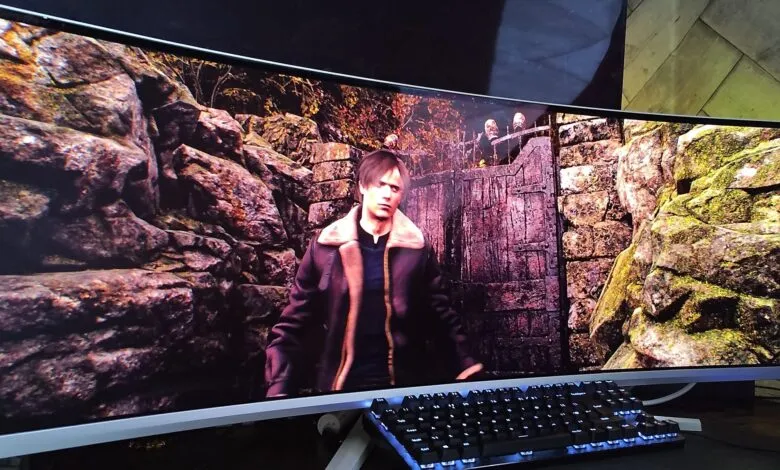
My initial attraction to the 49M2C8900 centered on its Ambilight RGB feature. I hoped it would elevate my gaming sessions, and in many ways, it succeeded. Playing titles like Resident Evil 4 Remake and Cyberpunk 2077, the color shifts added a new layer of immersion. However, the experience wasn’t flawless. The sheer physical length of this 49-inch screen meant I couldn’t fully appreciate the Ambilight effect as I’d imagined. Even without a second monitor above it, the feature felt less impactful than it would on a smaller display. Another point to consider is the Ambilight system’s occasional struggle with color accuracy, sometimes failing to match the on-screen hues perfectly.
This doesn’t render the feature useless, but it made me wonder if the 32:9 format is simply too wide for such a peripheral lighting system to shine. General super ultrawide challenges also persist. The monitor demands considerable desk real estate, and not all games natively support its extreme aspect ratio. Furthermore, the Auto Brightness Limiter (ABL) is far more noticeable on this large OLED panel than on smaller counterparts, a characteristic I confirmed by comparing it to other OLED ultrawides.
Where this monitor truly excels is in raw gaming performance. Jumping into fast-paced titles like Call of Duty provides a tangible competitive advantage. The blazing 240Hz refresh rate and incredibly fast 0.03ms Grey-to-Grey response time combine to eliminate ghosting and motion blur, provided your graphics card can keep up. This fluidity isn’t just for competitive shooters; narrative-driven adventures feel incredibly cinematic, placing you directly at the heart of the action.
The QD-OLED panel is the star of the show, delivering perfect black levels that standard LED or even mini-LED monitors cannot match. While mini-LED can offer higher and more consistent brightness without ABL interference, OLED’s ability to turn off individual pixels creates an unparalleled contrast. This is a particular boon for horror games or any content that relies on dark atmospheres. When the Ambilight works in harmony with rapid on-screen color changes, it can genuinely enhance jump scares and dramatic sequences.
Originally retailing for around $1,500, the monitor’s price was a major hurdle. Fortunately, its cost has fallen substantially since its 2023 release, making it a much more compelling proposition. At its current discounted price, it becomes an easier recommendation for gamers determined to enter the QD-OLED super ultrawide arena.
Potential buyers should note that finding this model might require some quick action, as stock appears limited with new Evnia models likely on the way. Physically, the included stand is functional but consumes a good amount of desk space; a VESA desk mount is a wise investment to reclaim that area.
Beyond gaming, the monitor is a productivity powerhouse. The vast screen real estate allows for effortless multitasking with multiple windows open side-by-side. While some users might notice minor text fringing common to OLEDs, it was never a significant issue during my use. The on-screen display (OSD) is manageable, and the option to control settings through the Philips Evnia Precision Center software on your PC is a welcome convenience.
In summary, the Philips Evnia 49M2C8900 QD-OLED is not without its imperfections. The Ambilight can be inconsistent, and the ABL system is noticeable. Yet, its core strengths are undeniable. The immersive 32:9 canvas, exceptional motion performance, and stunning QD-OLED picture quality create a gaming experience that is hard to top, especially now that it can be found for a much more reasonable price.
(Source: techradar)