AMD’s New CPUs Could Make Low-End GPUs Obsolete
▼ Summary
– AMD’s Strix Halo lineup, including the Ryzen AI Max+ chips, offers integrated graphics that provide a budget-friendly alternative to discrete GPUs for gaming at 1080p to 1440p resolutions.
– Leaked specs for lower-end models like the Ryzen AI Max+ 388 and 392 show 8-core and 12-core variants with boosted clock speeds and the Radeon 8060S integrated GPU for strong gaming performance.
– Affordable discrete GPUs from Nvidia and AMD, such as the RTX 5060 and Radeon RX 9060, have limited improvements with minimal 8GB VRAM and are overshadowed by more expensive variants.
– AMD is developing new gaming CPUs using Zen 5 microarchitecture, like the Ryzen 7 9700X3D, which feature 3D V-Cache for faster memory access and enhanced gaming performance.
– Handheld PCs like the GPD Win 5 and OneXFly Apex are incorporating Ryzen AI Max+ chips, aiming to deliver high-end graphics in portable devices at potentially lower costs.
AMD’s latest Strix Halo processors are poised to disrupt the entry-level graphics card market by delivering impressive integrated gaming performance that could render many budget GPUs unnecessary. Leaked specifications for new Ryzen AI Max+ models suggest the company is expanding this powerful lineup with more affordable options. Rather than competing directly with high-end discrete graphics, these accelerated processing units (APUs) combine substantial CPU and GPU capabilities on a single chip, creating a compelling alternative for cost-conscious gamers.
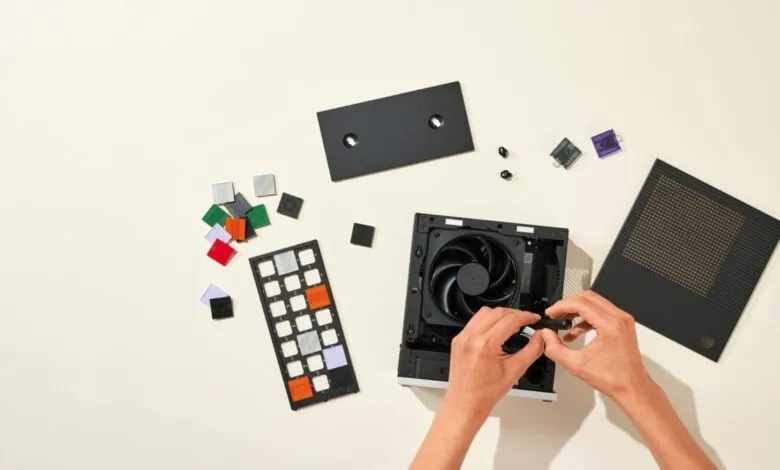
Recent benchmark entries from PassMark have revealed what appears to be a more accessible Strix Halo variant, specifically the Ryzen AI Max+ 388. VideoCardz initially spotted these leaked specifications alongside details for a potentially more powerful Ryzen AI Max+ 392 model. The crucial differentiator for these chips appears to be the inclusion of the full Radeon 8060S integrated graphics. This integrated GPU component is what enables surprisingly solid gaming performance at 1080p and even 1440p resolutions. Independent testing by Gizmodo on the Framework Desktop confirmed that these APUs deliver remarkable power in compact, portable systems.
According to the leaked data, the Ryzen AI Max+ 388 features an 8-core CPU design with boost clocks reaching 5GHz. The AI Max+ 392 might represent a step up with 12 processing cores. The integrated Radeon 8060S graphics contain 40 compute units, which directly influences the overall graphical throughput. For comparison, a discrete Radeon RX 9060 GPU includes 28 compute units alongside dedicated ray tracing and AI accelerators. While the discrete card maintains a performance advantage, the gap narrows significantly when considering the substantial price premium for purchasing both a separate graphics card and a capable CPU.
The performance trajectory of budget graphics cards has noticeably flattened while APU technology continues advancing rapidly. This year’s most accessible GPU offerings, including Nvidia’s GeForce RTX 5060 and AMD’s Radeon RX 9060, arrived with merely 8GB of video memory, creating immediate limitations for higher-resolution gaming. Both products were quickly overshadowed by their more expensive Ti and XT variants priced around $430. Nvidia’s response to the modest generational improvements of the RTX 5060 involved restricting review samples and applying pressure on reviewers regarding their testing methodologies.
When consumers invest $300 in a graphics card, they reasonably expect significantly better performance than integrated solutions. Intel’s Arc B580 presents another budget option at approximately $250, though the company’s long-term commitment to discrete GPU production remains uncertain. Intel instead points toward its upcoming Panther Lake processors with integrated Xe3 graphics as its primary competitive strategy against AMD’s APU offerings.
PassMark data also indicates AMD is developing additional gaming-focused processors based on the Zen 5 architecture, including a potential Ryzen 7 9700X3D. Industry leaks suggest even more powerful models like the Ryzen 7 9850X3D and Ryzen 9950X3D2 might be in development. The current flagship Ryzen 7 9800X3D demonstrates how 3D V-Cache technology dramatically improves memory access speeds, resulting in superior gaming performance when paired with capable graphics.
Several manufacturers are already incorporating these powerful APUs into handheld gaming systems. The GPD Win 5 includes the high-end Ryzen AI Max+ 395 alongside an external battery pack to manage the substantial power requirements. Another crowdfunded device, the OneXFly Apex launching November 9 on Indiegogo, promises Radeon 8060S graphics performance that could challenge established handheld gaming systems. The prospect of a Ryzen AI Max+ 388 appearing in devices priced below $1,000 presents an intriguing value proposition, potentially delivering excellent gaming performance in sleek, portable form factors that eliminate the need for separate graphics components.
(Source: Gizmodo)