DJI Romo Robot Vacuum: First Look
▼ Summary
– DJI has launched the Romo robot vacuum line in Europe, featuring three models with the flagship Romo P having a fully transparent design.
– The Romo series combines vacuuming and mopping capabilities with advanced navigation technology derived from DJI’s drone expertise.
– It offers superior obstacle detection, identifying objects as thin as 2mm using dual fish-eye vision sensors and solid-state lidar.
– The self-cleaning base station includes unique features like a floor deodorizer option and noise-suppression technology reducing sound to 65 decibels.
– While innovative, the Romo is more expensive than comparable models like Roborock’s Qrevo Curv, with pricing starting at €1,299 for the basic model.
When DJI, the powerhouse behind some of the world’s most advanced drones and cameras, announced its entry into the robot vacuum market, it turned more than a few heads. The DJI Romo represents a bold step for the company, bringing its signature navigation technology down to earth in a line of robotic cleaners that are as visually striking as they are functional. Available now across Europe in three distinct models, the Romo series combines vacuuming and mopping capabilities with a design that’s literally transparent.
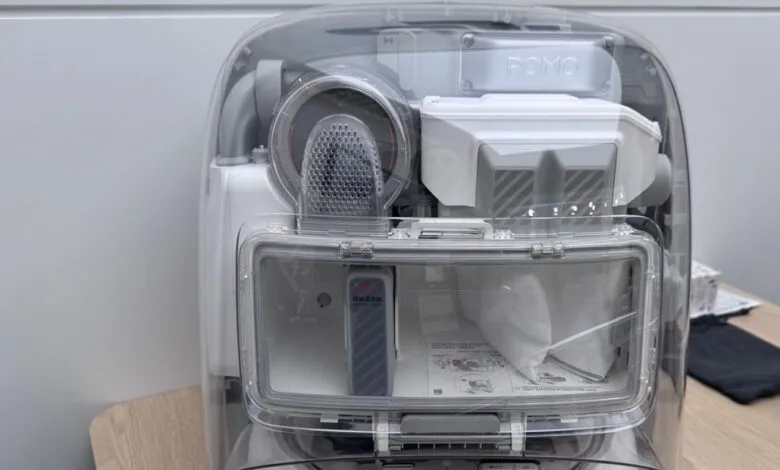
I had the opportunity to examine the Romo P up close at the IFA trade show earlier this year. While a live demonstration wasn’t possible in the confined space, the hardware on display revealed several intriguing features. The most obvious is the see‑through construction, both the robot and its self‑cleaning base station are fully transparent in the flagship Romo P model. This design choice certainly makes for a conversation piece, though it raises questions about how well it will hold up to the wear and tear of daily use over time.
Pricing for the lineup starts at €1,299 for the all‑white Romo S, moves up to €1,599 for the Romo A (which pairs a transparent robot with a white base), and tops out at €1,899 for the fully transparent Romo P. All three share nearly identical core specifications, with the premium for the P model largely reflecting its distinctive aesthetic rather than major functional upgrades.
Under the hood, or in this case, under the clear lid, the Romo doesn’t stray far from established competitors like Roborock’s Qrevo Curv series. It uses a similar split‑roller brush system designed to direct hair toward the center for pickup, along with an extendable side brush to sweep debris from corners. Both vacuum families also employ dual‑spinning mop pads that automatically retract when carpet is detected. Where the Romo pulls ahead is in raw suction power, rated at 25,000Pa, and a larger 164ml onboard water tank that reduces how often it needs to return to the dock for a refill.
Where DJI’s expertise truly shines is in the Romo’s navigation system. The robot employs a hybrid setup combining dual fish‑eye vision sensors and wide‑angle solid‑state LiDAR, technology directly adapted from the company’s high‑end drones. DJI claims this enables millimeter‑level obstacle detection, allowing the vacuum to identify and avoid objects as slim as a 2mm charging cable or even a single playing card. That level of sensitivity appears to surpass systems like Roborock’s StarSight, which identifies objects no smaller than 2cm.
The self‑cleaning base station introduces a few innovations of its own. In addition to the standard cleaning solution tank, the Romo P includes a separate slot for a floor deodorizer, letting you freshen floors without a full mop cycle. A high‑pressure jet system cleans the mop pads, followed by hot‑air drying. DJI has also incorporated a noise‑reduction system using extended muffler ducts and chambers, cutting the typical screech of self‑emptying stations by roughly 80 percent to around 65 decibels.
While the transparent design offers a fascinating glimpse into the robot’s inner workings, it remains to be seen whether this will be viewed as a clever feature or a maintenance challenge after months of use. For now, the DJI Romo is not available in the United States, though a full review is planned once a European model can be tested in a real‑world home environment.
(Source: The Verge)