Kingston Fury Renegade G5 2TB SSD Review: Return of a Champion
▼ Summary
– Kingston’s Fury Renegade G5 is a PCIe 5.0 SSD offering up to 14,800 MB/s sequential read speeds and improved power efficiency in a simple, single-sided design.
– The drive is priced higher than competitors like the SanDisk WD Black SN8100 and Samsung 9100 Pro, making it less competitive in the current market.
– It features exceptional endurance with 1,000 TBW per terabyte and comes with a five-year warranty, setting it apart for users prioritizing write durability.
– The SSD uses efficient hardware including an SMI SM2508 controller with integrated power management and Kioxia BiCS8 TLC flash for better responsiveness and lower power consumption.
– Kingston provides software support with the SSD Manager for firmware updates and Acronis True Image for data backup, enhancing usability and maintenance.
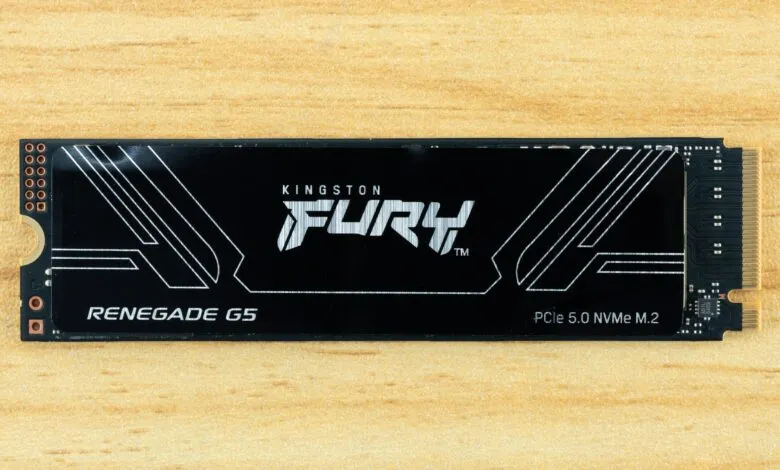
Kingston’s latest flagship solid-state drive, the Fury Renegade G5, delivers a significant performance upgrade with PCIe 5.0 support, offering nearly double the bandwidth of its predecessor while improving power efficiency. This straightforwardly named drive builds on Kingston’s reputation for reliable, high-performance storage, packing robust hardware into a clean, single-sided M.2 2280 design. The Fury Renegade G5 is engineered to handle demanding workloads without unnecessary extras, and its practical heat-spreading label echoes the effective, no-fuss approach seen in earlier models like the KC3000.
One area where the drive faces challenges is its pricing. At launch, the Fury Renegade G5 carries a premium compared to competing models from brands such as Crucial, WD/SanDisk, and Samsung. These vertically integrated rivals have been able to set aggressive price points, putting pressure on Kingston to carefully position the G5 in a crowded market. While the drive doesn’t introduce groundbreaking new features, Kingston’s strong brand recognition and global distribution network could help it gain traction through competitive regional pricing and availability.
For existing Kingston enthusiasts, the Fury Renegade G5 represents a solid high-end choice. In markets where competing drives are scarce or priced higher, it could easily become the default option. That said, alternatives like the Crucial T710 at 1TB and the Samsung 9100 Pro with its 8TB capacity present compelling alternatives. The SanDisk WD Black SN8100 also performs well across the board and is expected to release an 8TB variant later this year, leaving the Kingston drive to compete primarily in the 2TB and 4TB segments.
Here are the detailed specifications for the Kingston Fury Renegade G5:
Here’s your data neatly formatted into a markdown table:
| Specification | 1TB Model | 2TB Model | 4TB Model |
|---|---|---|---|
| Pricing | $164.95 | $239.95 | $449.95 |
| Form Factor | M.2 2280 (Single-sided) | M.2 2280 (Single-sided) | M.2 2280 (Single-sided) |
| Interface / Protocol | PCIe 5.0 x4, NVMe 2.0 | PCIe 5.0 x4, NVMe 2.0 | PCIe 5.0 x4, NVMe 2.0 |
| Controller | SMI SM2508 | SMI SM2508 | SMI SM2508 |
| DRAM | LPDDR4 | LPDDR4 | LPDDR4 |
| Flash Memory | Kioxia 218-Layer TLC | Kioxia 218-Layer TLC | Kioxia 218-Layer TLC |
| Sequential Read | 14,200 MB/s | 14,700 MB/s | 14,800 MB/s |
| Sequential Write | 11,000 MB/s | 14,000 MB/s | 14,000 MB/s |
| Random Read | 2,200K IOPS | 2,200K IOPS | 2,200K IOPS |
| Random Write | 2,150K IOPS | 2,200K IOPS | 2,200K IOPS |
| Max Power | 6.6W | 7.0W | 9.5W |
| Endurance (TBW) | 1,000TB | 2,000TB | 4,000TB |
| Part Number | SFYR2S/1T0 | SFYR2S/2T0 | SFYR2S/4T0 |
| Warranty | 5-Year | 5-Year | 5-Year |
Available in 1TB, 2TB, and 4TB capacities, the Fury Renegade G5 enters the market at prices that currently sit above key competitors. Both the SanDisk WD Black SN8100 and Samsung 9100 Pro offer similar performance at lower cost, while the Lexar NM1090 Pro undercuts them all, albeit with slightly reduced speeds. The Crucial T710 competes directly in the same price bracket, and although the Kingston model uses Kioxia BiCS8 flash, known for responsiveness and efficiency, its current pricing makes it a harder sell against closely matched alternatives.
Performance is exactly as expected, with the drive reaching up to 14,800 MB/s sequential read and 14,000 MB/s sequential write speeds in the 4TB configuration. Random read and write performance tops out at 2.2 million IOPS. The 4TB model achieves peak performance, whereas competing drives like the T710, which uses flash with more planes for better interleaving at lower capacities, perform best at 2TB. Power consumption rises with capacity, and the 9.5W maximum draw on the 4TB model could be a consideration for laptop users, though this reflects peak, not typical, usage.
Kingston supports the Fury Renegade G5 with a five-year warranty. While the warranty period is standard, the endurance rating stands out, offering 1,000 terabytes written per terabyte of capacity, which is 67% higher than the typical 600 TBW. This makes the drive particularly appealing to buyers who prioritize write endurance. Although TBW isn’t always a decisive factor, it does indicate high-quality flash memory, which is reassuring in a high-performance drive built for sustained heavy use.
Kingston provides two software utilities for the Fury Renegade G5: Kingston SSD Manager and Acronis True Image for Kingston. The SSD Manager allows users to monitor drive health, review drive details, and update firmware. Kingston has a strong track record of issuing firmware updates, including fixes for earlier Phison E18 performance issues in models like the KC3000 and PCIe 4.0 Fury Renegade. Acronis True Image is a well-known tool for cloning drives and backing up data, simplifying migration to a new SSD.
The Fury Renegade G5 uses a single-sided PCB across all capacities, improving compatibility and simplifying cooling. A built-in heat-spreading label aids thermal management in systems without dedicated heatsinks, though users can also attach a heatsink if space allows. Early PCIe 5.0 drives often required active cooling, but newer controllers like the one in the G5 are more forgiving. Most modern motherboards include a heatsink for the primary M.2 slot, and the drive’s efficient operation means additional cooling isn’t always necessary.
Inside the 2TB version, you’ll find the SSD controller, one DRAM package, and two NAND packages. The absence of a separate power management IC (PMIC) is due to the integrated power controller within the SMI SM2508 controller. This integration contributes to the drive’s power efficiency, allowing it to deactivate unused blocks and reduce idle power draw. While SSDs may seem similar on the surface, their internal designs continue to grow more sophisticated.
The drive uses LPDDR4 memory for caching metadata. This low-power variant is more energy-efficient than standard DDR4 and can deliver similar or better throughput in a smaller footprint. For M.2 SSDs, where physical space is limited, power savings and cost often outweigh raw bandwidth. LPDDR4’s lower latency also benefits lookup table performance, making it a good match for power-conscious PCIe 5.0 systems.
The flash memory is Kioxia’s 218-layer BiCS8 TLC, which generally outperforms competing offerings like Micron’s 232-layer TLC or older YMTC flash. It excels in power efficiency and random read performance, contributing to a snappy, responsive user experience in everyday tasks. While not superior in every scenario, it remains a top-tier choice among current NAND options.
(Source: Tom’s Hardware)