I spent a week with the Trump phone and it was terrible

▼ Summary
– The T1 Phone has a cheap gold plastic design with a curved waterfall display, an angular frame, and inconsistent branding details like a missing stripe on the American flag logo.
– It only supports 2G signal outside North America due to incompatible network bands, making data unusable in Europe and likely elsewhere globally.
– The phone’s hardware, including a Snapdragon 7 Gen 3 chipset and 12GB RAM, is often sluggish in performance, and its cameras take basic photos with no optimization, including a poor ultrawide lens.
– It runs near-stock Android 15 with minimal modifications, preloading only Truth Social and Doctegrity, but Trump Mobile has not committed to software update timelines beyond a February 2026 security patch.
– The T1 is essentially a marketing stunt for Trump Mobile’s cell service, assembled from dated HTC-based hardware without serious effort, making it unworthy of consumer attention.
For a week, I lived with the Trump phone. And it was, without exaggeration, a deeply frustrating experience. This device was never positioned as a serious contender in the smartphone market. From its awkward announcement last June, complete with questionable renders and a spec sheet that made little sense, to the quick admission by Trump Mobile that it wouldn’t be made in the US, the signs were there. Even the final reveal, first shown to me over a video call in February and later to the world via a slick, AI-generated commercial in April, felt more like a publicity stunt than a product launch.
Now, the T1 is on sale for $499, long past its shifting release dates. Some buyers, including The Verge, have received their units, though many are still waiting. It is a real phone, but that doesn’t make it a serious one. Still, I’ll attempt to treat it as such for the next thousand words.
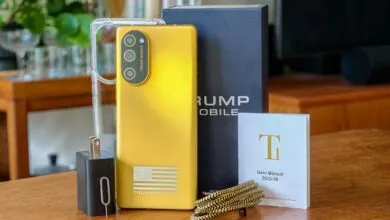
A serious phone wouldn’t look like this. The T1 Phone is a curved slab of cheap gold plastic, the smartphone equivalent of knockoff wraparound Oakleys. The gold finish shifts from yellow to shimmering depending on the light, but it’s consistently tacky, with a sticky friction that makes it unpleasant to hold. My unit arrived with a tiny scratch in the top-right corner. The phone is thin and light, but its excessively curved waterfall display feels dated, and the oddly angular frame digs into my palm, negating any ergonomic benefit.
Almost every detail screams bad design. The American flag logo is missing a stripe. “Trump Mobile” appears on the back twice, in two different fonts and orientations. The three camera lenses are spaced at irregular intervals. It’s maddening. Yet, there are some bright spots: the 3.5mm headphone jack, a microSD card slot, and the inclusion of a case, charger, and braided USB cable. These are features that many Android fans have been missing for years. The notification LED, a feature I thought was lost forever, is a genuine treat. But even these welcome touches reveal the phone’s age; it’s based on an old HTC design that felt like a throwback two years ago.
A serious phone would work outside the US. Living in the UK, I may have the only Trump phone outside of North America. It cannot maintain a signal stronger than 2G, making it usable for texts and calls but not for data. After digging through the FCC certification documents, it’s clear the phone simply doesn’t support the network bands used in Europe. Even American users traveling abroad would likely find the T1 useless in most of the world.
A serious phone would use more than the minimum hardware. At first glance, the spec sheet seems decent: a 120Hz OLED screen, a 5,000mAh battery, and a triple rear camera with 50-megapixel sensors. But these specs are common on $200 Android phones. The T1’s standout features are its generous 512GB of storage, 12GB of RAM, and wireless charging. Despite the Qualcomm Snapdragon 7 Gen 3 chipset, the phone is often sluggish. Switching apps or triggering animations causes stutters, making even basic apps like Duolingo frustrating. The camera’s limitations are similar. Daylight photos are vivid and oversaturated, nighttime shots are noisy, and the telephoto lacks stabilization. Every shot is overlaid with a small T1 watermark, as if anyone would want to claim credit.
A serious phone would have made more effort in its software. Contrary to expectations, the T1 isn’t a bloated mess of spyware and MAGA-themed apps. It runs Android 15, nearly two years old, with almost no modifications. The only preinstalled apps are Truth Social and Doctegrity, a telehealth platform. That’s it. While the lack of bloatware is welcome, there’s no sign that Trump Mobile intends to optimize the software or deliver any features beyond the bare minimum. More worrying is the lack of a commitment to software updates. When I asked executives in February, they seemed confused by the question. The phone currently has a February 2026 security patch; I wouldn’t hold my breath for updates.
A serious company would put more effort in. In a strange way, the T1 Phone isn’t all that terrible, but only because it proves how hard it is to make a truly terrible phone today. Trump Mobile threw together baseline hardware, slapped Android on top, and called it a day. For some old-school Android fans, the dated features might be oddly compelling, but that’s entirely by accident. This isn’t a serious phone. It’s a marketing stunt that got out of hand, a way to grab attention and boost subscriber numbers for an overpriced cell service. Trump Mobile doesn’t care about this phone. After a year of reporting on it, I’m thrilled to finally say: Neither should you.
(Source: The Verge)