Specialized S-Works Tarmac SL9: Win Fin, Flow Fork, Speed Sniffer
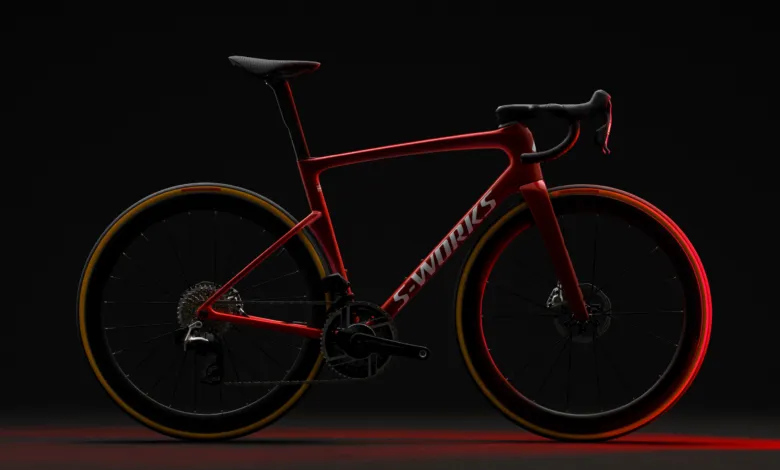
▼ Summary
– Specialized launched the Tarmac SL9, the latest flagship race bike, which is four watts more aero than the SL8 and has a claimed frame weight of 687g.
– The SL9 features a redesigned frame with a deeper fork, curved “Win Fin” seat tube, and narrower seatpost to improve aerodynamics.
– Specialized used its “Equation of Speed” simulation software to design the bike for faster finish times, claiming it is 14 seconds faster than the SL8 over the final 80km of the 2024 Tour de France Femmes stage.
– The SL9 ships with 30mm tubeless tires, narrower handlebars (42cm on a 58cm frame), and shorter cranks by 2.5mm across all sizes.
– The S-Works model is available now starting at $13,500 (Di2) or $14,000 (AXS), with lower-spec models to follow later.
The wait is finally over for devotees of Specialized’s road lineup. The American brand has officially unveiled its latest flagship race machine, and despite widespread speculation, it is not a new Venge. Instead, it carries forward a storied lineage and is called the Tarmac SL9.
The launch has followed the familiar, turbulent pattern of previous Tarmac releases. It began with an early digital image leak from a distant retailer, circulated on the WeightWeenies forum. Social media then fueled the fire when a Red Bull-Bora-Hansgrohe team photographer posted,and quickly deleted,a picture. Finally, our own Will Jones captured spy shots at the Dauphiné, resorting to hiding in a bush like a paparazzo, which earned him a social media threat from a team mechanic.
What is new?
At a glance,and even at a second look,the SL9 appears nearly identical to the SL8. But having spent time with one, it is clear that extensive work has gone into details that may escape casual observation. In fact, every single tube has been reshaped. The most noticeable changes include:
- The seat tube now curves rearward, following the contour of the rear tyre.These refinements yield a bike that is four watts more aerodynamic than its predecessor. The claimed frame weight is just two grams heavier, at 687 grams for a size 56 in Raw Carbon/Gloss Amethyst Frost. However, complete builds now start at 6.5 kilograms, thanks to lighter components.Tyre clearance remains at 32mm, but the stock option has been bumped up to 30mm. For now, only the S-Works model is available. More budget-friendly versions will follow, but today is dedicated to the flagship product as the Tour de France approaches, along with team replica framesets.The equation of speedWhen the Tarmac SL8 launched, it came with claims of being stiffer, lighter, and more aero, but quietly appended were calculations suggesting it was 20 seconds faster up the Col du Tourmalet or 128 seconds quicker over Milan-San Remo. Those numbers were largely overlooked. This time, the focus has shifted dramatically. Specialized now leads its presentation with a bold statement: “Time to the finish is all that matters.”The brand asserts that the SL9 is 14 seconds faster than the SL8 over the final 80 kilometers of the 2024 Tour de France Femmes,the very stage where FDJ-SUEZ leader Demi Vollering lost the yellow jersey by four seconds. I am told Vollering was not thrilled to hear that statistic.Specialized describes “Time to Finish” as a physics-based simulation that predicts total elapsed race time over a specific real-world course. It uses measured inputs from aerodynamics, weight, rolling resistance, surface roughness, environmental conditions, and rider power. This is not a slogan; it is the result of measured data applied to real courses.This approach stems from a 10-year journey the brand calls the “Equation of Speed.” In 2016, Specialized hired Marcel Keyser, a former Scuderia Toro Rosso F1 engineer, as a Senior Engineer for Race Simulation. Over the past decade, he developed software that examines every force acting on a cyclist, mirroring the tools used in Formula 1 to predict lap times and guide car design.The six primary inputs are supplemented by metrics like tyre grip and rider skill. For example, Keyser can analyze a rider’s cornering speed from .FIT files, assign a cornering ability score, and recommend the optimal setup for an upcoming race,whether they need slower, grippier winter tyres in the rain or can handle a fast descent on faster-rolling summer rubber.By developing isolated tests,such as measuring rolling resistance or CdA per rider per bike,Keyser could input known variables and simulate how long a rider would take to finish a specific course.How does this relate to the Tarmac SL9?Specialized took this race-day optimization software and applied it to designing the optimal equipment. The Tarmac SL8, the SL9, and the recently released Crux were all conceived not just to be more aerodynamic in a wind tunnel or lighter on a scale, but to be faster to the finish line on a variety of key course profiles.This seems to point toward a potential resurgence of a dedicated aero bike like the Venge. Specialized argues that the Tarmac SL9 can be optimized through configuration. For the upcoming Tour de France, riders will have three wheelset options: Rapide CLX III, Alpinist CLX III, and Rapide Sprint. But why should the optimization stop at wheels? It is difficult to believe that a single frame design can be optimal for Paris-Roubaix, a flat sprint stage, and the Col du Tourmalet simultaneously. I will not hold my breath.The differences, in detailDeeper forkThe most controversial feature of the SL8,the protruding “Speed Sniffer” head tube,has technically not disappeared. However, a deeper fork, dubbed the Flow Fork, with its further-forward leading edge, makes the front end look seamless once again.Lower down tubeBehind the fork, the down tube has been dropped slightly to better manage airflow from the fork and front wheel.Narrower head tubeThe “Speed Sniffer” head tube shape remains largely unchanged from the side, but head-on it has shrunk by 4mm, reducing its frontal area by 10 percent. This posed design challenges, as the reduced space left little room for the brake hose to pass through. The solution: the fork’s steerer tube kinks to the right inside the head tube, then kinks back to center at the top, allowing the rear brake hose to sit alongside it.Curved “Win Fin” seat tubeNo Specialized Tarmac launch would be complete without an unusual descriptor. This time it is the Win Fin seat tube, which curves rearward to follow the shape of the rear tyre. After studying WorldTour riders during critical race moments,when breaks form or races are won and lost,Specialized found they almost always have ejected a bottle and are running an empty cage. The SL9 was designed with this in mind, and this change alone is reportedly worth 0.5 watts at 45 km/h.Narrower seatpostAbove the Win Fin is a new S-Works Rapide seatpost, which also fits the new Crux. Its top half is narrower, removing material in an area where airflow accelerates between a rider’s legs.Spec changesI have long criticized Specialized’s reluctance to embrace narrower handlebars. There is finally movement here. Previously, a 58cm bike shipped with 44cm bars; now it ships with 42cm bars. Better still, the measurement at the base of the hoods is now 36cm thanks to the flare of the Rapide cockpit,much narrower than before. All bikes also come with 2.5mm shorter cranks across the board.Bikes still ship with a 15mm offset seatpost, so riders seeking a modern aero position with an effective steep seat tube, short cranks, and narrow bars will likely need to swap it out. That is possible, but it requires an accommodating bike shop. I understand why Specialized did not flip the well-loved geometry of its flagship bike to appease a still-small market segment. Perhaps that is where the Venge fits in.Another welcome change: the S-Works Tarmac now ships with 30mm Turbo Cotton Tubeless tyres. This contrasts with most brands that have increased clearance to 32 or 34mm yet still send bikes out with 28mm or even 25mm rubber.Tarmac SL9 vs. Cervélo S5, Colnago Y1RS, and Factor ONEIt is common for new bikes to launch with claims of being better than a named competitor, and the S-Works Tarmac is almost always one of those competitors. Specialized has grown tired of this and decided to return the favor. It benchmarked the Tarmac SL9 against the Cervélo S5, the Colnago Y1RS, and the Factor ONE. The inclusion of the Factor ONE is notable, reflecting Factor’s rise to relevance in recent years.These comparisons do not simply quote a single metric like CdA. They input CdA and weight into the Equation of Speed simulation to quantify speed differences over various courses.The bikes were set up with components as listed, and Specialized measured the following:| | Tarmac SL9 | Tarmac SL8 | Colnago Y1RS | Cervélo S5 | Factor ONE | |—|—|—|—|—|—| | Weight (kg) | 6.8 | 6.89 | 7.49 | 7.44 | 7.99 | | Weighted CdA (m²) | 0.2227 | 0.2251 | 0.2227 | 0.2215 | 0.2231 |Over three laps of a relatively flat 2026 Montreal Worlds course, the differences were:
- SL9 Time to Finish: 00:19:17.100On a single ascent of Alpe d’Huez:
- SL9 Time to Finish: 00:38:18.000Early reviewI still want to put more miles through the Tarmac SL9,and run it through a wind tunnel,before writing a full review. But having ridden the SL6, SL7, SL8, and SL9, as well as the Venge Vias, Venge, Roubaix, Allez, and Aethos, I can confidently say the SL9 retains the well-loved Tarmac handling and ride feel. That does not mean it is exactly the same.A caveat: I am now a father. Since January, my riding volume has dropped, my fitness has tanked, and my willingness to rail around corners has diminished. Perceived bike performance is closely tied to my ability to ride it. Take 40 watts off my FTP, and bikes will not feel as sprightly uphill. Nor will they feel telepathic on descents. I am comparing today’s apples against last year’s oranges.Despite this, after about four to five hours of riding, the magic returned on a fast descent of Coe, a spicy climb north of Morgan Hill. Following a group of Specialized employees and locals who knew the roads, I let the bike shine. It was stable, predictable, and planted on wider corners, yet agile on tighter turns and easy to accelerate out of them. The SRAM Red brakes were reliable for late braking, and the wide tyres added composure on rough, gritty roads.The handlebar flare meant leverage was not lost for tiny steering inputs on fast descents, while the narrower hood spacing was perfect for tucking into the slipstream. It was a fun experience that reminded me why I love riding bikes.One thing unaffected by fitness is comfort and ride feel. The balanced quality that has long shone through in previous S-Works Tarmacs remains abundant. It is a lovely blend of snappy, punchy responsiveness under power, yet smooth, stable, and refined the rest of the time.Price and availabilityFor now, only the S-Works model is available. Lower-spec versions will follow, but that simplifies options for anyone wanting to buy one before the Tour de France.| Model | Price | |—|—| | S-Works Tarmac SL9 AXS | $14,000 / €13,999 / £11,999 / $21,500 | | S-Works Tarmac SL9 Di2 | $13,500 / €13,999 / £11,999 / $20,500 | | S-Works Framesets (incl. Team Replica colours) | $6,000 / €5,999 / £5,499 / $9,500 |