Blue Origin Unveils Space Data Center Venture
▼ Summary
– Blue Origin has requested FCC permission to launch “Project Sunrise,” a proposed network of over 50,000 satellites to function as an orbital data center and shift compute workloads from Earth.
– The company plans to use its separate “Terawave” satellite constellation as a communications backbone for this orbital computing network.
– Several other companies, including SpaceX and Starcloud, are pursuing similar concepts, attracted by space’s abundant solar energy and fewer regulatory constraints.
– Significant economic and technological hurdles remain, including developing affordable cooling and laser communication systems and ensuring chips function in space radiation.
– Major obstacles also include orbital congestion, potential atmospheric harm from satellite disposal, and experts predicting such projects won’t be operational until the 2030s.
Blue Origin, the aerospace company established by Jeff Bezos, has formally requested authorization from U.S. regulators to deploy a vast constellation of over 50,000 satellites designed to function as an orbital data center. This ambitious initiative, detailed in a recent Federal Communications Commission filing, aims to relocate energy-intensive computing workloads from terrestrial facilities to space, potentially alleviating strain on local power grids and water resources. The project, internally named “Project Sunrise,” proposes using advanced in-orbit computation to handle demanding processing tasks.
The specific computational capacity of this planned network remains unclear, as the filing provides limited technical details. However, Blue Origin indicated it would leverage another proposed satellite system, Terawave, to serve as a high-speed communications link for the data center constellation. The fundamental appeal of moving computation off-planet lies in the abundant availability of solar power and a regulatory environment with fewer restrictions than on Earth. Proponents of this concept anticipate a future where widespread artificial intelligence applications will rely heavily on orbital infrastructure for data processing, or “inference” work.
Blue Origin is not alone in pursuing this vision. Several companies are already pursuing the idea, including SpaceX, which has sought approval for up to a million satellites to create a distributed orbital computing network. Other entrants include startup Starcloud and Google, the latter collaborating with Planet Labs on a demonstration mission called Project Suncatcher slated for next year. Despite the growing interest, significant economic and technical hurdles persist.
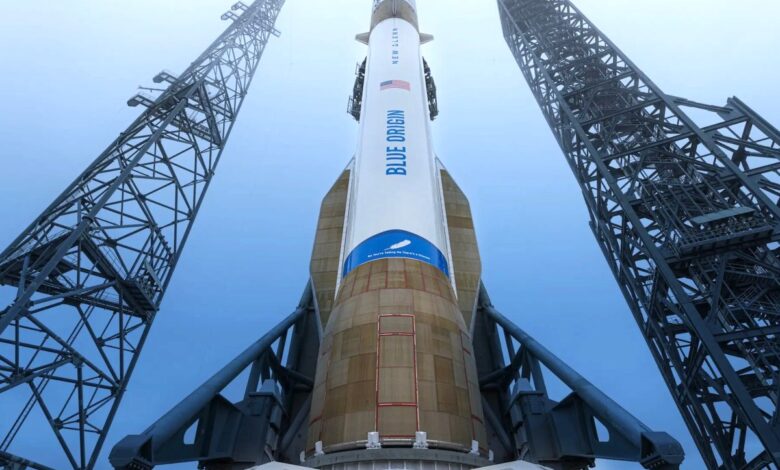
Key challenges include developing affordable technology for cooling processors in a vacuum and establishing reliable, high-bandwidth laser links between spacecraft. Furthermore, the performance of advanced semiconductor chips must be thoroughly tested against the damaging effects of space radiation. A critical area is the cost to launch these computers into orbit, with many in the industry hoping that forthcoming, fully reusable rockets like SpaceX’s Starship will dramatically reduce launch expenses. Blue Origin may possess a unique advantage here with its powerful New Glenn rocket, which achieved its first flight last year. If the company can achieve routine, cost-effective reuse of New Glenn, it could mirror the vertical integration strategy that made SpaceX’s Starlink a success.
Beyond engineering, the plan faces environmental and logistical obstacles. The orbits closest to Earth are becoming increasingly crowded, and adding tens of thousands of new satellites raises the risk of catastrophic collisions. Additionally, the standard practice of disposing of old satellites by burning them up in the atmosphere could alter the chemistry of the upper atmosphere, with scientists concerned about potential damage to the protective ozone layer.
While the FCC submission did not include a development timeline, industry analysts suggest these pioneering space-based data centers are unlikely to become operational before the 2030s. The journey from concept to reality will require overcoming a complex array of technological, economic, and environmental challenges.
(Source: TechCrunch)


