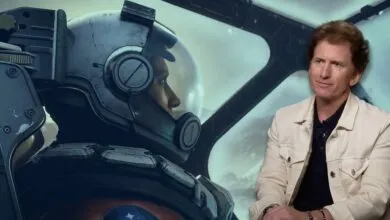
Todd Howard on Elder Scrolls 6, Starfield PS5, & Bethesda’s Future
▼ Summary
– Bethesda is releasing a major Starfield update called “Free Lanes” on April 7, which adds spaceflight between planets and new gameplay systems to address launch criticisms about exploration.
– Todd Howard states Bethesda is now more cautious about announcing games too early, preferring to compress the time between reveal and release to manage player expectations.
– The studio is developing Creation Engine 3 for *The Elder Scrolls 6*, focusing on foundational data systems and world-loading tech alongside expected graphical improvements.
– Bethesda maintains a scaling development model, starting projects with a small team and expanding once the vision is solid, which is now the case for *The Elder Scrolls 6*.
– The upcoming PlayStation 5 port of Starfield was always planned as a matter of time, according to Howard, who emphasizes Bethesda’s continued relationship with Sony.
Visiting the Bethesda Game Studios headquarters offers a unique glimpse into the future of some of gaming’s most beloved franchises. During a recent conversation, studio head Todd Howard provided significant updates on Starfield’s ongoing evolution and shared fresh perspectives on the highly anticipated The Elder Scrolls 6. The discussion spanned development philosophy, engine technology, and the delicate balance of managing community expectations while steering massive creative projects.
Reflecting on Starfield’s journey since launch, Howard explained the studio’s approach to post-release content. The team grapples with a wealth of possibilities, from quality-of-life improvements and new quests to major systemic additions. The goal for what they call “Year Two” was to bundle experiences meaningfully rather than releasing piecemeal updates. This led to initiatives like the Creations mod system and the Tracker’s Alliance faction quests, culminating in the upcoming story expansion. The focus shifted toward enhancing the long-term “meta” gameplay, affecting how players engage with the universe over dozens or hundreds of hours, rather than offering isolated, consumable storylines.
Managing communication with a vast and passionate player base presents an ongoing challenge. Howard acknowledged periods where the team has been quieter, concentrating on assembling substantial content before sharing details. While the desire to keep fans informed is strong, Bethesda aims to announce updates when they are concrete and ready to be released, ensuring the news is both exciting and reliable. The studio continuously evaluates how and when to share information, actively seeking community feedback on what players want to hear.
The topic of a PlayStation 5 version for Starfield was also addressed. Howard noted that bringing the game to PS5 was always considered a matter of timing. Despite Bethesda’s alignment with Xbox, the studio maintains a strong, longstanding relationship with PlayStation, continuing to support titles like Fallout 76 and Skyrim on the platform. The team is enthusiastic about finally expanding Starfield’s reach to PlayStation gamers.
Regarding recent leadership changes at Xbox, Howard expressed mixed feelings. While excited for new directions and future hardware plans, he voiced sadness over Phil Spencer’s departure, highlighting Spencer’s and Matt Booty’s consistent support for creative vision behind the scenes. He conveyed confidence in the incoming leadership and optimism for Bethesda’s path forward under the Xbox banner.
Looking ahead to next-generation hardware, Howard emphasized a technical philosophy of casting a wide net. Rather than designing for a single, fixed specification, the focus is on scalability, ensuring games can leverage high-end capabilities while remaining accessible on lower-powered devices, including the growing handheld market. This approach provides flexibility and avoids the constraints of past console generations.
A significant portion of the conversation centered on technology, specifically the move to Creation Engine 3 for The Elder Scrolls 6. Howard praised the technical team for managing this transition more smoothly than the shift to Creation Engine 2 for Starfield, which was a major upheaval. While visual rendering improvements are a given, he highlighted foundational upgrades in data systems, world streaming, and content loading as critical. These behind-the-scenes enhancements are crucial for handling the immense scale and detail Bethesda games are known for, affecting everything from AI to save states.
The new Free Lanes update for Starfield, which introduces seamless spaceflight between planets, was born from player feedback and technical exploration. Initially, design decisions focused gameplay on specific points of interest within star systems. However, observing community desire and mods demonstrating the possibility prompted the team to develop a dedicated system. Balancing the vast emptiness of space with engaging encounters was key; the solution involves tools like radar beacons that alert players to points of interest without cluttering the experience, preserving the feeling of authentic space exploration.
When discussing RPG design philosophy, Howard reflected on player choice and consequence. He prefers to avoid the concept of “friction” that leads to permanent regret, citing lessons from older titles. Modern Bethesda games often provide starting points for role-playing, like backgrounds in Starfield, while allowing flexibility to correct course later. The studio is interested in exploring systems that offer meaningful scarcity in character builds without locking players into early mistakes, seeking a middle ground that satisfies both dedicated role-players and a broader audience.
Howard was notably cautious about discussing The Elder Scrolls 6, humorously deflecting direct questions. He reiterated a personal preference for compressing the time between a game’s announcement and its release, aiming to align player excitement with immediate availability. While strategic announcements are sometimes necessary, the goal is to manage expectations carefully and give each project its dedicated spotlight.
On the subject of AAA development scaling, Howard outlined Bethesda’s model. Projects often begin with smaller pre-production teams for two to three years to solidify vision and direction before expanding to full production. This helps minimize costly rework. The studio now balances supporting live games like Fallout 76 with developing new titles, a complex but manageable dynamic. For The Elder Scrolls 6, the studio has reached a point where the bulk of the team and external partners are actively engaged, with daily builds becoming consistently stable, a positive sign for development momentum.
While Howard remained tight-lipped on Elder Scrolls 6 specifics, he confirmed that lessons from Starfield’s engine transition are being applied. The technical team’s improved integration of Creation Engine 3 allows content development to proceed with fewer disruptions, a stark contrast to earlier challenges. Looking further ahead, Howard assured that Starfield’s roadmap extends beyond the imminent update, with a list of future features and content already in planning stages. He concluded with gratitude for the dedicated player community, whose feedback continues to shape the game’s journey.
(Source: IGN)