Samsung Galaxy S26 Ultra vs. S25 & S24 Ultra: Full Comparison
▼ Summary
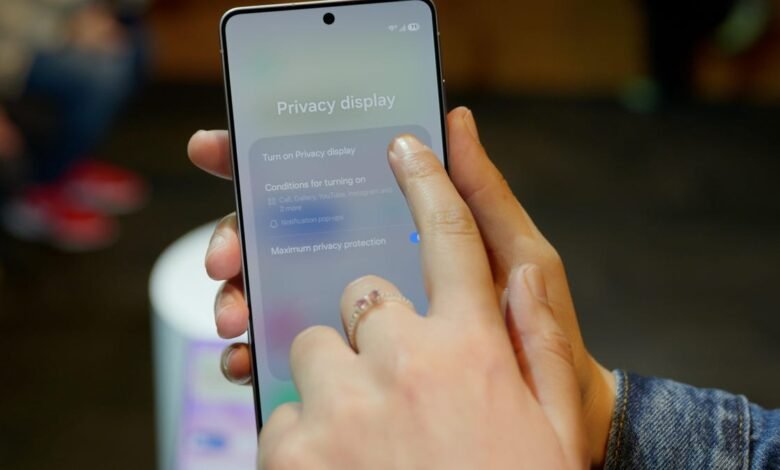
– Samsung unveiled the Galaxy S26, S26 Plus, and S26 Ultra, with the Ultra model featuring a new Privacy Display that limits screen visibility from side angles.
– The S26 Ultra’s design changes include a slightly larger 6.9-inch screen, an aluminum frame (replacing titanium), and a thinner, lighter build compared to its predecessors.
– Its camera hardware is identical to the S24 and S25 Ultra models, but it features software upgrades like Horizontal Lock for video and improved low-light performance from larger apertures.
– The S26 Ultra offers faster 60W wired and 25W wireless charging and is the only model in the Ultra line to offer a 16GB RAM option with higher storage tiers.
– While it includes a newer processor and some material upgrades, many of the S26 Ultra’s core features and its $1,300 price remain similar to the previous two Ultra models.
Samsung’s latest flagship, the Galaxy S26 Ultra, arrives with a headline-grabbing Privacy Display and a suite of subtle refinements. While it maintains the same premium price point as its predecessors, the new model introduces a few key upgrades in materials, charging, and performance that aim to justify its position at the top of the lineup. This comparison breaks down exactly how it stacks up against the S25 Ultra and S24 Ultra, helping you decide if the newest iteration is worth the investment.
The most significant change this year is the introduction of a pixel-level Privacy Display. This clever feature allows the screen to remain fully visible when you look at it directly, while making it extremely difficult for anyone viewing from an angle to see your content. You can customize its use per app or even set it to activate only for notifications, blending privacy with convenience. Beyond this, the screen itself is slightly larger at 6.9 inches, though it shares the same sharp 3,120 by 1,440 resolution and adaptive 120Hz refresh rate with the 6.8-inch displays on the two older models. The new model also benefits from upgraded Gorilla Glass Armor 2, which promises better durability against scratches and drops.
Physically, the S26 Ultra feels a bit different in the hand. It is marginally taller and wider than the S25 Ultra, but also slightly thinner. Notably, Samsung has switched from a titanium frame back to an aluminum frame, a change that some may notice in terms of weight and feel.
When it comes to photography, the hardware story is one of consistency. All three Ultra models, the S26, S25, and S24, feature the same versatile quad-camera array: a 200-megapixel main sensor, a 50-megapixel ultrawide, a 10-megapixel 3x telephoto, and a 50-megapixel 5x telephoto lens. The front-facing camera is also a consistent 12 megapixels across the board. The improvements for the S26 Ultra are found in the software and optics, with larger apertures designed to pull in more light for better low-light performance. New computational features include a Horizontal Lock for steady video and more natural skin tone processing for selfies.
Performance and battery life see expected generational bumps. All three phones pack a 5,000 mAh battery, but the S26 Ultra pulls ahead with faster 60W wired charging and 25W wireless charging, compared to the 45W wired and 15W wireless speeds on the two older models. The processor is upgraded to the latest Snapdragon 8 Elite Gen 5 for Galaxy, following the Snapdragon 8 Gen 3 in the S24 Ultra and the Snapdragon 8 Elite in the S25 Ultra. A notable spec upgrade is the availability of 16GB of RAM on the S26 Ultra with the higher storage tiers, whereas the S24 and S25 Ultras are capped at 12GB.
In essence, the Galaxy S26 Ultra represents an evolutionary step. Its standout privacy screen and faster charging are compelling new features, supported by the latest chipset and more RAM. However, with identical core camera hardware and a similar design philosophy, the decision to upgrade may hinge on how much you value these specific enhancements over the still-capable S25 Ultra and S24 Ultra.
(Source: CNET)


