Galaxy S26 Ultra Privacy Display: A Game-Changer
▼ Summary
– The Galaxy S26 Ultra’s most impressive new hardware feature is its Privacy Display, which uses two pixel sets to limit the screen’s viewing angle and prevent others from seeing your content.
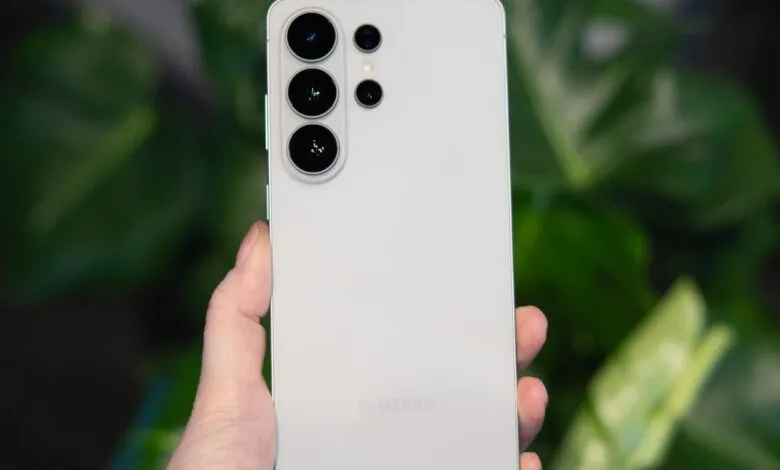
– The phone’s design has been refined to be slimmer and lighter, with aesthetics now aligned across the entire S26 series, and it features slightly brighter lenses on its main and telephoto cameras.
– Samsung has integrated extensive AI features, including generative photo editing in the gallery app and an agentic Google Gemini assistant for limited tasks like ridesharing.
– The software update includes Pixel-like features such as contextual keyboard prompts (Now Nudge), scam call detection, AI call screening, and an improved Bixby for phone help.
– All global models will use a custom Snapdragon 8 Elite Gen 5 chipset, and the starting price remains $1299 for the 256GB/12GB configuration despite broader industry cost pressures.
In a smartphone market where major hardware leaps feel increasingly rare, the Galaxy S26 Ultra’s new Privacy Display stands out as a genuinely impressive and practical innovation. This feature, which intelligently limits the screen’s viewing angle to shield content from prying eyes, delivered a more compelling experience than anticipated. While the underlying technology has appeared in laptops before, its implementation on a flagship phone feels fresh and remarkably useful in an era where digital privacy is a constant concern.
The functionality goes far beyond a simple screen filter. You can toggle the Privacy Display on or off with a tap, thanks to a dual-pixel system within the screen itself. One set of pixels projects the image straight forward to the viewer, while another handles off-axis light for wider viewing angles. Deactivating that second set makes the screen appear normal to the person holding the device, but it becomes dramatically dim and unreadable from the side. Someone positioned directly behind you might catch a faint glimpse, but the effect is most powerful at oblique angles. For heightened security, a secondary setting intensifies the obscuring effect, drastically reducing contrast and making text virtually impossible to decipher from anywhere but the front.
What makes this feature truly powerful is Samsung’s signature approach to customization. Users aren’t stuck with a simple on/off switch. You can configure the Privacy Display to activate automatically under specific conditions, such as when entering a PIN or opening a particular app like your banking software. It can be set to obscure only incoming notifications as they appear at the top of the screen. The system also integrates with Samsung’s Routines, allowing it to turn off when you arrive home and reactivate when you leave. The privacy effect works consistently whether the phone is held in portrait or landscape orientation.
Beyond this headline feature, the S26 Ultra represents a refined evolution rather than a complete overhaul. The device is slightly slimmer and lighter than its predecessor, partly due to a shift from titanium back to an aluminum frame. The design language has been fully unified across the S26 series, with the Ultra now sharing the same curved corners as the standard and Plus models, leaving its boxier “Note” heritage behind. Notably, the phone itself still lacks built-in magnets for accessories; those are included in the optional case.
Camera upgrades, while subtle, are meaningful. Both the 200-megapixel main sensor and the 50-megapixel 5x telephoto lens feature brighter apertures, which should improve performance, particularly in low-light conditions. The main lens opens to f/1.4, and the telephoto to f/2.9, allowing more light to reach the sensors.
Artificial intelligence features are pervasive, as expected. Samsung has introduced natural-language photo editing within the Gallery app, similar to Google’s tools. Users can give multimodal prompts, even using a second image as a source to, for instance, make it appear they are holding a different object or wearing another outfit. The S26 series will also be among the first devices to feature an agentic Google Gemini assistant. In its initial, limited rollout, this AI can handle tasks within select apps like Uber for ride booking. You can let it work in the background or monitor its progress and intervene if necessary.
Additional software enhancements bring several Pixel-like capabilities to the S26. A feature called Now Nudge provides contextual prompts directly in the keyboard, suggesting calendar checks if a friend asks about your availability. The phone also gains scam call detection and AI screening for unknown numbers. Even Bixby receives an update, allowing for more natural language queries about phone settings to help navigate menus.
Globally, every S26 Ultra will be powered by the custom-tuned Snapdragon 8 Elite Gen 5 for Galaxy chipset. Pricing remains unchanged from the previous generation, starting at $1,299 for the model with 256GB of storage and 12GB of RAM, a welcome constant in a climate of component shortages and economic pressures.
(Source: The Verge)