X-Rays Uncover Kingfisher Feather Secrets
▼ Summary
– Qing dynasty artisans used a technique called tian-tsui to decorate objects by inlaying them with iridescent kingfisher feathers.
– Scientists have now used high-energy x-ray imaging to analyze these feathers at nanoscale resolution, revealing their unique photonic crystal structure.
– The feathers’ color comes not from pigment but from microscopic ridges on keratin strands, which act as a natural diffraction grating.
– These photonic crystals are tunable, meaning their structure determines which specific wavelengths of light they reflect or block.
– The high demand for these feathers led to kingfishers becoming endangered, and the last traditional tian-tsui studio closed in 1933.
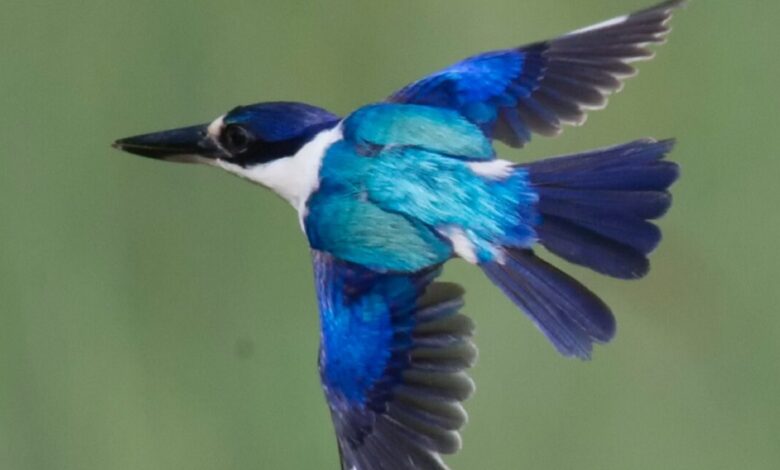
Scientists have unlocked the nanoscale secrets behind the dazzling blue feathers used in a centuries-old Chinese art form, revealing how nature’s own structural engineering creates color without pigment. Using high-energy x-ray imaging, researchers achieved unprecedented resolution of the microscopic architecture within kingfisher feathers, which were historically prized for a decorative technique known as tian-tsui. This method involved cutting and gluing the iridescent feathers onto gilt silver to create intricate patterns on items like hairpins, fans, and headdresses. The new analysis provides a detailed look at the natural photonic crystals responsible for the feathers’ vibrant hues.
The brilliant colors seen in kingfisher feathers, butterfly wings, and beetle shells do not come from pigments but from intricate nanostructures that manipulate light. These are known as photonic crystals, which are precisely ordered materials that act like a selective filter for light. They block certain wavelengths while allowing others to pass through, producing specific, intense colors. In the feathers, this effect is created by microscopic ridges covering parallel rows of keratin strands. By altering the size and spacing of these nanostructures, nature can “tune” the crystal to reflect different colors, a principle that inspires advanced optical technologies today.
These natural structures are essentially sophisticated diffraction gratings. However, unlike a simple grating that splits light into a full spectrum like a prism, photonic crystals are finely tuned to produce only specific wavelengths. This makes them incredibly efficient at generating pure, vivid color. The arrangement is so precise that scientists consider biological organisms to be master nanofabricators. The ability to study these structures at the nanoscale opens new avenues for understanding biological color and for designing synthetic materials with similar properties.
The cultural significance of these feathers cannot be overstated. For centuries, Chinese artisans and poets celebrated the kingfisher’s plumage. The tian-tsui technique, whose name translates to “dotting with kingfishers,” involved painstakingly orienting tiny feather pieces to maximize their iridescent effect. This craft created objects of remarkable beauty, but its popularity came at a steep ecological cost. Demand for the feathers grew so high that kingfisher populations were pushed toward endangerment, particularly after the Chinese Communist Revolution. The last dedicated tian-tsui studio closed its doors in 1933, marking the end of a vibrant artistic tradition.
Today, the scientific study of these feathers bridges art, history, and advanced materials science. The research not only preserves the knowledge of a lost art but also highlights how biological systems achieve optical effects that human engineers strive to replicate. Photonic crystals derived from natural models are now used in a range of technologies, including optical communications, lasers, filters, and anti-reflection coatings. By looking to the kingfisher, scientists continue to find inspiration for the next generation of photonic devices, proving that some of the most advanced designs have been flying in nature all along.
(Source: Ars Technica)

