Shoot the Stars with This Updated Vintage Camera
▼ Summary
– OM System has announced the OM-3 Astro, an upgraded version of its OM-3 camera specifically enhanced for astrophotography, set for release in March 2026 at $2,499.99.
– The key hardware upgrade is a specialized infrared cut filter that allows nearly 100% transmission of deep-red Hydrogen-alpha light to better capture the colors of red nebulae.
– The camera comes with three pre-programmed film-look profiles optimized for different astrophotography scenarios, such as imaging red nebulae or combining stars with landscapes.
– It retains useful astro-features from the standard model, including Starry Sky AF for autofocusing on stars and a Night Vision mode for the LCD screen to aid framing in darkness.
– The Night Vision mode enhances screen contrast for visibility while reducing display intensity to preserve the user’s night vision during operation.
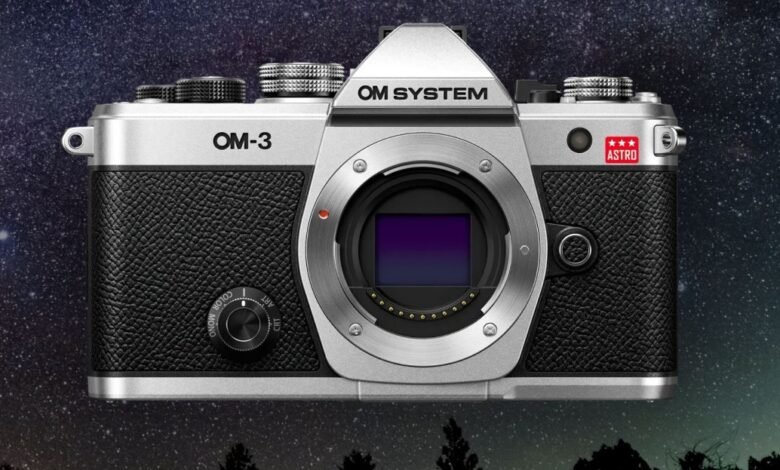
Capturing the cosmos just became more accessible with a specialized camera designed for the night sky. OM System has unveiled an enhanced version of its popular vintage-styled mirrorless camera, the OM-3 Astro. This new model, set for release in March 2026 at a price of $2,499.99, builds upon the standard OM-3 with targeted hardware and software upgrades aimed squarely at astrophotography enthusiasts. While both cameras can photograph stars, the Astro variant introduces key improvements to better render the deep red hues of celestial nebulae.
The most significant hardware change is a newly designed infrared cut filter placed in front of the camera’s 20.37-megapixel stacked back-illuminated sensor. This filter is specifically tuned to allow nearly 100% transmission of Hydrogen-alpha (Hα) light wavelengths. Standard digital cameras use IR filters to block infrared light for color accuracy, but they often attenuate this specific deep-red light. Hydrogen-alpha is the emission that gives red nebulae their famous color and structure, so this modification allows the OM-3 Astro to capture these cosmic clouds with greater clarity and vibrancy.
A photo comparison of the Orion constellation’s center demonstrates the difference, with the Astro model showing enhanced red nebulosity compared to the standard OM-3.
Beyond the sensor filter, the camera includes specialized software profiles. The OM-3 series is known for its dedicated control dial for film simulation looks and custom profiles. The Astro model comes pre-loaded with three profiles tailored for different night-sky scenarios. Color1 enhances images of red nebulae, Color2 is optimized for combining starry skies with terrestrial landscapes, and Color3 is designed for handheld star photography, providing astrophotographers with versatile starting points right out of the box.
This specialized model retains all the standard OM-3 features beneficial for low-light work. Its Starry Sky AF function uses autofocus to lock onto stars, eliminating the need for tedious manual focusing by zooming in on the live view. While not as rapid as standard AF, it significantly speeds up the shooting process in the dark. Furthermore, a Night Vision mode for the LCD screen boosts display contrast for easier framing and focus adjustments in total darkness. This mode also dims the screen’s intensity to help preserve the user’s natural night vision, allowing for camera operation without the disruptive glare of a flashlight.
(Source: The Verge)
