Anker’s New Charger Has a Screen, But Is It Useful?
▼ Summary
– The Anker 45-watt Nano charger features a small color screen that displays an animated character and details like power draw and device battery level for supported Apple products.
– Its display is often seen as a marketing gimmick, as the information shown is already available on the connected devices and the screen automatically turns off after a few seconds.
– The charger includes a three-stage “smart” charging system (fast, steady, trickle) designed to prolong battery life by adjusting power delivery based on charge level.
– A key practical upgrade is its redesigned, 180-degree rotating folding prongs, which offer more flexibility for plugging into outlets and orienting the screen or USB-C port.
– While it works with unsupported devices, the charger’s smart identification and battery level features are limited to recent Apple hardware like iPhone 15+ and iPads from 2020 onward.
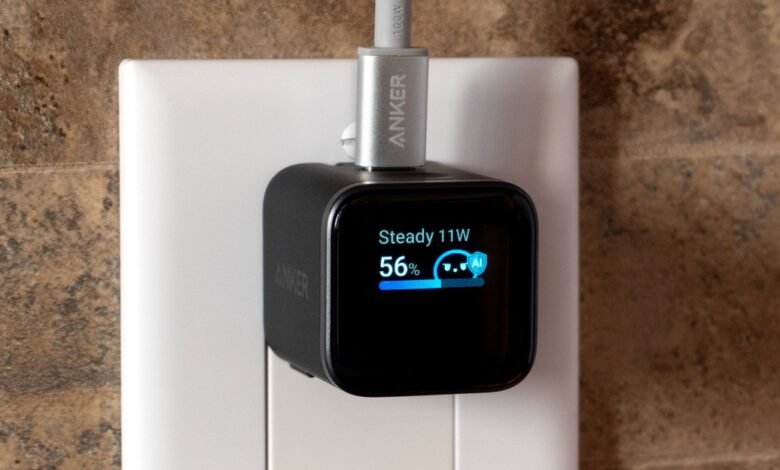
Anker’s latest 45-watt Nano charger introduces a small color screen, making it one of the most distinctive power adapters available. While this display adds a novel visual element, its practical utility for everyday charging is questionable. The charger itself remains impressively compact for its power output, but the screen feels more like an attention-grabbing feature than a genuinely essential upgrade for most users.
The hallmark of this new model is a roughly one-inch screen that occupies half the charger’s glossy front panel. Typically, such displays are reserved for Anker’s larger, multi-port power stations. When you plug in a compatible Apple device, like an iPhone 15 or later, or a 2020-or-newer iPad, the screen briefly shows the device’s name before switching to display the current power delivery and battery level. The charger employs a three-stage system that adjusts wattage to help prolong battery health, labeling these phases as “fast,” “steady,” and “trickle” on the display.
An animated character on the screen accompanies the charging data, though its expressions can be puzzling. It might look sleepy or oddly agitated. When only a cable is connected, this character sometimes transforms, like turning into a fortune cookie that reveals vague messages such as “fun ahead.”
A touch-sensitive button, rather than a full touchscreen, lets you cycle through different information screens. You can view the charger’s temperature or switch between charging modes. Holding the button for two seconds flips the display orientation by 180 degrees, which is handy for repositioning the USB-C port. The default “auto” mode adjusts power delivery dynamically, while a “care” mode reduces output to generate less heat, ideal for overnight charging. The screen displays the word “gentle” in this mode as a reminder to switch back if you need a faster charge.
For devices not officially supported, like a Kobo e-reader, the charger skips the identification step and goes straight to showing the power delivery wattage. The screen’s most potentially useful function, showing your iPhone or iPad’s battery level, is information those devices already provide on their own screens. After a few moments, the charger’s display turns off to conserve power, requiring a tap to reactivate it. This raises a practical question: if your phone is nearby, why not just check its screen directly?
The display could feel more substantial if it offered additional data, such as a time-to-full-charge estimate or an automated schedule for the gentler care mode. Instead, its value seems largely decorative.
The more compelling reason to choose this new $39.99 model over last year’s $34.99 version is the redesigned folding prongs. They now rotate a full 180 degrees, allowing you to plug the charger into an outlet in two different orientations. This simple but clever design improves flexibility, making it easier to position the screen or keep the USB-C port accessible depending on your outlet’s location. This practical improvement is a thoughtful upgrade that genuinely enhances usability.
Ultimately, the animated screen is a fun but largely superfluous addition. The real-world benefits come from the charger’s compact 45-watt capability, its battery-care charging system, and the significantly more versatile rotating plug design.
(Source: The Verge)