How a Fanny Pack Robot Helped Me Walk Miles
▼ Summary
– The author tested a new, compact exoskeleton called the Wirobotics Wim S at CES, which features a front-mounted “fanny pack” design for easier wear.
– Unlike military or industrial exoskeletons, this leisure-focused model doesn’t increase speed or strength but reduces walking exertion by up to 20% by helping lift and cushion the legs.
– The Wim S was praised for being lightweight, easy to put on and remove, and more comfortable for sitting compared to a bulkier exoskeleton tested previously.
– A significant drawback was its unreliable battery life, which provided inconsistent power readings and abruptly shut off during use.
– The front-facing design offered practical benefits, like less obstruction and the ability to be hidden under clothing, making it a promising personal mobility aid for the future.
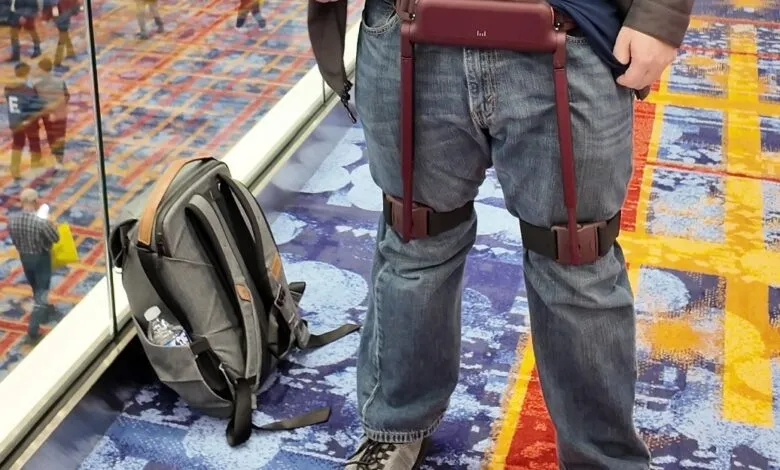
Walking the vast, crowded halls of the Consumer Electronics Show in Las Vegas is a marathon, not a sprint. For the second consecutive year, I turned to a robotic exoskeleton to help cover the miles, but this time, the experience was transformed by a surprisingly simple design shift: the entire system was built into a fanny pack. This isn’t about superhuman strength or speed; it’s about endurance. A new wave of lightweight, personal exoskeletons aims to reduce the fatigue of walking, and putting the technology in a pack worn on the front proved to be a game-changer for mobility and convenience.
The device I tested, the Wirobotics Wim S, claims to reduce walking exertion by up to 20 percent. It achieves this not by making you faster, but by using small motors to assist in lifting each leg and cushioning its impact with the ground. The sensation is subtle but significant. Turning the device off makes walking feel noticeably heavier, as if gravity has increased. With it on, you simply last longer. It’s akin to having a reserve energy tank, allowing for longer, more sustained strides without the same level of muscle fatigue. Some models, including this one, offer a resistance mode that works in reverse, making walking harder to build strength, a feature Wirobotics calls “Aqua mode” for its water-like resistance.
My previous experience was with a bulkier exoskeleton that mounted motors and a battery across the lower back. While effective, it was cumbersome. Sitting down was a struggle, the rigid frame dug into my spine, and wearing a backpack was impractical. The five-pound device was awkward to put on, take off, and store. The Wim S, at just 3.6 pounds, presented a stark contrast. Its fanny pack design made it incredibly quick to snap onto its belt and attach to the leg straps. I could put it on while walking down a hallway. When detached, it folds compactly and charges via a standard USB-C cable, making it far easier to live with.
However, this minimalist approach comes with compromises, primarily in battery life. The capacity is less than many handheld gaming devices. During my testing, after roughly three miles of use, the power cut out abruptly without warning. The companion app’s battery meter was unreliable, fluctuating wildly throughout the day. It’s also worth noting that the battery in this model is not user-replaceable and is listed as a consumable item needing annual replacement, which is a significant long-term consideration.
The front-facing design offered several unexpected advantages. The lifting arms, which telescope to match your stride, rarely got in the way. Unlike bulkier models with hip-hugging frames that can block pockets and limit movement, the Wim’s arms lift directly from the front. This also made it easier to conceal under a loose shirt, whereas the previous model required a full jacket. When sitting, the flat bars of the exoskeleton even served as a surprisingly stable, level surface for my laptop, though a protective pad would be needed to prevent scratching.
Naturally, the design isn’t perfect. The small motors provided little assistance on stairs, and the belt system has an awkward relationship with regular pants belts, I ended up wearing both. But the core benefit is profound: reduced fatigue over long distances. This technology feels less like a futuristic prototype and more like a practical aid for extended walking, rehabilitation, or hiking. I can easily envision using a refined version of this later in life or during recovery. Wirobotics has already launched the device in Korea and is exploring expansion into other markets. As for me, the question isn’t if I’ll use an exoskeleton at CES again, but which streamlined, pack-based design I’ll try next.
(Source: The Verge)