Ancient Treasure Reveals Extraterrestrial Metal
▼ Summary
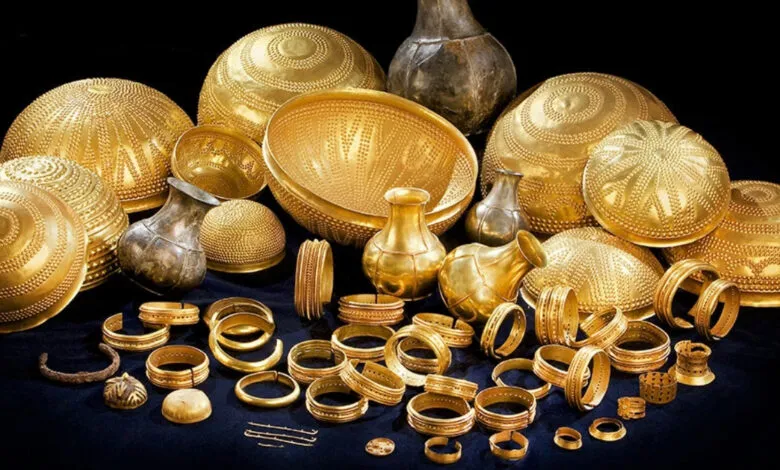
– The Treasure of Villena is a Bronze Age hoard of 66 mostly gold objects discovered in Spain in 1963, considered one of Europe’s most important goldsmithing collections.
– Two corroded, iron-looking artifacts in the treasure, a bracelet and a hemisphere, presented a dating puzzle because they predated the Iberian Iron Age by centuries.
– Researchers analyzed these objects and found a high nickel content, strongly indicating they were forged from meteoritic iron, not terrestrial ore.
– This discovery suggests metalworking in Iberia over 3,000 years ago was highly advanced and provides the first evidence of meteoritic iron artifacts in the region.
– The findings place the iron artifacts in the same Late Bronze Age period (1400-1200 BCE) as the rest of the treasure, resolving the chronological dilemma.
Nestled within a stunning collection of Bronze Age gold artifacts from Spain, two seemingly unremarkable items have emerged as perhaps the most significant. A corroded bracelet and a rusted hemisphere, once overlooked, are now believed to be crafted from iron originating not on Earth, but from meteorites that streaked across the ancient sky. This revelation, spearheaded by researcher Salvador Rovira-Llorens, points to a previously unrecognized sophistication in metalworking over three millennia ago on the Iberian Peninsula.
Known as the Treasure of Villena, this hoard of 66 predominantly golden objects was unearthed in Alicante, Spain, more than six decades ago. It is widely celebrated as one of the most exceptional examples of prehistoric goldsmithing in all of Europe. However, dating the entire collection has long been complicated by the presence of these two anomalous pieces. Their dark, iron-like appearance was a chronological puzzle, as the local Iron Age, marked by the smelting of terrestrial iron, did not begin until centuries after the gold items were made, around 1500 to 1200 BCE.
The answer lies beyond our planet. Iron derived from meteorites possesses a distinct chemical signature, notably a much higher nickel content compared to iron mined from Earth’s crust. This celestial material was occasionally used in antiquity to create rare and highly valued objects, such as the famous dagger found in Pharaoh Tutankhamun’s tomb. To solve the mystery, scientists carefully analyzed samples from the Villena artifacts. Despite significant corrosion, the results from mass spectrometry strongly indicate a meteoric origin for both the hemisphere, possibly part of a scepter hilt, and the bracelet.
This discovery elegantly resolves the timeline dilemma, placing these iron objects within the same late Bronze Age period as their golden counterparts. Researchers note that these are likely the first artifacts in the Iberian Peninsula identified as being made from meteoritic iron, predating the widespread use of terrestrial iron. While the severe corrosion means the findings are not yet absolutely definitive, the study suggests that applying modern, non-invasive analytical techniques could provide even stronger confirmation. The analysis offers a captivating glimpse into how ancient artisans utilized the rarest materials available, transforming gifts from the cosmos into symbols of power and prestige.
(Source: Science Alert)