Open-Ear Buds With Surprising Noise Reduction
▼ Summary
– The author’s main criticism of open-ear earbuds is their poor performance in loud environments like city commutes, often requiring a separate pair for noisy situations.
– Shokz’s new OpenFit Pro earbuds, announced for CES 2026, feature noise reduction (not true ANC) using a triple microphone array and an adaptive algorithm to dampen environmental noise.
– Testing showed the noise reduction works effectively for moderately loud settings like cafes, making music and audiobooks more audible, though it still can’t match true ANC in extreme noise.
– The earbuds improve on typical open-ear weaknesses with better bass quality and support for features like Dolby Atmos, but the author finds the fit bulky and insecure, especially with glasses.
– While too niche to fully replace traditional ANC earbuds for most, they are a significant upgrade for users who need situational awareness during activities like walking or commuting.
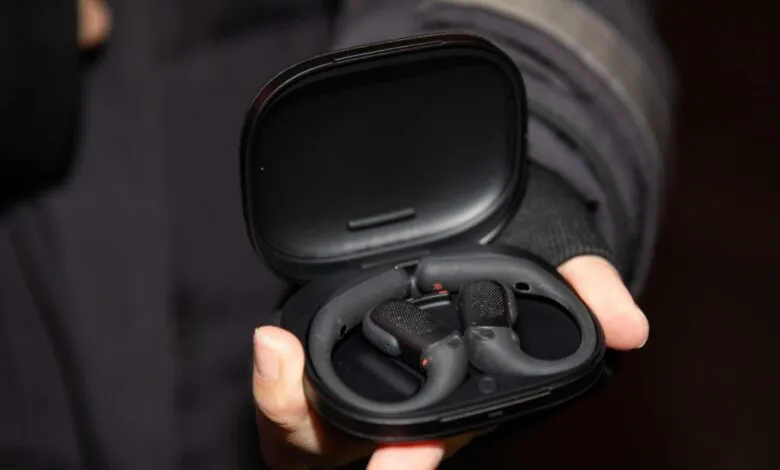
Finding a pair of open-ear earbuds that can handle the chaos of a noisy commute has long been a challenge. The very design that keeps you aware of your surroundings typically means sacrificing audio clarity when background noise intrudes. The new Shokz OpenFit Pro buds aim to solve this with an innovative noise reduction system, offering a compelling upgrade for those who need situational awareness but don’t want their audio drowned out.
My initial reaction to hearing about “noise cancellation” in an open-ear design was pure skepticism. True active noise cancellation requires a seal, which these buds deliberately avoid. Instead, Shokz employs a triple microphone array and an adaptive algorithm to tackle unwanted sound. Two mics monitor your environment, while a third, positioned right by your ear canal, listens to what actually reaches your ear. The system then works to dampen those specific disruptive frequencies.
Having tested many open-ear models before, I expected the usual struggle to hear podcasts over subway noise. The improvement here, however, is genuinely noticeable. Engaging the highest noise reduction setting in the companion app makes a significant difference. It’s not the utter silence of full ANC headphones, a boisterous mariachi band on the train would still win, but for moderately loud environments like a bustling cafe or a rumbling bus, these buds perform admirably. Music stays clear, and audiobooks become listenable in many more scenarios than before.
At home, the technology effectively softened the constant drone of appliances like my air purifier. It won’t overpower a blaring television, but that’s not the goal. These are perfect for when you want to focus on a podcast or playlist while remaining alert to a partner calling from another room or the doorbell ringing.
Audio quality sees a welcome boost, particularly in the bass response, which is often a weak point for open-ear designs. The updated drivers support a wider frequency range and reduce distortion at the lower end, providing a richer, more satisfying listen. A new Dolby Atmos with head-tracking feature feels more like a novelty than a necessity for this style of earbud, but it’s a harmless addition for those who enjoy spatial audio.
The main drawbacks are familiar ones for this form factor. The ear hooks remain somewhat bulky, creating an awkward fit when worn with glasses. They don’t always feel as secure or comfortable as I’d prefer for all-day wear. The charging case is also quite large, though it does compensate by offering a substantial 50 hours of additional battery life. The earbuds themselves last about 12 hours, which drops to a still-respectable six hours with the noise reduction feature activated.
These are not a direct replacement for a premium pair of sealed, noise-cancelling earbuds. For someone who values complete auditory immersion on a flight, a traditional ANC model is still the superior choice. However, for runners, cyclists, busy parents, or anyone who needs to stay tuned into their environment, the Shokz OpenFit Pro represents a meaningful step forward. They deliver much-improved audio isolation without sacrificing the critical awareness that makes open-ear designs so useful in the first place.
(Source: The Verge)