Lego’s Smart Bricks: Not Just for Kids or Experiments
▼ Summary
– Lego’s top marketing executive, Julia Goldin, positions the new Smart Brick as a significant “platform” and “tremendous opportunity” but explicitly states the company is not betting its entire future on it.
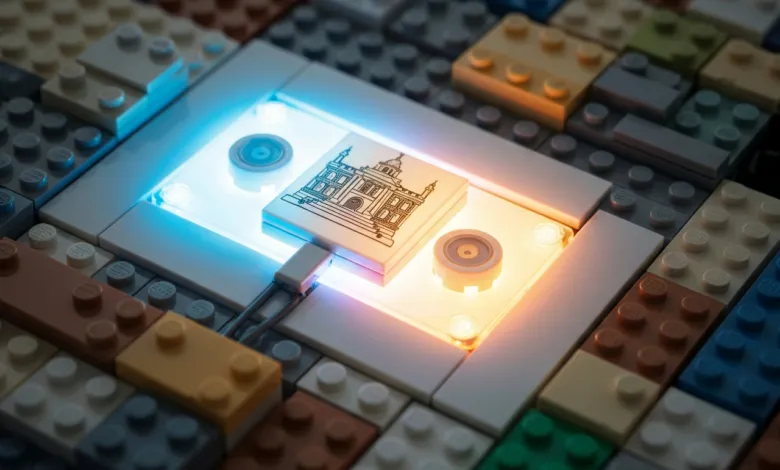
– The Smart Play initiative, featuring sensor-packed bricks with light, sound, and motion detection, is intended for both children and adults, with plans to eventually include them in adult-oriented Lego sets.
– The system allows for interactive, context-aware behaviors, like a vehicle tile enabling crash sounds or refueling, with many future interactions expected to be discovered by fans combining premade elements.
– While the Smart Bricks are not currently user-programmable, Lego’s Creative Play Lab director acknowledges fan demand for this and suggests it’s a possibility for the future after ensuring a secure system.
– Lego views the technology as a flexible, updatable system (like a game console with launch titles) that can evolve based on feedback, allowing the company to adapt without overcommitting.
The introduction of Lego’s Smart Bricks represents a significant evolution in creative play, blending physical building with digital interactivity. While the company is cautious about declaring this its definitive future, senior executives see it as a major platform with substantial potential for both children and the rapidly growing adult fan base. Julia Goldin, the Lego Group’s chief product and marketing officer, emphasizes that this initiative is not an experiment but a “tremendous opportunity,” though she is careful not to overpromise its role in upcoming sets or major brand expansions like Lego Pokemon.
Goldin, who oversaw the successful push into adult-oriented sets, has “no doubt” these sensor-packed bricks will eventually appear in builds for older enthusiasts. She hints that their integration could “bring a different meaning” to adult sets, suggesting interactive layers beyond static display. The vision positions Smart Bricks as a versatile, multi-purpose tool in a builder’s inventory. Imagine a standard piece, like a hot dog, transforming into a flower with added petals; similarly, a smart tile designed as a medical scanner could become a jail alarm in a city layout if a minifigure attempts an escape.
The system promises intriguing combinations, especially as Lego develops more interactive tiles and minifigures. Goldin poses a compelling scenario: what happens when smart Lego Star Wars characters encounter smart Lego Marvel figures? With Disney controlling both franchises, such crossovers are entirely plausible. The interactivity aims to go beyond simple sound effects. If a tile designates a creation as a “vehicle,” it won’t just produce engine noises; it could simulate crashes upon sudden stops or refuel when near a station tile.
Fan creativity is expected to be a huge driver, discovering unexpected and fun interactions between premade tiles. Goldin suggests that while Lego will design some specific character-aware moments, similar to Sonic recognizing Doctor Who’s screwdriver in past games, the “majority will be designed by our fans.” The system allows for complex scenarios, like a smart aircraft tile sounding an alarm if flown erratically, with a pilot minifigure inside audibly reacting. However, these interactions currently rely on Lego’s predefined programming, as the bricks are not user-programmable at launch.
Tom Donaldson, head of the Lego Creative Play Lab, doesn’t rule out user programming eventually. He acknowledges fan demand is likely but states the priority is establishing a secure, hack-resistant environment first. “It’s not where we want to start,” he notes, indicating it’s a consideration for the future.
When questioned about whether every classic theme, City, Space, Castle, will incorporate this technology, Goldin remains noncommittal. “It could be,” she says, “we don’t know yet.” She highlights the system’s adaptability, noting that the Smart Bricks run on updatable software and firmware, allowing behaviors to evolve based on user feedback. Updates will be delivered via a Bluetooth-connected app.
Addressing the historical precedent of Lego’s near-bankruptcy after over-innovating, Goldin frames the Smart Brick venture differently. She compares it to launching a game console, with the initial Lego Star Wars sets serving as its first titles. “When you build your game, you take a risk,” she admits. “But if that game doesn’t work, you produce another game, or you evolve it.” This approach allows Lego to explore the interactive frontier without “betting the farm,” treating it as a dynamic platform with room to grow, adapt, and learn from its global community of builders.
(Source: The Verge)