Teradar Unveils First Terahertz Vision Sensor for Vehicles
▼ Summary
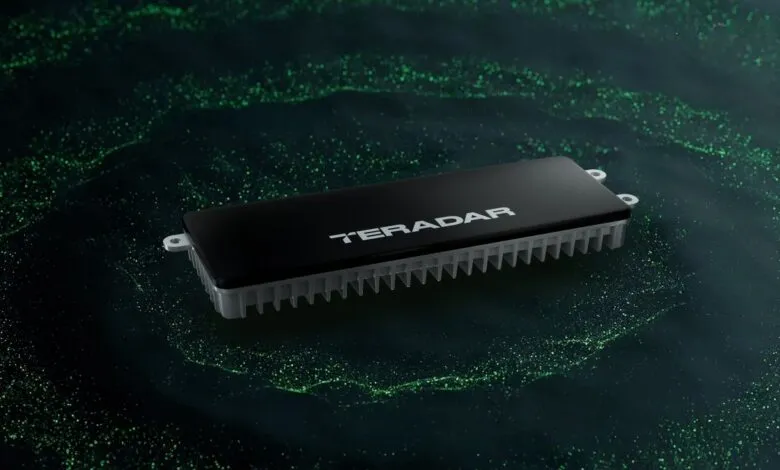
– Teradar unveiled its first flagship terahertz sensor, called Summit, at CES 2026, positioning it as a long-range, high-resolution sensor designed to perform in any weather.
– The solid-state sensor leverages the terahertz band to combine the best qualities of lidar and radar, aiming to address lidar’s cost and radar’s limitations for automakers.
– The company is targeting a 2028 shipping date for Summit, contingent on securing contracts, to help automakers add partial or full autonomy features to vehicles.
– Teradar’s market entry coincides with industry challenges, as evidenced by Luminar’s bankruptcy and strong, low-cost lidar competition from China, though demand for advanced sensors like Rivian’s planned lidar persists.
– Beyond automotive, Teradar’s vision and recent $150 million Series B funding include defense applications, with backing from Lockheed Martin’s venture arm and a defense-focused fund.
A new player is entering the competitive field of automotive sensing technology, aiming to solve a persistent challenge for self-driving vehicles. Teradar, a Boston-based startup, has unveiled its first flagship terahertz vision sensor at CES 2026, introducing a device designed to perform reliably in all weather conditions. Named Summit, this solid-state sensor operates in the terahertz band of the electromagnetic spectrum, a relatively unexplored region between microwaves and infrared light. The company claims this approach combines the best attributes of traditional radar and lidar, offering long-range, high-resolution perception without the mechanical parts that can complicate other systems.
If Teradar secures contracts with automakers, the Summit sensor could begin shipping by 2028. The company’s goal is to enable vehicle manufacturers to incorporate advanced partial or full autonomy features into their models. This potential comes at a critical juncture for the sensor industry. Recent struggles among established lidar providers, including the bankruptcy filing of Luminar after key deals with Volvo and Mercedes-Benz dissolved, have highlighted market volatility. Industry observers note that competition from lower-cost Chinese manufacturers, where lidar adoption remains robust, has intensified these pressures.
Teradar is not limiting its ambitions to passenger cars. The company’s recent $150 million Series B funding round included investment from Lockheed Martin’s venture arm and a defense-focused fund, signaling strong interest in military and aerospace applications. This broader vision could provide a strategic buffer as the automotive market evolves. The company reports it is already conducting technology demonstrations with five major automakers from the U.S. and Europe, along with three top-tier suppliers.
Despite the challenges facing some lidar firms, demand for advanced sensing has not disappeared. Electric vehicle maker Rivian announced plans in December to integrate a roof-mounted lidar unit into its forthcoming R2 SUV, indicating that automakers still seek sophisticated technology to enable autonomous driving, particularly at accessible price points. Teradar’s leadership believes their terahertz technology can meet this need for performance and affordability. CEO Matt Carey emphasized a pragmatic approach, stating the company’s primary mission is to ensure its sensor is adopted widely across the automotive industry, pursuing whatever path achieves that objective.
(Source: TechCrunch)