DIY Giant Game Boy with Electroluminescent Screen and Custom Graphics
▼ Summary
– A modder created a giant, functional Lego Game Boy using a custom electroluminescent (EL) display to achieve a soft, glowing pixel look without the pixelation of a scaled-up old screen.
– The EL display was chosen for its CRT-like qualities, such as self-emitting pixels and a natural glow, but it required a completely custom graphics adapter and BIOS to work with modern signals.
– Building the display system was complex and costly, as the EL panel is expensive and was never designed to accept modern video signals like VGA.
– The modder 3D-printed and assembled the large Lego shell, adding custom buttons and a wired NES controller to play classic games like Super Mario Bros.
– The entire project is open-source, allowing others to replicate it, though the display is monochrome and shares issues like image retention with modern OLED technology.
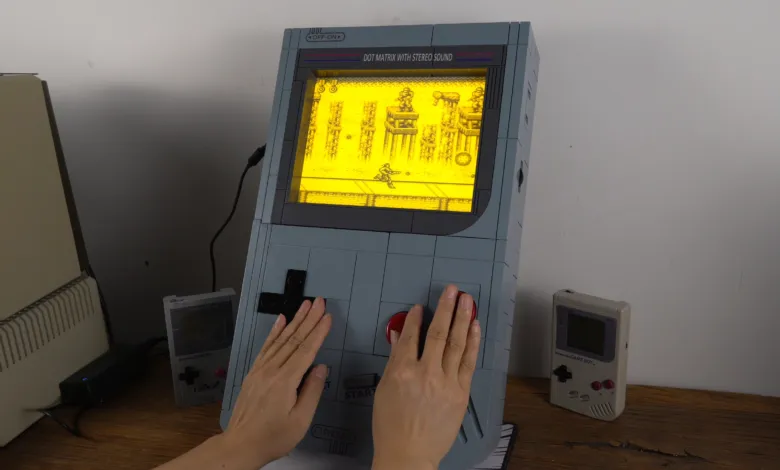
While the official Lego Game Boy is a popular display model, its non-functional nature and small screen left one modder wanting more. LCLDIY, a creator from China, embarked on an ambitious project to build a fully operational, giant-scale Lego Game Boy. To solve the problem of ugly pixelation when enlarging a classic screen, he turned to a unique and rarely used technology: an electroluminescent (EL) display. This choice was central to achieving a specific, nostalgic visual aesthetic that modern screens often struggle to replicate authentically.
The decision to use an EL panel wasn’t made lightly, as these displays are both expensive and notoriously difficult to interface with modern hardware. They weren’t designed for contemporary video signals and lack support for common outputs like VGA. This meant LCLDIY had to engineer a solution from the ground up, starting with the fundamental communication between the display and a graphics processor.
So, why go through all that trouble for an electroluminescent screen? The answer lies in its unique visual properties. In many respects, EL technology is a precursor to today’s OLED. Both feature self-emissive pixels, instant response times, and theoretically infinite contrast since no backlight is involved. However, EL displays produce a distinctive soft glow and blended pixel look, reminiscent of older CRT monitors, through phosphor persistence. This naturally masks the harsh pixelation of low-resolution retro games, creating that romanticized, glowing appearance without the need for bulky cathode ray tubes or software shaders that mimic the effect on OLED.
To make the EL display functional, LCLDIY couldn’t use off-the-shelf components. He designed a custom graphics adapter and wrote his own BIOS to drive it. The core of this adapter is an older CHIPS 65548/5 integrated circuit, responsible for generating the precise Horizontal Sync and Vertical Sync signals the EL panel requires from a standard GPU framebuffer. The adapter uses a PCI interface, compatible with PCIe cards via a converter. For this build, an Intel 854 motherboard with integrated graphics provided the necessary video output, with all the complex signal translation handled by the custom adapter.
With the core electronics solved, the physical build was more straightforward but still required significant effort. The giant Lego Game Boy shell was entirely 3D-printed using custom-designed parts, a process that took about a week. After printing, the pieces were painted and assembled, using what appears to be genuine Lego bricks internally for structural support. The modder added custom buttons and even integrated a wired NES controller into the side for playing games from various platforms.
The final result showcases classic titles like Super Mario Bros., Contra, and Sonic with a stunning, haloed glow effect. The monochrome display exhibits a prominent and unapologetically retro-futuristic look, akin to something from a 1990s anime. It’s important to note that, like OLED, this technology can suffer from image retention due to its phosphor-based nature. Nevertheless, this project stands as a remarkable feat of modding and reverse engineering. The fact that LCLDIY has made the entire project open-source, allowing others to follow in his footsteps, makes the achievement all the more impressive for the DIY community.
(Source: Tom’s Hardware)