Physicists 3D-Print a Christmas Tree From Pure Ice
▼ Summary
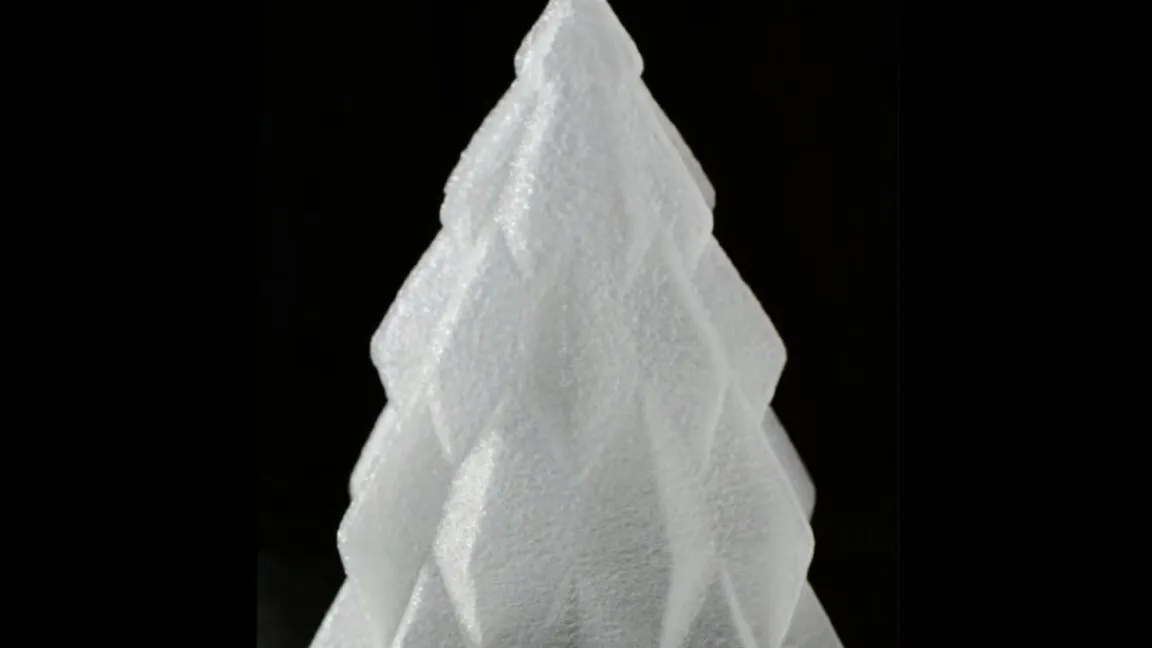
– Physicists 3D-printed a small ice Christmas tree using evaporative cooling, without refrigeration equipment.
– Evaporative cooling is a known phenomenon used by mammals and seen in everyday examples like steaming coffee.
– The same cooling effect causes the “stall” in BBQ, where meat sweats and evaporation slows cooking.
– This is the first application of evaporative cooling principles to 3D printing ice, using a vacuum chamber and water jet.
– The method was discovered accidentally while experimenting with spraying water in a vacuum to reduce air drag.
Researchers at the University of Amsterdam have developed a novel method for 3D printing intricate structures from pure ice. This festive demonstration, an eight-centimeter-tall Christmas tree, was created without any traditional refrigeration or freezing equipment, relying instead on a clever application of evaporative cooling. The technique, detailed in a recent preprint, represents a significant and cost-effective advancement in additive manufacturing with potential applications in fields ranging from biomedical engineering to art.
The process hinges on a fundamental physical principle: evaporative cooling. This is the same phenomenon that helps mammals regulate body temperature and causes steam to rise from a hot beverage. In this specific setup, the printing occurs inside a vacuum chamber. A jet nozzle acts as the print head, depositing water layer by layer. The team made this discovery somewhat by accident while experimenting with spraying water in a vacuum to reduce air drag. They found that the rapid evaporation of the water under low-pressure conditions instantly freezes it, allowing for precise, on-demand construction of geometric shapes.
Evaporative cooling is a powerful and versatile physical process with implications far beyond holiday decorations. It is a critical component in creating exotic states of matter like Bose-Einstein condensates. On a more everyday level, it also explains the “stall” often encountered in barbecue, where moisture evaporating from cooking meat cools the surface and slows the cooking process, a challenge pit masters address by wrapping the meat.
Traditional methods for printing ice typically involve complex cryogenic systems or pre-cooled surfaces. This new approach, utilizing a simple vacuum chamber and water, bypasses those requirements entirely. The researchers note that this marks the first successful application of evaporative cooling principles to 3D printing technology. By guiding the water jet with precise motion control, they can build free-standing ice objects directly, opening up new possibilities for rapid prototyping and fabrication in environments where conventional cooling is impractical.
(Source: Ars Technica)