Cherry XTRFY K5 Pro TMR Compact Keyboard Review
▼ Summary
– The 65% layout is particularly comfortable for users with small hands, reducing fatigue during extended gaming sessions.
– It features TMR (Tunnel Magneto-Resistance) switches, which offer high precision and responsiveness, primarily benefiting competitive gamers.
– The keyboard includes extensive customization software (Magcrate) for lighting, key actuation settings, and gaming-specific features like SnapKey.
– Its plastic construction and understated black/orange design are seen as underwhelming for its $185/£140 price point.
– The review notes several more affordable alternatives with similar features, such as the Gamakay x NaughShark NS68 with Hall effect switches.
The Cherry XTRFY K5 Pro TMR Compact presents a compelling, if niche, proposition. This 65% gaming keyboard leverages advanced TMR (Tunnel MagnetoResistance) switch technology to deliver exceptional precision, but its premium price and focused feature set mean it won’t be the right fit for every gamer. While its wired-only connection and understated plastic design may underwhelm some, the keyboard excels in providing a uniquely comfortable and responsive platform, particularly for players with smaller hands.
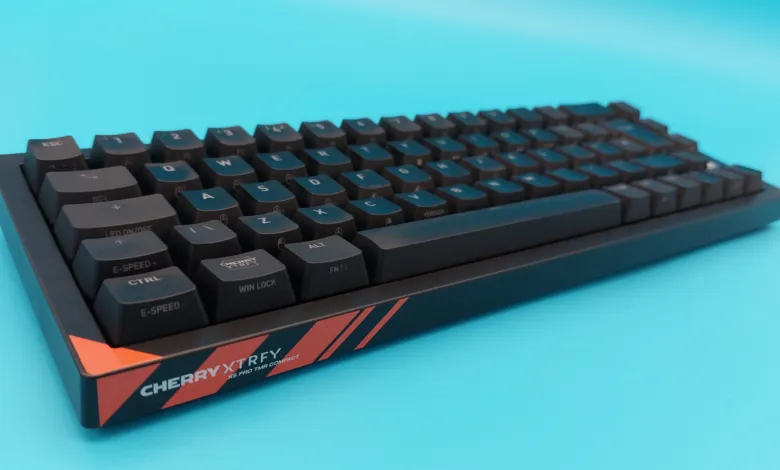
My first impression was admittedly lukewarm. The predominantly plastic construction and a design centered on a simple orange accent stripe felt underwhelming for a peripheral costing $185. It stands in stark contrast to my daily driver, which features a brushed aluminum top plate. Furthermore, the Cherry MK Crystal magnetic switches, while satisfyingly crisp, produce a pronounced clack accompanied by a notably loud, thudding spacebar. The initial value proposition seemed difficult to justify.
Perception shifted, however, once I began using it. The compact 65% layout is this keyboard’s secret weapon. By eliminating the numpad and dedicating space efficiently, it creates a surprisingly spacious feeling key arrangement. For someone with smaller hands, this design is transformative. The reduced distance to the shift key and the thoughtful placement of the arrow cluster eliminated the hand strain I often experience with other compact boards, making extended gaming sessions far more comfortable.
Where the K5 Pro TMR Compact truly justifies its place is in its performance-oriented gaming features. The core TMR switches offer a tangible step up in precision over even Hall effect switches, with actuation points that are adjustable from 0.1mm to 3.2mm for every key via the accompanying Magcrate software. This software also enables Rapid Trigger functionality, called “Toggle Switch” here, and SnapKey, Cherry’s implementation of SOCD cleaning for advanced movement techniques. It’s important to note that features like SnapKey are banned in titles like Counter-Strike 2, but the ability to store multiple onboard profiles allows for easy switching between competitive and casual setups.
The technical specifications are robust, including a polling rate configurable up to 8,000 Hz and full N-key rollover. Yet, the wired connection feels like a missed opportunity, as the power efficiency of TMR switches would be a significant benefit in a wireless model. This becomes more apparent when comparing it to Cherry’s own Xtrfy MX 8.2 Pro TMR TKL, a wireless alternative with premium build quality, albeit at a roughly $70 higher price point.
Ultimately, the value assessment is challenging. For competitive players seeking every millisecond of advantage, the customizable actuation and high polling rate are powerful tools. For everyone else, the price is a serious consideration. Excellent alternatives exist, like the Keychron K2 HE with its magnetic switches and premium aesthetic, or the astonishingly value-packed Gamakay x NaughShark NS68. That budget board offers Hall effect switches and many similar gaming features for a fraction of the cost, making the K5 Pro TMR Compact’s premium difficult to universally recommend.
This keyboard carves out a specific niche. It is a high-performance tool best suited for competitive gamers, especially those with smaller hands who will most appreciate its ergonomic layout. If you fall into that category and prioritize cutting-edge responsiveness, it makes a strong case for itself. For the average player or those on a budget, however, more affordable options provide tremendous capability without the steep entry fee.
(Source: PC Gamer)