MacBook Air M5 Review: A Subtle Yet Perfect Update
▼ Summary
– The 2026 MacBook Air update is minor, adding the M5 chip, Wi-Fi 7, and faster 512GB base storage, but it is now $100 more expensive.
– The new MacBook Neo, priced $500 below the base Air, creates a new entry point but does not make the more capable and sleeker Air obsolete.
– The M5 Air offers improved performance over the M4 model, with the most significant gains in storage speeds and GPU performance, though it is slightly slower than the fan-cooled M5 MacBook Pro.
– For most users, upgrading from a recent M1, M2, or M4 MacBook Air is unnecessary; the Neo is ideal for first-time or light users, while the Air suits those needing more power for creative work.
– The MacBook Air is positioned as a versatile “jack-of-all-trades” laptop, offering a balanced performance and feature set that makes it the ideal middle ground for many users between the Neo and the Pro.
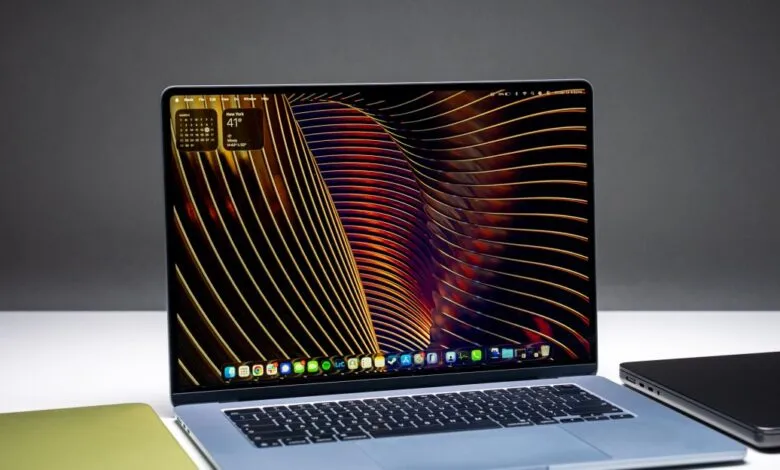
The latest MacBook Air with the M5 chip arrives as a subtle but meaningful update, refining an already excellent laptop rather than reinventing it. For 2026, the changes are focused on internal improvements: the new M5 processor, support for Wi-Fi 7, and a welcome doubling of the base storage to 512GB. While the starting price has increased by $100, this iteration solidifies the Air’s position as a top-tier ultraportable. However, its role in Apple’s lineup has shifted with the introduction of the more affordable MacBook Neo, presenting buyers with a clearer, though more complex, set of choices.
The most significant evolution isn’t just in the Air’s specs, but in its place within the broader MacBook family. The new MacBook Neo offers a compelling entry point at $500 less than the base 13-inch Air. This doesn’t make the Air obsolete; it simply redefines its purpose. The Air now stands as the clear step-up option from the Neo, offering greater capability and a sleeker design, while still leaving ample room for the more powerful MacBook Pros above it. This positioning raises a question: does the Air feel like an awkward middle child, or does it represent the perfect balance? The answer leans strongly toward the latter.
Nearly everything praised in last year’s M4 MacBook Air reviews holds true for this M5 model. The display remains bright and color-accurate. The keyboard feels solid, the trackpad is generously large and responsive, and the 12-megapixel Center Stage webcam continues to be the best in the business for a built-in option. Battery life is stellar, easily lasting a full workday and beyond; in mixed use with web browsing, messaging, and media streaming, I consistently saw between 13 to 14 hours on a charge. The six-speaker system in the 15-inch model also impresses, delivering surprising volume and clarity for such a slender machine.
Where the new model makes its mark is with a across-the-board speed boost. The M5 chip, with its 10-core CPU and GPU, delivers predictable gains over the M4. Benchmark results show it performing slightly behind the fan-cooled 14-inch MacBook Pro with the same chip, but notably ahead of last year’s Air. The most substantial leap, however, comes from drastically faster storage speeds. Read and write performance is more than twice as fast as the M4 Air, bringing it in line with the M5 MacBook Pro. This makes file transfers snappier and helps the system remain stable under heavy load, even when using swap memory.
To test this, I pushed the Air with a demanding simultaneous workload: importing over a thousand high-resolution RAW photos into Lightroom while exporting a 4K video in Premiere and downloading a game, all with numerous browser tabs open. The laptop used nearly 20GB of swap memory, slowed down considerably, and grew warm, but it never crashed or froze. It’s a testament to the robustness of the platform, though such extreme multitasking is firmly in “get a MacBook Pro” territory.
For anyone who purchased an M4 MacBook Air last year, there’s little reason to feel an urgent need to upgrade. That machine remains an excellent computer for the long haul. The M5 Air’s advancements in processing, storage, and connectivity offer a bit more future-proofing, but the upgrade is most compelling for those on an M1, Intel-based Mac, or an M2 Air that’s beginning to feel sluggish.
This brings us back to the Neo. For first-time Mac buyers or those finally retiring an aging Intel model without update support, the $600 MacBook Neo is a fantastic value that will satisfy many users. If your work involves creative applications like Adobe’s suite, the Air’s extra power is worth the investment. And for those whose daily workflow is centered on professional content creation, the MacBook Pro remains the necessary tool.
This is the dynamic of Apple’s product ladder. There’s a tailored option for nearly every need and budget, with each step up offering temptations like more screen, memory, storage, or processing power. The MacBook Air has gracefully settled into its role as the versatile centerpiece. It’s incredibly portable, a balanced performer for everything except the most graphics-intensive tasks, and packed with premium features like Thunderbolt 4 ports, MagSafe charging, and that superb haptic trackpad.
With the Neo now serving budget-conscious users and the Pros catering to power users, the MacBook Air confidently occupies the sweet spot. It’s the jack-of-all-trades laptop, receiving the latest Apple silicon to ensure longevity. Even as the middle child in the family, for a great many people, the MacBook Air continues to be Apple’s “just right” computer.
(Source: The Verge)