Steam Controller Revisited: Valve’s Flawed Yet Influential Legacy
▼ Summary
– The Steam Controller, launched in 2015, was a unique PC gaming pad that replaced traditional thumbsticks and a d-pad with dual trackpads, resulting in a high learning curve and divisive design.
– The controller was widely criticized for its cheap, plastic-heavy build quality, loud and clacky buttons, and awkward ergonomics that made it feel flimsy and poorly constructed.
– In gameplay, it often performed poorly for traditional controller games and fast-paced shooters, with the trackpads feeling imprecise and creating awkward transitions to face buttons.
– However, the controller showed its value for playing mouse-centric strategy and simulation games from the couch, fulfilling its original vision for the Steam Machines.
– The Steam Controller was a trailblazer that directly influenced the superior control scheme of the Steam Deck and its upcoming successor, which aims to address the original’s flaws.
When Valve introduced the Steam Controller in 2015, it represented a bold attempt to redefine living room PC gaming. The device discarded conventional design, swapping the right thumbstick for a mouse-emulating trackpad and placing another trackpad where the d-pad normally sits. This unconventional approach promised greater precision for desktop games played from the couch, but it arrived with a steep learning curve and a divisive aesthetic. Over a decade later, its influence is undeniable, especially in the Steam Deck, making it a fascinating piece of hardware history worth revisiting.
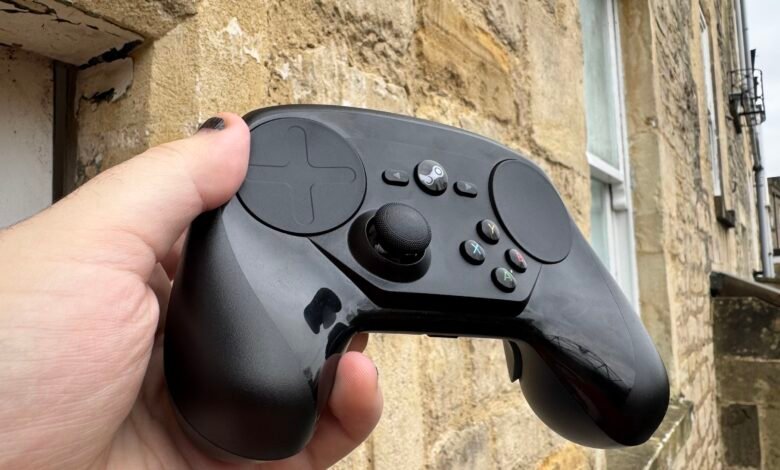
Initial impressions of the controller are not particularly favorable. Picking it up, the absence of a right thumbstick and its sunken sides give it a prototype-like feel, reminiscent of old console mockups. The build quality feels insubstantial, with a noticeably plastic-heavy and rattly construction. Buttons, especially the bumpers, produce a distinct, hollow clack that is far from premium. Even the trackpads can emit an odd ticking sound linked to the haptic feedback system, a noise only mitigated by turning the feedback down.
Its physical design presents immediate ergonomic challenges. The large right trackpad and small, recessed face buttons (A, B, X, Y) are placed awkwardly far apart. To avoid accidental inputs, you must completely lift your thumb off the trackpad before reaching for a button, breaking gameplay flow. The controller supports both wireless play via a USB dongle and two AA batteries, or wired connection through a Micro USB port. The battery compartment, with its clever latch-and-eject system, is one of the few universally praised elements.
Testing the controller across various genres reveals its core struggle: bridging the gap between mouse precision and controller comfort. In fast-paced shooters like Counter-Strike 2, fine aim is manageable but snap shooting feels sluggish and unrewarding. The trackpad demands a hovering thumb position, preventing the relaxed, flat thumb placement of a standard joystick. In a game like Rocket League, the translation is worse; controls feel rigid, complex maneuvers are slower, and camera control via the trackpad becomes janky and stuttery.
The controller truly stumbles in games with hybrid control schemes. Some titles fail to properly interpret the trackpad input, registering it as a jerky joystick rather than a smooth mouse. This led to frustrating experiences in art simulators and strategy games, where cursor movement lacked the necessary glide. For traditional controller-centric games, the Steam Controller consistently feels like a clumsy alternative.
However, its intended purpose shines in specific scenarios. Playing complex strategy and management games like Against the Storm from the couch is where the vision becomes clear. While a mouse is still preferable, the trackpad allows for competent control of menus and maps, fulfilling the original promise of the Steam Machines era. Community-created control layouts are essential here, often providing a workable, if not perfect, scheme. The focus on trigger and trackpad use also minimizes reliance on those awkwardly placed face buttons.
This experimental DNA proved invaluable. Valve directly applied lessons from the Steam Controller to the Steam Deck, creating a far more versatile control scheme with dual trackpads, joysticks, and a d-pad. The original controller’s legacy is its role as a trailblazer, forcing broader Steam support for unconventional input devices and exploring how PC games could be played differently.
Ultimately, the original Steam Controller is a flawed artifact. It feels cheap, looks odd, and demands significant adaptation for often middling results. Yet, its influence is profound. The newly announced follow-up controller appears to address many build quality and feature shortcomings. While it’s easy to critique the 2015 model’s failures, its pioneering spirit and direct lineage to the excellent Steam Deck controls cement its status as a curious, influential, and important piece of gaming hardware.
(Source: PCGAMER)


