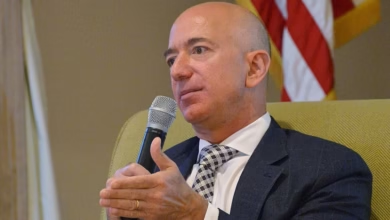
OpenAI Veteran Kevin Weil Joins Stoke Space Board

▼ Summary
– Kevin Weil, a tech executive from Twitter, Meta, Planet Labs, and OpenAI, has joined the board of Stoke Space, a reusable rocket startup competing with SpaceX.
– Stoke CEO Andy Lapsa said Weil provided crucial fundraising and business guidance since investing in the company in 2020, helping it raise $1.34 billion.
– Weil’s recent role at OpenAI raises speculation about a possible link between the AI lab and Stoke, but Lapsa declined to comment on OpenAI rumors.
– Stoke is building Nova, a fully reusable rocket, aiming to overcome the extreme heat of reentry, a challenge that has deterred other companies like Blue Origin.
– Military contracts and space data centers are key to Stoke’s success, and Weil brings relevant experience from the US Army Reserve and his tenure at Planet Labs.
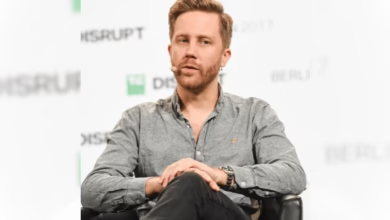
Kevin Weil, a prominent tech executive with leadership roles at Twitter, Meta, Planet Labs, and OpenAI, has officially joined the board of Stoke Space, a well-funded Seattle startup developing reusable rockets to rival SpaceX.
“It’s real simple for me,” Stoke CEO Andy Lapsa told TechCrunch, recalling how he met Weil when he cofounded the company in 2020 and entered Y Combinator’s winter batch. “I came out of engineering, started a company, had no idea how to fundraise. I had no idea how Silicon Valley worked. I had no network. Kevin [an early investor in the company with his wife Elizabeth, through their fund Scribble Ventures] comes with all of that background and was able to help me think about fundraising and getting the company off the ground.”
The two have stayed in close contact as Lapsa raised $1.34 billion, including a $510 million Series D funding round in 2025, to build a rapidly reusable rocket that could take flight this year. Now, Weil is stepping into a formal board director role to help guide the company’s next phase of growth. Stoke declined to make Weil available for an interview, and he did not respond to TechCrunch’s outreach.
Weil’s background focuses on digital products and platforms, which may not seem directly aligned with Stoke’s hardware-intensive mission. Most recently, he led OpenAI’s efforts to accelerate scientific research, leaving in April after that program’s work was distributed more broadly across the frontier lab. Before that, he served as OpenAI’s chief product officer from June 2024 until October 2025.
His tenure at OpenAI raises an obvious question: Last year, reports surfaced that OpenAI’s Sam Altman was considering an investment in Stoke, potentially backing a SpaceX competitor. Could Weil serve as the bridge between the AI lab and a future space partner? Lapsa declined to comment on “gossip and rumors” about OpenAI, emphasizing that Weil’s role is to focus on Stoke itself.
Stoke is building Nova, a rocket designed for full reusability, capable of flying repeatedly. No company has ever achieved this; SpaceX has come closest with its massive Starship. The immense technological challenge of reusing a rocket, especially surviving the extreme heat of atmospheric reentry, has deterred even the deepest-pocketed space investors. Jeff Bezos’ Blue Origin, where Lapsa once worked, has explored the concept but has not made it a priority.
However, SpaceX’s blockbuster stock market debut, with much of its valuation tied to Elon Musk’s promises that Starship will fly operational missions this year, has validated Lapsa’s vision. Despite billions poured into new launch vehicles, the supply of rockets remains insufficient. The next company to deliver a reasonably priced, regularly flying rocket stands to reap enormous rewards.
“The world is realizing that launch is still not solved,” Lapsa said. “The idea of full, rapid reuse was a little bit out there at that time…that’s now been rather normalized, and people see the inevitable now.”
The concept of building distributed data centers in space to harness solar power and bypass geopolitical restrictions on Earth has captured the imagination of some venture capitalists. The main hurdle is the cost of transporting computer chips into orbit. Space data centers “really only make sense with full rapid reuse,” Lapsa noted, positioning Stoke’s rocket as a potential key enabler.
Military contracts will also be critical to Stoke’s success. Weil brings relevant experience bridging Silicon Valley and the Department of Defense. He was one of four tech leaders who joined the US Army Reserve to improve recruitment and collaboration between the Army and industry. This is also not his first foray into space; he served as president of Planet Labs, a satellite earth observation company, for three years as it went public in 2021.
Whatever strategic insight Weil adds as the company nears delivering an operational launch vehicle, execution remains paramount.
“We’ve got a good chunk of the risk behind us, we’ve got more to go,” Lapsa said. “We’ll work as hard as we can, and we’ll go when it’s ready.”
(Source: TechCrunch)