Uber’s Lime IPO: Scooter Firm Gets Key Anchor Investor
▼ Summary
– Lime is going public on Nasdaq under ticker LIME, seeking to raise up to $180.9mn by selling shares at $24 to $26 each, targeting a valuation near $1.8bn.
– Uber is an anchor investor in the IPO, already owns over 10% of Lime, guarantees some of its debt, and accounts for about 14% of Lime’s revenue through its app.
– Lime is one of the few surviving venture-backed micromobility companies after competitors like VanMoof and Rad Power collapsed or filed for bankruptcy.
– Revenue grew to $886.7mn in 2025, up from $686.6mn in 2024, but net loss widened to $59.3mn from $33.9mn the prior year.
– The IPO tests investor appetite for smaller, hardware-heavy, low-margin businesses amid the dominant SpaceX debut and a challenging IPO market.
Uber is stepping in as a key anchor investor for the upcoming Lime IPO, deepening a relationship that already includes a significant ownership stake and revenue-sharing ties. The scooter and bike rental company, officially known as Neutron Holdings, has set its pricing range and is aiming to raise up to $180.9 million by offering 6.7 million shares priced between $24 and $26 each. Current shareholders, including CEO Wayne Ting and co-founder Brad Bao, are also selling an additional 276,731 shares.
At the top end of that price range, Lime would command a valuation of roughly $1.7 billion. Reports from The Information suggest the company is targeting a valuation closer to $1.8 billion and a raise near $200 million during its road show this week. The shares will trade on the Nasdaq under the ticker LIME, with Goldman Sachs and JPMorgan leading the underwriting. Lime initially filed for the IPO last month.
Uber’s involvement goes far beyond a simple investment. The ride-hailing giant already holds more than 10 percent of Lime and guarantees some of its debt. Roughly 14 percent of Lime’s revenue is generated through the Uber app, and the corporate connection extends to the executive level: Ting previously served as chief of staff to Uber CEO Dara Khosrowshahi. An updated prospectus will formally name Uber as an anchor investor, with The Information describing the commitment as “meaningful.”
Lime’s path to the public market places it among the last venture-backed survivors in the micromobility sector. The category has been brutal on its once-celebrated startups. VanMoof collapsed in 2023 after raising over €200 million, and Rad Power, once valued at $1.65 billion, filed for bankruptcy in late 2025. The survivors now fall into two camps: bootstrapped companies like Lectric, which thrived without venture capital, and those like Lime that relied on deep-pocketed backers to reach an IPO.
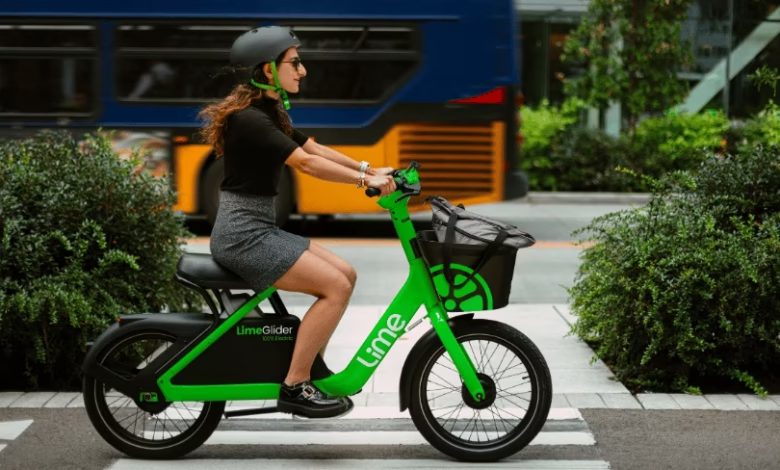
“Lime was founded on a simple but radical idea: people and cities deserve a future where transportation is shared, affordable and carbon-free,” Ting wrote to prospective investors. The company’s growth story is compelling. Revenue climbed to $886.7 million in 2025, up from $686.6 million the previous year, and first-quarter revenue rose 32 percent. Lime counted 3.8 million monthly active users last year, a more than 20 percent increase from 2024. Its green bikes and scooters now operate in over 230 cities worldwide, from Sacramento to Sofia to Sydney.
Profitability remains elusive. Lime’s net loss widened to $59.3 million in 2025, compared to $33.9 million the year before. The valuation has also been a rollercoaster: the company was worth $2.4 billion in 2019, then dropped to just $510 million during a 2020 funding round led by Uber. A successful float would mark a significant recovery. Lime first considered an IPO in 2021 but held off as the entire sector endured a brutal downturn.
The timing of this offering is notable. Lime is floating a relatively modest sum just as the record-breaking SpaceX debut dominates IPO headlines. Smaller tech offerings have struggled to capture investor attention next to the giants. The Lime IPO will test whether there is still appetite for a hardware-heavy, low-margin business built on shared scooters. For Lime, the bet is that scale and an Uber-shaped safety net are enough. For the broader market, it offers a read on how open the IPO window truly is.
(Source: The Next Web)