49 lbs of Cocaine Hidden in Xerox Printers Intercepted in Australia
▼ Summary
– Three Australian men were sentenced for attempting to smuggle 22.4 kg of cocaine concealed inside five printers.
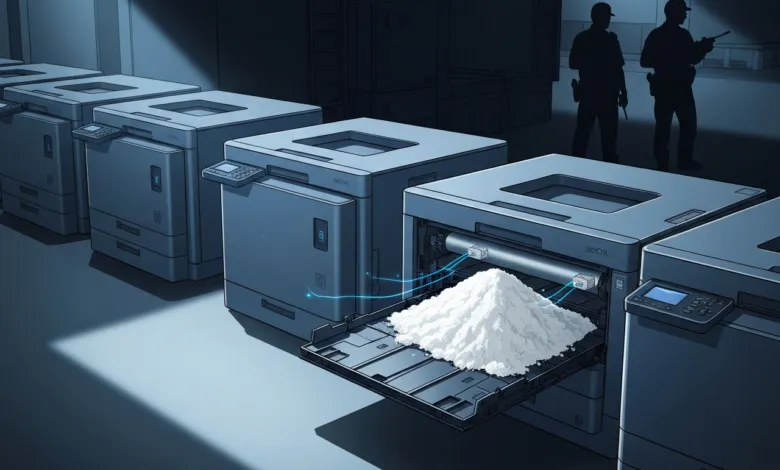
– The Australian Border Force intercepted the printers in Melbourne on April 30, 2017, and found compressed white powder in the paper trays.
– Authorities removed the cocaine, replaced it with alternative material, and added tracking devices before sending the printers to their intended destination.
– Four men were arrested in May 2017 for attempting to retrieve the printers, with three later sentenced to prison terms ranging from nine to ten years.
– The AFP described the incident as an example of advanced smuggling attempts by organized crime groups to bring illegal drugs into Australia.
Four Australian men have taken the concept of “bricked printers” to an entirely new level. In a case that underscores the lengths to which drug traffickers will go, authorities have successfully dismantled a smuggling plot involving Xerox printers packed with nearly 50 pounds of cocaine.
The Australian Federal Police (AFP) and Australian Border Force (ABF) announced today that three of the four men involved have now been sentenced for their roles in the scheme. The operation was first uncovered back in 2017, when the ABF intercepted the printers at a Melbourne facility on April 30 of that year. Upon inspection, officers discovered 10 packages of compressed white powder hidden inside the paper trays of the machines. Presumptive testing quickly confirmed the substance was cocaine, with an estimated street value ranging between 9.3 million and 12.4 million Australian dollars , equivalent to roughly $6.7 million to over $9 million in U. S. currency.
Rather than simply seizing the drugs, law enforcement took a more strategic approach. The cocaine was removed and replaced with an inert substitute material, and the printers were then sent along their intended route to a factory in Airport West, Victoria. According to reports from Channel Nine, authorities also placed tracking devices inside the printers to monitor their progress.
In May 2017, four men were arrested as they attempted to retrieve the printers. They were charged with attempting to possess a commercial quantity of a border-controlled drug. The case has since wound its way through the courts, with sentences handed down at different intervals. One man was sentenced this month to nine years in prison with a non-parole period of four-and-a-half years. Two others had already been sentenced: one received 10 years in 2025 with a non-parole period of five-and-a-half years, while another was sentenced in 2022 to 10 years with a non-parole period of six-and-a-half years. The fourth man arrested was found not guilty.
Simone Butcher, the AFP’s acting commander, highlighted the sophistication of the plot. “The AFP, as well as our domestic and international partners, are steadfast in our mission to protect the community by disrupting and dismantling organized crime groups and their efforts to profit off the misery caused in our community,” she said.
This case serves as a stark reminder of the innovative methods criminal organizations use to smuggle illegal substances across borders. From hidden compartments in everyday office equipment to the use of tracking technology, the battle between law enforcement and drug traffickers continues to evolve.
(Source: Ars Technica)