Gas Prices Boost EV Sales Temporarily
▼ Summary
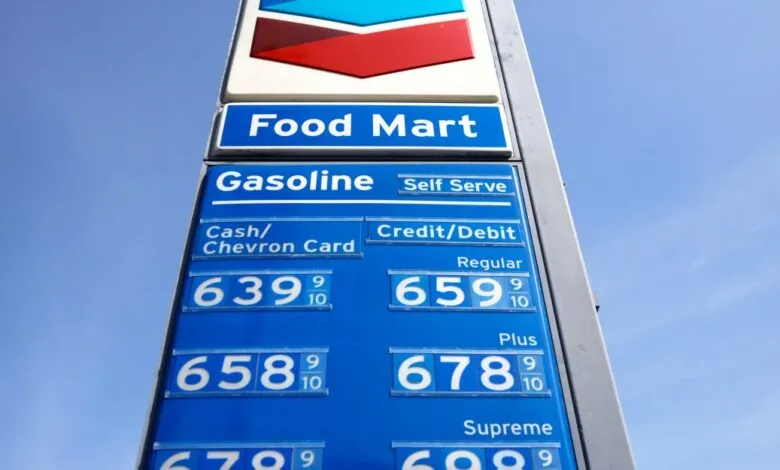
– Surging gas prices near $4 per gallon nationwide are causing some American car shoppers to consider fuel-efficient alternatives like hybrids and EVs.
– A car-buying consultant reports a recent sharp increase in customer transitions to hybrids and heightened conversations about fuel economy compared to when gas was cheaper.
– Analysis shows high gas prices could add $9.4 billion in monthly U.S. fuel costs, with Californians facing prices over $5.80 per gallon and fill-ups exceeding $100 for some SUVs.
– Experts note it typically takes four to six months of sustained high prices to trigger a major shift to economical models, and a rushed new car purchase for fuel savings often isn’t financially wise.
– Automakers like Toyota, Honda, Hyundai, and Kia, which maintained strong hybrid and passenger car lineups, are positioned to gain market share if high gas prices persist.
A sharp and sustained rise in gasoline prices is prompting a noticeable, though likely temporary, shift in American car-buying behavior. With the national average nearing $4 per gallon, a significant jump from earlier this year, the immediate financial pain at the pump is pushing some consumers toward more efficient vehicles. This reaction underscores a familiar pattern where fuel economy moves to the forefront of purchase decisions only when costs become acutely visible.
Car-buying consultant Tomi Mikula has observed this shift firsthand. His firm, Delivrd, reports a marked increase in client interest in hybrid vehicles over recent weeks. “There’s definitely a heightened awareness of fuel economy,” Mikula states, noting far more conversations about efficiency now than when gas was cheaper. He recently helped a Michigan family secure a substantial discount on a new electric SUV, a purchase motivated directly by their frustration with volatile fuel costs. Mikula points out that while interest is rising, a true and lasting market shift typically requires four to six months of sustained high prices to take hold.
The current price surge carries a heavy economic toll. An analysis estimates it could add $9.4 billion monthly to the nation’s collective fuel bill, averaging about $34 in extra costs each month for every driver. The impact is most severe in states like California, where averages exceed $5.80 per gallon. Ivan Drury of Edmunds observes that the psychological effect of a triple-digit fill-up for a common SUV creates a unique consumer pressure distinct from other inflationary expenses. “You want to light the American consumer on fire, mess with the price of those things,” he remarks.
This pressure is reflected in shopping data. The share of car shoppers considering an electric vehicle on Edmunds has climbed from 9.5% to 12%, a nearly 20% gain. Drury cautions, however, that this is just the beginning of a potential transition. “The seeds are planted, but they haven’t sprouted yet,” he says, explaining that a crisis must be “long enough, high enough, and sharp enough” to make drivers permanently abandon internal combustion engines. He also advises most current owners against a reactive trade-in, as high vehicle prices and interest rates would likely erase any fuel savings. “The answer to $5-a-gallon gas is never a $50,000 purchase,” Drury concludes.
For those already in the market, however, rising fuel costs can be the decisive factor. This dynamic is benefiting automakers with robust hybrid lineups. Toyota’s strategy of offering popular models like the RAV4 and Camry exclusively as hybrids now looks prescient; Mikula notes the 2026 RAV4 hybrid is already in unusually short supply. Brands like Honda, Hyundai, and Kia, which have maintained commitments to traditional passenger cars and expanded hybrid offerings, are also well-positioned to gain market share if high prices persist.
Legacy Detroit automakers, having largely abandoned sedans and focused on large trucks and SUVs, could be more vulnerable in a prolonged scenario. While Ford’s efficient Maverick hybrid pickup and GM’s new affordable EVs like the Chevrolet Equinox provide some balance, their portfolios are heavily weighted toward less efficient vehicles. This strategy was bolstered by recent pro-petroleum policies, but a sustained fuel crisis would test its resilience.
For buyers seeking immediate relief, the used EV market presents a compelling value proposition. Models like the Nissan Ariya, Tesla Model 3, and Ford Mustang Mach-E can be found between $21,000 and $32,000, offering insulation from gas prices and lower operating costs. New affordable options exist, too, such as the improved 2026 Nissan Leaf and the 2027 Chevrolet Bolt, which starts under $29,000 with a 256-mile range and fast-charging capability. Notably, Chevrolet plans a limited 18-month production run for the Bolt before retooling its factory for gasoline SUVs, a move symbolic of the industry’s wait-and-see approach.
History suggests this shift may be fleeting. After past fuel spikes, American buyers consistently returned to larger vehicles. Yet the current moment serves as a potent reminder. “It’s good to remind yourself that gasoline is a cost, and it is variable, unlike so many things associated with your car,” Drury notes. For now, the industry and consumers alike are watching the pumps, calculating how long this latest reminder will last.
(Source: The Verge)