Modernize Your Tech Stack: 4 Pillars for a Powerful Publishing Engine
▼ Summary
– Media companies face a “Fragmentation Tax,” a hidden cost of inefficiency from siloed data, slow workflows, and technical debt that drains budgets and stifles growth.
– This tax is paid through strategic blindness from disconnected data, an editorial velocity gap that delays content, and tech debt that consumes innovation resources.
– To combat this, a modern publishing standard is proposed, built on four operational pillars: automated governance, fearless iteration, cross-functional collaboration, and native breaking news capabilities.
– These pillars aim to embed SEO, enable safe content updates, reduce team bottlenecks, and capture real-time search demand directly on the brand’s domain.
– Adopting this unified system reduces operational friction, allowing media organizations to shift focus from maintaining a fragile tech stack to strategic agility and audience growth.
For digital marketers and media leaders, the relentless pursuit of audience engagement and sustainable revenue is often hampered by a fragile, patchwork technology foundation. This disjointed system, built from legacy platforms and ad-hoc plugins, imposes a hidden but severe cost known as the Fragmentation Tax. This tax drains budgets, frustrates teams, and directly limits growth by creating operational inefficiencies that prevent organizations from scaling effectively or capitalizing on new opportunities.
This hidden cost manifests in three critical areas that stifle progress. First, siloed data leads to strategic blindness. When subscriber information, advertising data, and content analytics exist in separate systems, it becomes impossible to see a complete picture of the reader journey. Decisions end up being based on superficial metrics like page views instead of actionable insights into conversion paths or long-term audience retention. Second, organizations face an editorial velocity gap. In a news cycle measured in minutes, being second is the same as being last. Cumbersome, manual workflows caused by a fragmented stack delay publication, causing teams to miss the peak of search traffic and social conversation precisely when speed is most valuable. Finally, there is the constant battle of tech debt versus innovation. Every hour engineering spends patching plugin conflicts or addressing security vulnerabilities in a cobbled-together system is an hour not spent building new features or improving the user experience, silently consuming marketing resources.
To stop paying this tax and reclaim growth, forward-thinking media companies are adopting a unified publishing standard built on four operational pillars.
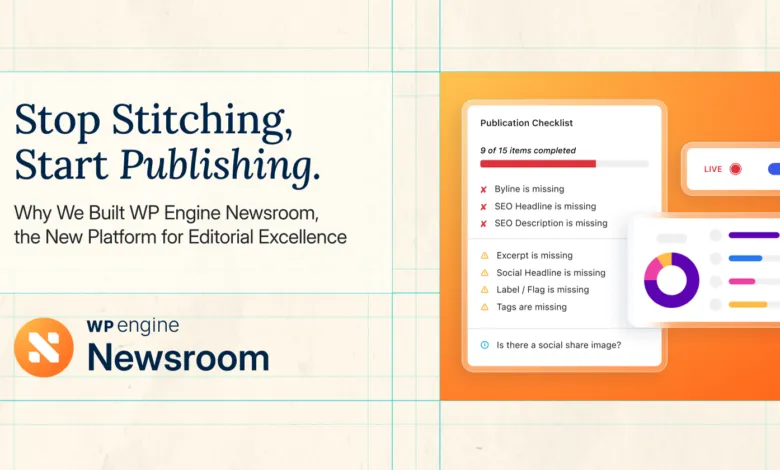
The first pillar is automated governance for built-in SEO and tracking integrity. In a fragmented setup, critical elements like meta tags, tracking codes, and brand guidelines are managed manually, leading to errors and inconsistencies. A unified system embeds governance directly into the workflow through automated checklists, ensuring no content publishes until it meets all defined standards. This protects the brand and guarantees every article is optimized for discovery from the moment it goes live.
Second is the capability for fearless iteration, enabling continuous SEO and conversion optimization without risk. A high-performing article is a major asset, but in a legacy system, updating it with a new call-to-action or refreshed content can be a high-stakes gamble that might break the site. A modern approach allows for staged edits, letting teams draft and preview changes to live content without immediately pushing them to the public. This creates a safe environment for constant improvement while safeguarding site performance and user experience.
The third pillar focuses on cross-functional collaboration to reduce workflow bottlenecks. Disruption requires real-time teamwork, but a patchwork stack often forces editorial, SEO, and engineering teams into separate tools, creating delays. A unified standard supports collaborative editing with distinct areas for text, media, and metadata. This allows an SEO specialist to optimize a story simultaneously with the journalist writing it, ensuring content is fully market-ready the instant the final draft is complete.
Finally, a modern system provides native breaking news capabilities to capture real-time search demand. Covering live events or unfolding stories traditionally required clunky third-party embeds that fragmented user data and slowed page loads. Treating breaking news as a native feature enables rapid-fire updates that keep the audience engaged on the brand’s own domain, maximizing opportunities for ad impressions and subscriber conversions.
Ultimately, embracing a unified standard is about trading technical toil for strategic agility. It eliminates the daily friction of “fighting the tools” and frees teams from the inefficiencies of siloed data. When the foundation is solid and fast, editors can publish with confidence, and marketers can test new growth tactics without waiting for lengthy development cycles. This shift allows everyone to focus on what truly matters: telling compelling stories and building deeper connections with the audience. The era of holding a digital presence together with makeshift solutions is over. For media companies to thrive, their technology infrastructure must act as a powerful launchpad for innovation, not a persistent hindrance to growth.
(Source: Search Engine Journal)