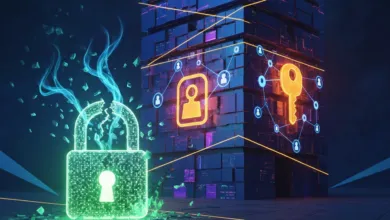
ISO 27001 Compliance in a Passwordless World

▼ Summary
– Passwords are a major security vulnerability, with nearly half of all incidents involving compromised credentials and widespread password reuse creating systemic risk.
– Passkeys are a modern, passwordless authentication method built on cryptographic keys and standards like FIDO2, offering stronger security by keeping a private key on the user’s device.
– For organizations with ISO/IEC 27001 certification, adopting passkeys requires mapping the implementation to specific controls, conducting risk assessments, and maintaining thorough documentation.
– Implementing passkeys provides significant benefits, including eliminating password-based attacks, improving user login success rates and speed, and reducing help desk costs associated with password resets.
– The transition to passkeys presents challenges like managing account recovery, operating in mixed authentication environments, and defending against new attack vectors like downgrade attacks.
Imagine the moment a business realizes its foundational security systems are no longer fit for purpose. The transition from relying on vulnerable passwords to adopting modern passkey technology is a leap in capability and safety, akin to trading an unreliable vehicle for a state-of-the-art model. This shift is not merely an upgrade; for organizations governed by ISO/IEC 27001, it represents a critical evolution in managing information security risks, demanding careful alignment with established controls and documentation.
For decades, passwords have been the default engine for digital access, but their weaknesses are glaring. Verizon’s 2023 Data Breach Investigations Report indicates that 49% of security incidents involve compromised passwords, and widespread password reuse creates cascading vulnerabilities. These are not minor flaws but fundamental security risks. Passwordless authentication, particularly using passkeys built on FIDO2 and WebAuthn standards, offers a more robust alternative. It replaces the need to remember secrets with cryptographic key pairs and biometrics, significantly reducing the attack surface.
Navigating ISO/IEC 27001 compliance during this transition requires mapping the new technology to the framework’s controls. The standard’s 2022 revision organizes controls into four themes, with authentication primarily falling under Annex A. Key areas include A.5.15 (Access Control), which governs access rules; A.5.17 (Authentication Information), covering credential management; and A.8.5 (Secure Authentication), which specifies technical requirements like multi-factor authentication. Adopting passkeys means demonstrating they meet or exceed the objectives of these controls through thorough risk assessment and documentation.
A practical implementation strategy involves defining the scope based on risk. Organizations should prioritize device-bound passkeys for privileged accounts to achieve higher assurance levels, while syncable passkeys are suitable for standard users. Critical steps include documenting enrollment and re-enrollment procedures, defining encryption for public key databases, and establishing clear fallback processes for scenarios like device loss. It’s also vital to detail how passkeys satisfy multi-factor requirements by combining possession (the device) with an inherence factor like a fingerprint.
The benefits extend beyond theoretical security. Google reports that passkeys eliminate password-based attacks for accounts using them exclusively, alongside faster sign-in times. Operationally, they reduce the substantial burden of password resets, which Gartner notes account for 20-40% of all help desk calls. Furthermore, passkeys align with requirements across multiple compliance frameworks, including NIST’s phishing-resistant guidelines and PCI DSS 4.0, providing a unified control.
However, the journey has challenges. Passkeys are not a silver bullet. Threats like downgrade attacks, which trick users into falling back to passwords, or complex account recovery scenarios must be addressed. Few organizations transition overnight, leading to mixed authentication environments that can create security gaps and policy inconsistencies. Successful enterprise implementation requires platforms that support flexible policies, robust audit trails, and gradual migration paths.
Best practices for a compliant rollout start with risk-based prioritization, beginning with the most sensitive accounts. A defense-in-depth approach remains essential, combining passkeys with strong session management and monitoring. Proactive planning for account recovery and comprehensive documentation of all procedures, architecture, and risk decisions is non-negotiable for meeting ISO 27001’s “documented information” requirements and facilitating smooth audits.
Ultimately, moving to passkeys is a strategic decision to build a more resilient and efficient authentication framework. While it doesn’t eliminate every risk, it positions an organization to integrate future security advancements seamlessly. The transition demands careful planning, but the result is a stronger security posture that protects assets and streamlines user access, turning a necessary upgrade into a competitive advantage.
(Source: Bleeping Computer)