How BYD Surpassed Tesla in the EV Race
▼ Summary
– BYD, a Chinese company, has surpassed Tesla to become the world’s largest seller of electric vehicles.
– The Vergecast episode discusses BYD’s origins, the appeal of its cars, and the implications of its rise for the EV market.
– The episode explores the possibility and potential timing of BYD cars, like the Dolphin Surf model, coming to the United States.
– An influx of Chinese EVs, which are popular with influencers, could significantly change the broader car market.
– The episode also addresses a listener question about whether giving a child an old iPhone differs meaningfully from giving them an iPad.
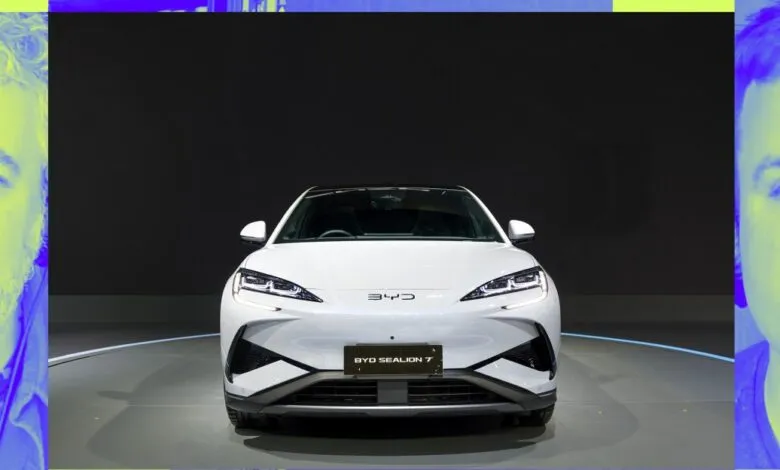
The global electric vehicle landscape has undergone a significant shift, with Chinese automaker BYD officially surpassing Tesla as the world’s largest seller of EVs. This change signals a new era in the automotive industry, where affordability, diverse model offerings, and vertical integration are becoming decisive competitive advantages. While names like the Tesla Model S, Ford Mustang Mach-E, and Hyundai Ioniq dominate Western markets, BYD’s rise introduces models like the Dolphin and Seal to the global conversation, showcasing a different approach to electric mobility that is rapidly gaining traction.
BYD’s journey to the top is a compelling story of strategic evolution. Originally a battery manufacturer, the company leveraged its core expertise to build a vertically integrated empire, controlling everything from battery cells and semiconductors to the final assembly of its vehicles. This control allows for remarkable cost efficiencies, enabling BYD to offer feature-rich electric and plug-in hybrid vehicles at price points that are difficult for many traditional automakers to match. Their cars are winning over consumers not just on price, but on technology, design, and a rapidly improving quality perception.
The implications of this shift are profound for markets worldwide. A major point of discussion is the potential arrival of BYD vehicles in North America. While direct sales are not imminent due to political and tariff-related hurdles, BYD’s global expansion is putting pressure on established automakers everywhere to accelerate their own EV plans and improve affordability. The company’s success demonstrates that winning the EV race isn’t solely about luxury performance or longest range; it’s also about making electric transportation accessible to a mass audience. Influencers and early adopters in regions where BYD already operates often praise the value proposition and tech features of these cars.
Looking beyond the headlines about sales figures, BYD’s model lineup reveals its strategy. Instead of focusing only on premium segments, it floods the market with options, from compact city cars like the Dolphin to family SUVs and sleek sedans like the Seal. This broad portfolio caters to a wider range of consumers and use cases, a key factor in achieving such high volume sales. Their heavy investment in plug-in hybrid technology also serves as a practical bridge for consumers hesitant to go fully electric, capturing a crucial segment of the market.
The rise of BYD represents more than a change at the top of a sales chart; it’s a challenge to the entire industry’s approach. It proves that deep supply chain control and a relentless focus on cost-effective innovation can disrupt even the most dominant players. As tariffs and trade policies shape the timeline, the competitive pressure from Chinese EV manufacturers is already influencing vehicle development, pricing strategies, and battery technology investments across Europe and North America. The future of driving is being reshaped, and it increasingly has a Chinese accent.
(Source: The Verge)