Trump’s AI Order Challenges State Regulations
▼ Summary
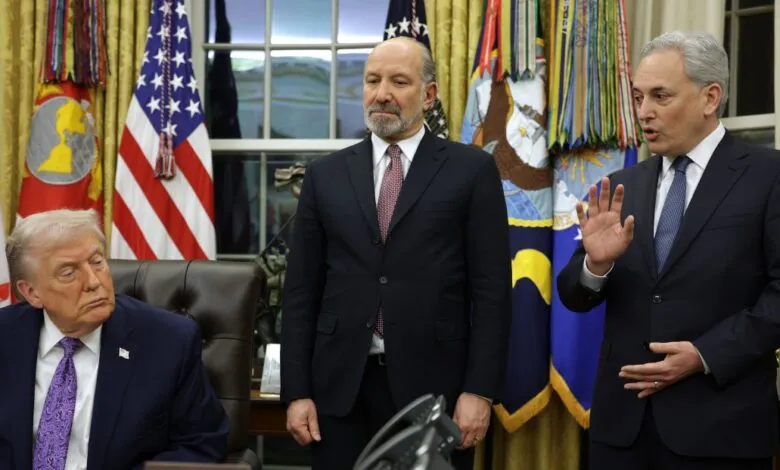
– President Trump signed an executive order aiming to establish federal control over AI regulation and reduce the influence of state laws.
– The order directs the creation of an “AI Litigation Task Force” to sue states over AI laws deemed inconsistent with national AI dominance goals.
– It instructs federal agencies to issue policies and reports that could preempt state laws and potentially withhold funding, like rural broadband grants.
– The order contains a vague carveout, stating it does not propose preempting certain state laws on topics like child safety or government AI use.
– This approach, controversial for concentrating power and bypassing Congress, follows failed legislative attempts to impose a moratorium on state AI laws.
In a significant move to centralize control over artificial intelligence policy, the federal government has taken steps to challenge the growing patchwork of state-level regulations. A new executive order signed by former President Donald Trump seeks to establish federal primacy in AI governance, directing multiple agencies to work toward minimizing the impact of existing state laws and discouraging the passage of new ones. While the order cannot automatically invalidate state statutes, it employs a strategy of leveraging federal authority and funding to pressure states into alignment with a national framework focused on maintaining U.S. competitiveness.
The order explicitly targets Colorado’s recently enacted consumer protection law, arguing that provisions aimed at preventing algorithmic discrimination could compel AI models to generate inaccurate outputs to avoid any differential impact on protected groups. This critique forms part of a broader argument that disparate state laws create an untenable environment for innovation. The directive mandates the formation of an AI Litigation Task Force, led by the Attorney General, with the express purpose of initiating lawsuits against states whose AI regulations are deemed inconsistent with the goal of sustaining U.S. dominance through a “minimally burdensome” national policy.
Federal agencies receive specific instructions to advance this goal. The Federal Trade Commission (FTC) is directed to clarify when state laws requiring alterations to AI model outputs are preempted by federal prohibitions on deceptive commerce. Furthermore, the Commerce Secretary has 90 days to identify states with conflicting laws and assess their eligibility for critical rural broadband funding from the Broadband Equity Access and Deployment program. Simultaneously, the FCC Chairman is tasked with developing a federal reporting standard for AI models designed to override any conflicting state requirements.
A notable, though ambiguous, exception exists within the order. It states that its recommendations are not intended to preempt otherwise lawful State AI laws concerning child safety, AI compute infrastructure, state government use of AI, and other undetermined topics. This carveout leaves considerable room for interpretation and future administrative action.
This federal push comes amid a surge of legislative activity at the state level, with numerous bills introduced and laws passed in the past year alone to establish guardrails around AI development and deployment. The tech industry has consistently argued that this regulatory patchwork stifles operation and innovation. The conventional solution would be comprehensive federal legislation from Congress, which would naturally preempt conflicting state laws under the Constitution’s Supremacy Clause.
Congressional efforts to impose a moratorium on state AI laws, however, have repeatedly stalled. These failed attempts, embedded in larger legislative packages, highlighted a political impasse. The executive order represents an alternative, and more contentious, pathway. Rather than establishing federal guardrails, the approach focuses on penalizing states that enact regulations the administration views as “onerous” or contradictory to its objectives.
Policy analysts observed that the development of this strategy appeared to concentrate significant influence with White House AI and Crypto czar David Sacks, a venture capitalist serving as a key liaison between the administration and Silicon Valley. His role in shaping policy has reportedly sidelined traditional federal agencies and, at times, led to presidential statements on AI and related tech issues that have alarmed some of Trump’s core political supporters. The former president has publicly championed the order’s intent, asserting on social media that it creates “only One Rulebook” to prevent AI from being destroyed “in its infancy” by dealing with fifty different state regulatory regimes.
(Source: The Verge)