Rivian’s Bold Autonomy Plan: Custom Chips, Lidar, Robotaxi Vision
▼ Summary
– Rivian announced plans for advanced vehicle autonomy, including new hardware like lidar and a custom 5nm chip, and hinted at a future entry into the self-driving ride-hail market.
– The company will launch “Universal Hands-Free” driver-assistance software in early 2026, expanding hands-free access to over 3.5 million miles of roads in the USA and Canada for a one-time fee or monthly subscription.
– Rivian outlined a progression from point-to-point navigation to allowing drivers to take their eyes off the road, with an ultimate goal of achieving “personal L4” autonomy where no human intervention is needed.
– A new third-generation autonomy computer (ACM3) and a lidar sensor will be introduced in late 2026, starting with the R2 SUV, to provide enhanced sensing and processing capabilities.
– While initial R2 SUVs shipping in early 2026 won’t have the new hardware, Rivian aims to continuously improve autonomy in its vehicles, stating the new hardware will enable a much higher performance ceiling.
Rivian has unveiled a comprehensive roadmap for bringing advanced autonomous driving capabilities to its electric vehicles, signaling a major push into the competitive self-driving technology arena. During its inaugural “Autonomy & AI Day” in Palo Alto, CEO RJ Scaringe detailed plans involving new custom hardware, sophisticated software, and a long-term vision that includes entering the robotaxi market. This public showcase aims to reassure investors that the automaker is not just keeping pace with rivals like Tesla and GM but is positioning itself as a leader in next-generation mobility.
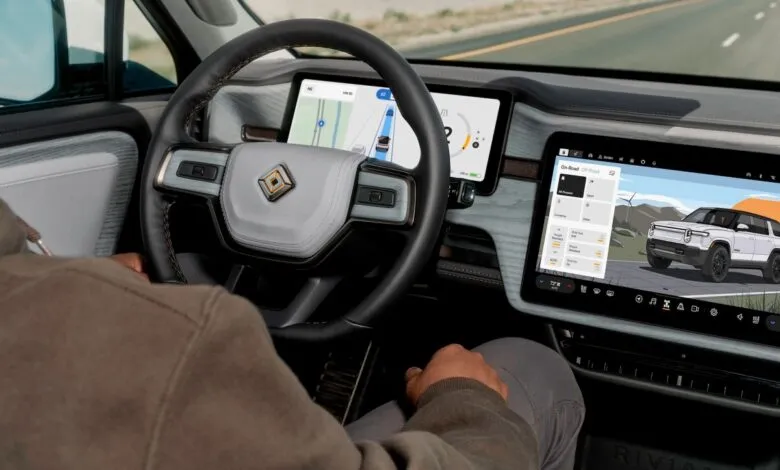
A cornerstone of the announcement is the expansion of its driver-assistance system. Dubbed “Universal Hands-Free,” the enhanced software is slated for an early 2026 launch. It promises to allow hands-free operation on over 3.5 million miles of roads across the United States and Canada, eventually including surface streets beyond just highways. For Rivian’s second-generation R1 vehicles, this will enable point-to-point navigation where the vehicle handles the entire journey. The company plans to offer this capability for a one-time fee of $2,500 or a monthly subscription of $49.99.
Scaringe emphasized the transformative potential of this technology, stating it will give drivers their time back, allowing them to engage in other activities without needing to monitor the road. The development path doesn’t stop there. Rivian outlined a clear trajectory toward what it calls “personal L4” autonomy, a level where the vehicle can operate without any human intervention in specific areas. Furthermore, Scaringe hinted at future ambitions in the rideshare space, suggesting Rivian could eventually compete with companies like Waymo.
To turn this vision into reality, Rivian is developing a multifaceted technological foundation. A key component is a “large driving model,” an AI system analogous to a large language model but trained for real-world driving scenarios. This represents a shift from rigid, rules-based programming to a more adaptive, learning-based approach. Powering this AI will be Rivian’s own custom-designed, 5-nanometer processor, developed in collaboration with Arm and TSMC.
This custom silicon is the heart of Rivian’s third-generation “autonomy computer” (ACM3), a system capable of processing a staggering five billion pixels per second. For enhanced perception, Rivian will integrate a lidar sensor at the top of the windshield, working in tandem with the ACM3 to create a detailed three-dimensional map of the vehicle’s surroundings. Company executives believe this sensor fusion provides “superhuman level” perception and is critical for safely handling unpredictable driving situations.
Senior vice president of electrical hardware Vidya Rajagopalan claimed that by late 2026, this combination of sensors and computing power will be the most powerful in any consumer vehicle in North America. It is destined for the mass-market R2 SUV, though initial shipments of that model in early 2026 will not include the new hardware. Rivian has committed to continuously upgrading the autonomy features in both its Gen 2 R1 vehicles and future R2 models.
While the company believes its current vehicles can achieve significant autonomy without the new suite, Scaringe confirmed that the upcoming hardware will enable a “much higher ceiling” for performance. By investing in custom chips, lidar, and advanced AI, Rivian is making a bold statement about its future, aiming to redefine what personal transportation and eventually, shared mobility, can be.
(Source: TechCrunch)