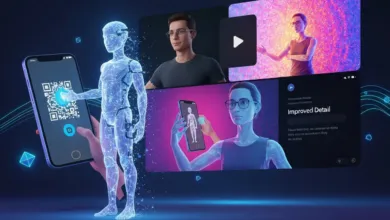
Google Vids adds AI avatar prompts for video creation
▼ Summary
– Google’s Vids app now allows users to direct AI avatars in scenes using natural language prompts, such as having them interact with objects.
– Users can customize avatar appearances, clothing, and backgrounds through text prompts based on their video’s theme.
– The app integrates the Veo 3.1 video-generation model to create eight-second clips and offers free monthly generations, with higher limits for premium accounts.
– Finished videos can be exported directly to YouTube as private uploads, simplifying the publishing process.
– A new Chrome extension for screen recording with audio or video has been added to the Vids tool suite.
Google has introduced a significant set of new capabilities for its Vids video editor, enhancing its AI-powered toolkit for creators. The latest update enables users to direct and customize AI avatars using simple text prompts, integrates the advanced Veo 3.1 video-generation model, adds a direct export path to YouTube, and includes a new screen-recording Chrome extension. These features collectively aim to streamline the professional video creation process directly within the Google Workspace ecosystem.
A central upgrade is the new avatar direction capability. Users can now employ natural language prompts to instruct avatars to perform specific actions within a scene, such as interacting with a product or a piece of equipment. Google emphasizes that the tool maintains character consistency across these dynamic outputs. Further personalization is possible, allowing creators to adjust an avatar’s appearance, change its apparel, and generate new backgrounds, all tailored to the video’s theme.
This follows last month’s integration of the Lyria 3 and Lyria 3 Pro models for adding music and sound effects. Now, the powerful Veo 3.1 video-generation model is being incorporated, capable of creating eight-second video clips directly inside the editing interface. All users receive 10 free Veo generations per month, while subscribers on the Google AI Ultra and Workspace AI Ultra tiers have a much higher allowance of up to 1,000 videos monthly.
To simplify publishing, Google Vids now supports direct export to YouTube. This feature removes the intermediate step of downloading a file and manually uploading it to a channel. All videos sent to YouTube are set to private by default, giving creators a chance to review the content before making it public.
The update also expands the toolset with a dedicated screen-recording Chrome extension. This addition lets users capture their screen with accompanying audio or video narration, integrating that footage seamlessly into their Vids projects.
Since its initial unveiling in 2024 for enterprise users, Google has steadily enhanced Vids with new functionality. The platform expanded to consumers last year with the introduction of AI avatars. Earlier this year, it added 2D and 3D cartoon-style avatars and broadened voice-over language support to include French, German, Italian, Korean, Portuguese, Spanish, and Japanese. In a competitive landscape, Google Vids now positions itself against other AI video creation platforms like Synthesia, HeyGen, D-ID, and Lemon Slice.
(Source: TechCrunch)