Aurora to Deploy Hundreds of Driverless Trucks by 2026
▼ Summary
– Aurora, an autonomous trucking company, delayed its commercial driverless launch to 2025 and temporarily reinstated safety drivers at a manufacturer’s request, though its CEO insists this is for optics, not a technological setback.
– The industry has faced delays and failures, with some competitors going out of business, as automating highway trucking is more complex than assumed due to high speeds and dangerous anomalies requiring powerful sensors.
– Aurora currently operates a small fleet of fully autonomous trucks on Texas routes, highlighting an efficiency advantage as they are not subject to human drivers’ legal hour limits and can run up to 20 hours a day.
– The company faces opposition from truck driver unions concerned about job losses, but its CEO argues the job is dangerous and that autonomous trucks will improve road safety for everyone.
– Aurora reports strong operational performance and financial runway, with plans to scale to hundreds of trucks by 2026 using next-generation hardware, though future funding and regulation remain uncertain.
The road to autonomous trucking is paved with both significant milestones and necessary adjustments. Aurora Innovation, the Pittsburgh-based company founded by self-driving veteran Chris Urmson, is charting a course to deploy hundreds of driverless trucks by the end of 2026. This ambitious scaling plan follows a year of operational progress mixed with strategic delays. While the company initially targeted a 2024 commercial launch, it rescheduled for April 2025. Shortly after that announcement, Aurora temporarily reintroduced safety drivers into its cabs at the request of its vehicle manufacturing partner. Urmson frames this decision as one of perception rather than a step backward in technology, asserting it does not impact the core operational timeline.
The path for self-driving trucks has proven more complex than many early predictions suggested. Although highways appear less chaotic than city streets, they present unique challenges. The high-speed environment demands exceptionally powerful sensors and robust systems capable of handling rare but severe anomalies. Urmson, who previously led Google’s self-driving project, notes that the assumption trucks would be easier to automate than passenger cars was flawed. Incidents like a tire blowout at seventy miles per hour require immediate, safe resolution without simply stopping in a traffic lane. Companies like Embark Trucks and TuSimple have shuttered, while others scaled back as timelines extended and investment capital became scarce. Public trust has also wavered due to high-profile setbacks from other players in the autonomous vehicle sector.
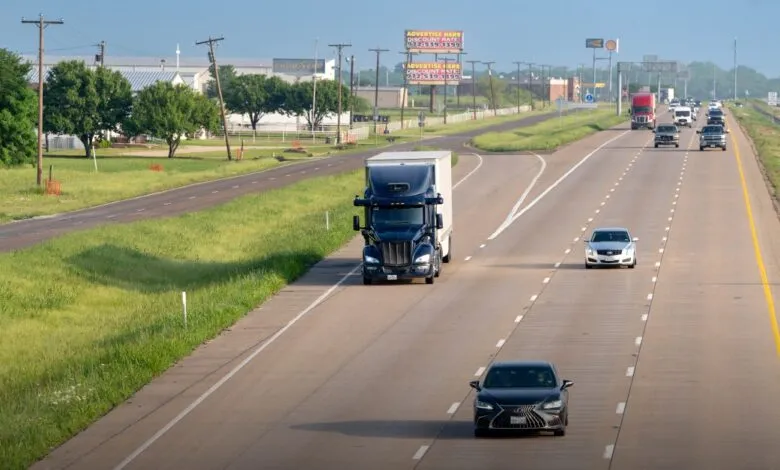
Aurora’s strategy emphasizes a measured, safety-first approach to commercialization. The company currently operates two distinct fleets. Its driverless fleet, with fully validated hardware and software, runs autonomously on routes like Dallas to Houston. A separate development fleet continues testing with safety drivers onboard. A recent expansion to a over 600-mile route between Fort Worth and El Paso highlights the technology’s potential. A human driver would need at least nine hours for that trip, bumping against federal limits of eleven hours of driving within a fourteen-hour window. An autonomous truck faces no such biological constraints, enabling it to operate for up to twenty hours daily, a capability Aurora will utilize in a new contract hauling fracking sand.
This efficiency, however, fuels opposition from labor groups. Truck driver unions, notably the Teamsters, argue autonomous vehicles threaten millions of working-class jobs and have lobbied for bans in states like California. Urmson acknowledges these concerns but questions the nature of the jobs being defended. He points out that professional truck drivers face a fatality rate ten times the national average for workers, alongside prevalent health and substance abuse issues linked to the job’s demanding nature. He believes the occupation isn’t facing immediate obsolescence, suggesting drivers will be able to retire in their roles, but that automation could improve overall road safety. He cites an instance where an Aurora truck autonomously swerved to avoid a police officer who had stepped into traffic, potentially saving a life.
On the business front, Aurora reports reaching 100,000 driverless miles with perfect on-time performance for clients like Uber Freight and Hirschbach Motor Lines. Financially, the company holds approximately $1.6 billion, which Urmson states provides a runway into the latter half of 2027. Further fundraising will be necessary, and the regulatory landscape remains uncertain. Despite these factors, Urmson projects thousands of Aurora trucks on the road within the coming years. The rollout of next-generation hardware in 2026, featuring sensors with double the current range, is expected to reduce costs and accelerate production. While the public may not see this expansion as viscerally as a robotaxi fleet, its impact on freight logistics could soon become unmistakable.
(Source: The Verge)