Gemini 3: The New AI Challenger Outshining ChatGPT
▼ Summary
– Gemini 3 is praised for being faster, smarter, and more adept at specialized tasks like coding and multimodality than its predecessors and rival AIs.
– Tech leaders, including Salesforce and Stripe CEOs, are impressed with Gemini 3’s reasoning, speed, and capabilities, with some switching from ChatGPT.
– Despite ChatGPT’s popularity with over 800 million weekly users, Gemini is catching up with around 650 million monthly users and strong performance on benchmarks.
– Gemini 3’s success is attributed to better usability, coherent conversations, and reduced errors, reflecting a shift toward practical, user-centric AI design.
– The AI supremacy battle is ongoing, with Gemini seen as the biggest threat to ChatGPT, but OpenAI may have a revolutionary new version in development.
The race for AI dominance is intensifying, with Google’s Gemini 3 emerging as a formidable challenger to the established leader, ChatGPT. This new model is generating significant buzz for its impressive speed, advanced reasoning capabilities, and superior performance in specialized tasks like coding. Tech executives and industry leaders are quickly taking notice, with some even publicly switching their allegiance from ChatGPT to Google’s latest offering.
Released recently, Gemini 3 is being celebrated not just for its raw power but for its refined behavior and practical usability. It demonstrates a strong ability to handle multimodal content, seamlessly working with text, images, audio, video, and code. Furthermore, its performance on benchmarks designed to test Ph.D.-level reasoning is turning heads, achieving top scores that surpass many competing models from companies like Anthropic and Meta. The basic version is freely available to all users through various Google services, while a more advanced Pro tier is offered to subscribers.
The model’s debut has captured the attention of prominent figures in the technology sector. Salesforce CEO Marc Benioff announced on social media that after a two-hour session with Gemini 3, he was abandoning his three-year daily habit of using ChatGPT, citing a dramatic leap in reasoning, speed, and multimedia handling. Former Tesla AI director Andrej Karpathy praised its personality and coding skills, calling it a “very solid daily driver.” Even OpenAI’s CEO, Sam Altman, acknowledged Gemini 3 as a “great model,” adding to the chorus of positive early impressions.
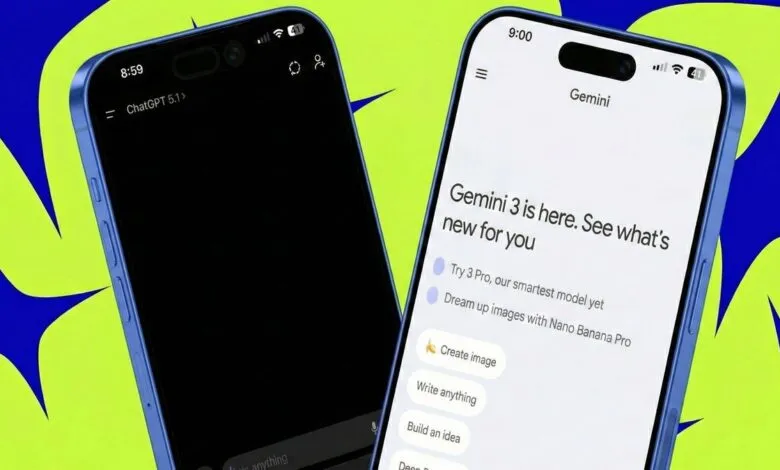
While ChatGPT remains the most widely used AI application globally, boasting hundreds of millions of weekly active users, Gemini is rapidly gaining ground in both popularity and performance. It currently holds the position of the second most popular free iPhone app. More importantly, industry analysis suggests that Gemini 3’s success stems from a focus on user-centric design and reliable interaction. The model is reported to maintain more coherent conversations with fewer errors, making it more practical for everyday and business applications. This represents a shift in AI development priorities toward creating tools that people can use effectively and depend on.
Financial commentators have noted the significant threat Gemini poses to OpenAI’s flagship product. One prominent media personality described Gemini as the most substantial challenge ChatGPT has yet faced, suggesting its success is “existential” for OpenAI. The competitive pressure is now immense for both companies to continue innovating.
Despite the current wave of acclaim for Google’s AI, the contest is far from decided. The expectation within the industry is that OpenAI is likely developing a revolutionary new version of its own product to counter this advance. For Google to maintain its momentum, it must continue refining Gemini and preparing its next iteration. The battle for AI supremacy is ongoing, and the arrival of Gemini 3 has undoubtedly made it more compelling.
(Source: ZDNET)