Gemini 3 Launches & Adobe Acquires Semrush: SEO News

▼ Summary
– Google integrated Gemini 3 Pro into AI Mode in Search at launch, expanding dynamic, tool-based responses beyond static text.
– Search Console introduced custom annotations for performance reports, allowing users to mark dates with notes on site changes or events.
– Adobe announced a $1.9 billion acquisition of Semrush, integrating SEO tools into Adobe’s Digital Experience business.
– Google added a branded queries filter in Search Console, using AI to automatically separate branded and non-branded search traffic.
– These updates focus on improving visibility and analysis of AI search impacts, helping SEOs track changes and understand traffic patterns.
This week’s developments in search and digital marketing signal significant shifts in how content is discovered and analyzed. Major announcements from Google and Adobe are reshaping the tools and strategies SEO professionals rely on, directly impacting how we understand user behavior and measure success.
Google has integrated its new Gemini 3 Pro model directly into the AI Mode within Search on the very day of its launch. This marks the first instance of a fresh Gemini model being deployed to Search immediately. For U.S.-based subscribers of Google AI Pro and Ultra, the model is accessible now by selecting the “Thinking” option from the model dropdown. The company intends to broaden availability to all users in the United States shortly, with paying customers enjoying more generous usage allowances. The model is also live within the Gemini app, AI Studio, Vertex AI, and the Antigravity platform. It introduces novel generative user interface layouts and a more assertive query fan-out approach, with an automatic model selection feature on the horizon to direct complicated inquiries to Gemini 3.
For search specialists, this evolution is critical. Gemini 3 steers AI Mode away from simple text answers and toward interactive, tool-based replies. The system can now determine when to present calculators, simulations, or comparison tables directly in response to a search, altering click-through patterns even when your website’s information forms the foundation of the response. This represents a move toward a more integrated, multi-media search results page where AI becomes the standard experience.
Separately, Google has rolled out custom annotations for its Search Console performance reports. This functionality allows you to attach explanatory notes directly onto traffic graphs, pinpointing specific dates to clarify site modifications or external occurrences. By right-clicking any date on a performance chart and choosing “Add annotation,” you can leave a note of up to 120 characters. These notes are visible to all users with property access, with a cap of 200 annotations per property, and entries older than 500 days are purged automatically.
This addresses a long-standing frustration for SEOs. Previously, correlating a site adjustment with a traffic fluctuation required piecing together information from project management tools or chat histories. Now, that context lives directly on the chart, providing a visual link between actions and outcomes. For collaborative teams, this shared perspective simplifies diagnosing the reasons behind traffic changes without needing to investigate who implemented what and when.
In a landmark business move, Adobe has entered into a definitive agreement to purchase Semrush in an all-cash deal valued at roughly $1.9 billion. The acquisition price of $12.00 per share represents a substantial premium, leading to a sharp increase in Semrush’s stock value following the news. The transaction has received approval from both companies’ boards and is expected to finalize in the first half of 2026, subject to regulatory and shareholder consent. Semrush is slated to become part of Adobe’s Digital Experience division.
This consolidation highlights a broader trend where essential SEO and visibility tools are being absorbed into large-scale enterprise platforms. Semrush’s recent expansion into tracking brand presence across AI assistants aligns well with Adobe’s overarching strategy for cross-channel experience management and analytics. For those dependent on Semrush, this likely signals a future of deeper integration with Adobe’s product ecosystem, which could be advantageous for teams already using Adobe tools but may alter the value proposition for others. The deal underscores that the true worth of search visibility lies in understanding the subsequent user actions, making the combination of SEO data and robust analytics a powerful asset.
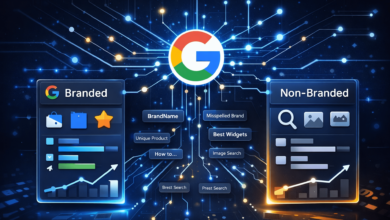
Google has also introduced a branded queries filter within the Search Console Performance report. This feature automatically distinguishes between branded and non-branded search traffic. Accessible under the “Filter by query” section, it functions across all search categories. A new Insights report card visually displays the click distribution between these two query types. The classification is powered by an AI system that identifies brand names, including common misspellings, variations, and references to unique products or services. The filter is being gradually released to top-level properties that have sufficient query volume.
This segmentation is invaluable for SEO analysis. Non-branded searches represent your discovery channel, indicating how well you attract new visitors. Branded searches reflect direct demand for your name. With this filter, you can easily measure the impact of your SEO campaigns on each segment, clarifying whether growth stems from expanded reach, heightened brand recognition, or a combination of both. It’s important to note that this is a reporting enhancement and does not influence search rankings, though the AI-driven classification may occasionally mislabel a query due to the nuanced nature of brand recognition.
A common thread connects these updates: the drive to make AI-influenced search more transparent and interpretable. The advancements with Gemini 3, coupled with new reporting tools in Search Console and the strategic Adobe-Semrush acquisition, all contribute to a clearer narrative. They help professionals articulate where a brand appears in AI-driven experiences, how that visibility evolves, and how to convert these patterns into meaningful business metrics.
(Source: Search Engine Journal)