Sam Altman Celebrates ChatGPT’s New Em Dash Formatting
▼ Summary
– Em dashes have become a perceived indicator of AI-generated text due to their frequent overuse in ChatGPT and other AI chatbot outputs.
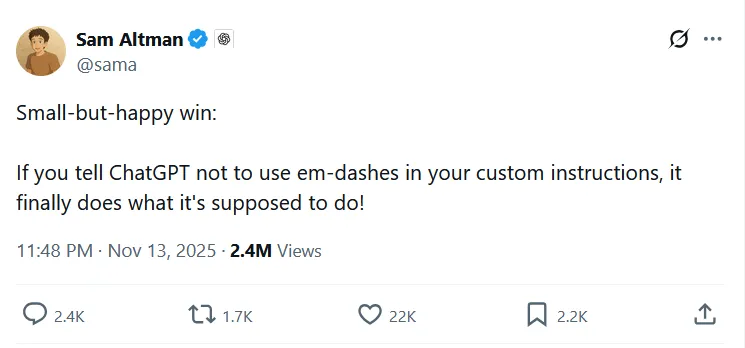
– OpenAI CEO Sam Altman announced that ChatGPT now follows custom instructions to avoid using em dashes, calling it a “small-but-happy win.”
– This improvement came two days after OpenAI’s GPT-5.1 release and follows years of user struggles with getting the chatbot to adhere to formatting preferences.
– The difficulty in controlling simple punctuation use raises questions about how far artificial general intelligence (AGI) is from being achieved.
– Critics on social media noted that OpenAI’s slow progress on this basic issue suggests limited control and understanding of the AI’s inner workings.
For years, the em dash has served as a subtle fingerprint of AI-generated writing, frequently appearing in outputs from ChatGPT and similar language models. Many readers feel they can spot machine-written text simply by noting an overabundance of this punctuation mark, though human writers certainly overuse it as well. Recently, OpenAI CEO Sam Altman shared what he called a “small-but-happy win” on social media: ChatGPT now properly follows user instructions to avoid inserting em dashes. His announcement arrived just two days after OpenAI rolled out its latest GPT-5.1 model, sparking a range of reactions from long-time users.
While some celebrated the improvement, others pointed out that it took three years for OpenAI to address this basic formatting issue. One user commented that the delay reflects how little control the company may actually have over the AI’s behavior, raising concerns about its readiness for more complex tasks. This seemingly minor punctuation update has ignited a broader conversation about the gap between today’s AI capabilities and the futuristic vision of artificial general intelligence (AGI). Altman often discusses AGI, superintelligence, and what he calls “magic intelligence in the sky” while fundraising and promoting OpenAI’s long-term goals. Yet the struggle to consistently manage something as elementary as punctuation suggests that truly reliable, human-like artificial intelligence remains a distant objective.
(Source: Ars Technica)