Grammarly Rebrands as Superhuman
▼ Summary
– Grammarly has rebranded as Superhuman, integrating with Coda, Superhuman Mail, and a new AI assistant called Superhuman Go under this new identity.
– The Superhuman suite is available starting today for paid Grammarly Pro subscribers, with Superhuman Go included at no extra cost until February 1st, 2026.
– Superhuman is shifting focus from a standalone writing tool to an AI-powered work platform that operates across browser tabs and connects to over 100 apps for contextual assistance.
– The rebranding was planned since late last year, following Grammarly’s acquisitions of Coda and Superhuman Mail, and is not just a result of the recent acquisition.
– Superhuman Go expands on Grammarly’s capabilities by offering broader task support beyond writing, accessible through a familiar sidebar interface and an AI Agent Store.
The popular AI writing assistant Grammarly has officially joined forces with other productivity tools under the new Superhuman brand. This rebrand brings together Grammarly, Coda, Superhuman Mail, and a new AI helper named Superhuman Go into a single, integrated suite. Starting immediately, anyone with a paid Grammarly Pro subscription gains access to the complete Superhuman platform. Subscribers can use Superhuman Go at no additional charge until February 1st, 2026, though the company has not yet announced what it will cost after that introductory period.
Grammarly is adopting the Superhuman name from the AI email application Superhuman Mail, which the company purchased in June. This move follows Grammarly’s earlier acquisition of the collaborative workspace app Coda in December 2024. All these services now operate collectively under the Superhuman identity, a change even reflected in an updated logo that signals the company’s evolution into a broader productivity AI brand.
While the familiar Grammarly writing tool remains available, it is now positioned as just one component within the larger Superhuman ecosystem. Noam Lovinsky, Chief Product Officer at Superhuman, addressed the transition, stating, “It’s a really complicated and frankly scary thing. But the reality is, the Grammarly brand isn’t going anywhere.” He emphasized that the rebranding initiative was not a sudden reaction to the recent Superhuman Mail acquisition. In fact, planning for this strategic shift began late last year, around the time the Coda acquisition was finalized.
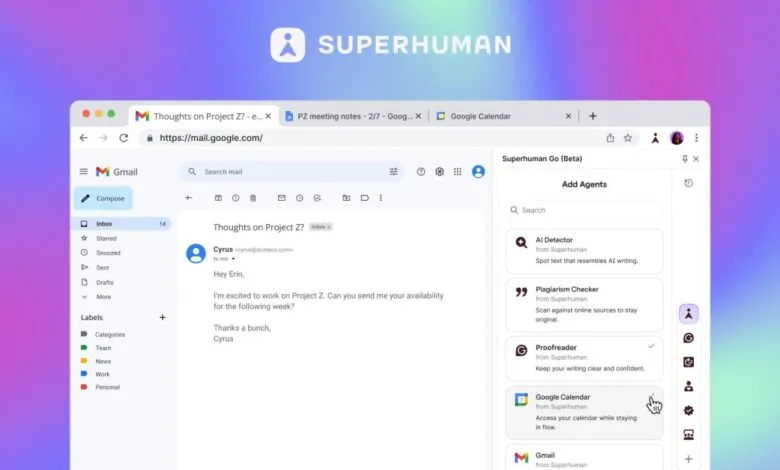
Following the rebrand, the core Grammarly writing assistant continues to function, but its role is secondary as Superhuman pivots toward delivering a comprehensive, AI agent-driven work platform. This new system is designed to operate across every browser tab, using contextual awareness to provide intelligent, useful suggestions. A company demonstration highlights its ability to connect with more than 100 different applications. For example, it can automatically schedule meetings by checking your Google Calendar availability or help refine a sales pitch by pulling relevant details from a connected database.
Users of Grammarly will find the interface for Superhuman Go quite familiar. It features a sidebar for reviewing suggestions, entering prompts, and accessing various specialized AI agents. Grammarly itself now functions as one of these agents within the platform. The new Superhuman Agent Store offers additional AI helpers tailored for specific applications like Google Workspace and Microsoft Outlook, expanding the tool’s utility far beyond simple grammar and style corrections.
Superhuman is strategically moving away from its original, narrower focus on writing assistance. Instead, the platform’s primary value proposition is its deep integration with other apps and web browsers. At the heart of this new offering is the Superhuman Go AI assistant. This tool is essentially an upgraded and more feature-rich version of Grammarly’s existing generative AI helper. Lovinsky explained the significant expansion in capability, noting, “The tasks that Superhuman Go is capable of helping me with are just far, far greater and much broader than what the original Grammarly Go product was able to do, because it was mainly focused on the writing use cases.”
(Source: The Verge)