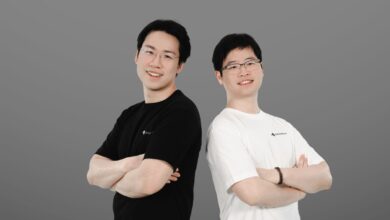
Ex-OpenAI, Google Brain Team Raises $300M for AI Startup

▼ Summary
– Periodic Labs emerged from stealth with a $300 million seed round led by Felicis, founded by OpenAI researcher Liam Fedus and former Google Brain scientist Ekin Dogus Cubuk.
– The startup aims to automate material science by integrating reliable robotic arms for synthesis, efficient machine learning simulations, and LLMs with advanced reasoning capabilities.
– Periodic Labs is initially focused on discovering new superconductor materials, leveraging a team of AI and scientific experts and generating valuable data even from failed experiments.
– Felicis secured the investment after a pitch walk with Fedus, despite initial interest from many VCs and a mistaken belief that OpenAI would invest.
– The company has already set up its lab and begun testing predictions, though the robotic components are not yet operational and require training.
A new venture named Periodic Labs, founded by former OpenAI researcher Liam Fedus and ex-Google Brain scientist Ekin Dogus Cubuk, has secured a massive $300 million seed investment to pioneer AI-driven material science. The funding round was spearheaded by Felicis Ventures and attracted a host of prominent angel investors and venture capital firms. This substantial financial backing underscores the immense confidence in their vision to transform scientific research through artificial intelligence.
The concept for Periodic Labs emerged from a conversation between Fedus and Cubuk roughly seven months ago. Cubuk, a leading figure in machine learning and material science at Google Brain, joined forces with Fedus, a key architect behind ChatGPT who led OpenAI’s post-training team. They observed that several technological pieces had finally fallen into place, making their ambitious project feasible. Cubuk pointed to three critical developments: the proven reliability of robotic arms for powder synthesis, the enhanced accuracy of machine learning simulations for modeling physical systems, and the advanced reasoning capabilities of large language models, partly thanks to Fedus’s work.
Integrating these technologies creates a powerful workflow. Simulations can propose new compounds, robots can physically mix the materials, and LLMs can analyze experimental outcomes and recommend adjustments. This闭环 represents the foundation for fully automated material science. Cubuk’s previous research at Google, which involved a robotic lab that created 41 novel compounds from AI-generated recipes, served as a direct precursor to this endeavor.
The founders also recognized a fundamental shift in the scientific process. Even experiments that fail generate invaluable data, which serves as the essential fuel for training and refining AI models. This approach challenges the traditional scientific incentive structure, which often prioritizes successful outcomes for publications and grants over the exploratory process itself. Fedus described bringing experiments into the AI loop as “the next frontier.”
After deciding to move forward, Fedus informed OpenAI of his resignation and plans. A public tweet suggested a potential ongoing partnership and investment from his former employer, but this did not come to pass. OpenAI is not a financial backer of Periodic Labs. Despite this, Fedus’s announcement triggered intense interest from the venture capital community, with some investors going so far as to write “love letters” to the startup in a bid to secure a stake.
The first serious conversation, however, was with Peter Deng, a former OpenAI colleague who had recently become an investor at Felicis. During a walk through San Francisco’s Noe Valley neighborhood, Fedus articulated the core philosophy of their venture: to do real science, AI must be given the tools to conduct experiments in the physical world. This vision resonated deeply with Deng, who committed to an investment on the spot. The enthusiasm was so immediate that Deng returned to his office ready to fund a company that, at that moment, lacked even a formal name or bank account.
With the $300 million secured, Periodic Labs has assembled an all-star team of researchers and scientists, including creators of advanced AI models and experts who have made significant discoveries in superconductors. To foster deep collaboration, the team holds weekly graduate-level lectures, ensuring every member understands the interdisciplinary nature of their work.
The company has already established its laboratory and is actively working with experimental data and simulations. Its primary initial mission is the discovery of new superconducting materials, a breakthrough that could enable a new generation of powerful, energy-efficient technologies. While the robotic systems are not yet fully operational and will require training, the foundational work is underway.
This venture is undoubtedly a high-risk, high-reward endeavor. Scientific discovery remains inherently unpredictable, even with AI acceleration. The team is optimistic, believing they are well-positioned to make significant findings or, at the very least, generate a wealth of useful data from their efforts. The competitive landscape is also heating up, with OpenAI itself announcing a new science-focused unit.
The final list of seed investors includes Andreessen Horowitz, DST, NVentures, Accel, and individual backers like Jeff Bezos and Eric Schmidt. The investor who penned the heartfelt letter, while flattering, did not ultimately participate in the landmark funding round.
(Source: TechCrunch)