Build Better Martech Stacks with Capabilities, Not Tools
▼ Summary
– AI and SaaS are not competitors but complementary technologies that work together on the same continuum of business capabilities.
– The real shift in stack management is moving from viewing tools as a collection to managing them as a portfolio of capabilities.
– AI is adaptive and probabilistic, excelling at augmentation for specific tasks rather than fully replacing systems or humans.
– SaaS provides reliability and predictability through rule-based systems, forming a solid foundation for business operations.
– Effective stack management focuses on capabilities—the ability to accomplish tasks—regardless of whether they come from SaaS, AI, workflows, or human skills.
Building a future-proof marketing technology stack requires a fundamental shift in perspective. Instead of focusing on the tools themselves, the most successful organizations manage their stack as a dynamic portfolio of capabilities. This approach moves beyond the tired debate of whether AI will replace SaaS, recognizing that both technologies serve to enhance a company’s ability to execute and adapt. The true value lies not in the software category, but in the reliable outcomes it produces.
Artificial intelligence introduces a new technological class built on large language models, differing from the predictable, rule-based architecture of traditional SaaS. Its strength is not in full replacement but in augmentation, enhancing human and system performance. AI agents deliver their most reliable results when designed for specific, well-defined tasks. Platforms now offer templates for granular jobs like personalized newsletter automation, lead data cleansing, and behavior-triggered outreach sequencing.
While SaaS operates on predictable, rule-based systems, it shares a common truth with AI: the value has never been in the entire tool. Industry research consistently shows that teams derive most of their value from a small subset of a product’s features. This reality has fueled a landscape of specialized applications, a long tail of solutions that operate like interchangeable Lego blocks. The trend accelerates as AI embeds into more niche offerings, making composability the daily reality of modern stack management.
Choosing between AI and SaaS is less about competition and more about understanding their complementary strengths. SaaS provides the reliable, predictable foundation, the steady backbone of operations for functions like CRM and billing. AI, being probabilistic, offers flexibility and creative augmentation, though it often requires a human in the loop to ensure accuracy. They work in concert, not in opposition.
This convergence forms a fluid fabric where platforms, AI agents, workflows, and human skills interweave. Within this system, capability management becomes the true currency of the stack. A capability is simply the ability to accomplish a specific task, regardless of whether it’s powered by a SaaS feature, an AI agent, or human skill. What matters is that it exists, is reliable, and integrates seamlessly.
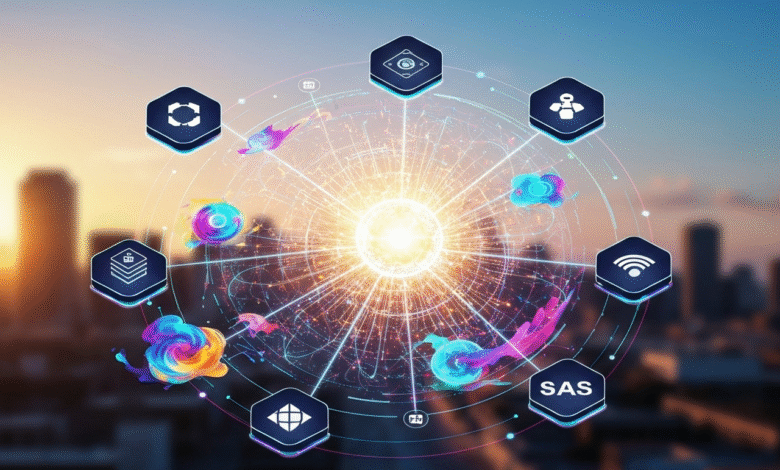
Leaders must abandon the “shopping list” mentality that leads to tool sprawl. Viewing a stack as a collection of app containers is outdated. A more effective metaphor is a solar system, with core platforms as the center of gravity and specialized apps, AI agents, and human skills orbiting around them. Each organization assembles a unique mix of these capabilities, shaped by its industry, business model, and size. There is no universal template.
The strategic advantage now comes from how these capabilities connect and perform together. A martech stack is a living system powered by SaaS, AI, workflows, and human expertise, each serving a distinct purpose. Success is not measured by the number of tools acquired, but by how effectively they work in unison to drive tangible business outcomes. The companies that lead will be those that treat capability management as a core strategic priority, continuously adapting their ecosystem to meet evolving market demands.
(Source: MarTech)