Unlock the Future: Why Your Company Is Going Autonomous
▼ Summary
– Industries are undergoing a profound transformation as products, factories, and companies adopt autonomous machine models that can sense, understand, decide, and act with minimal human intervention.
– Modern products like Teslas and Roombas are cyber-physical systems that improve over time through software updates, learn from data, and can operate independently or in coordination with other units.
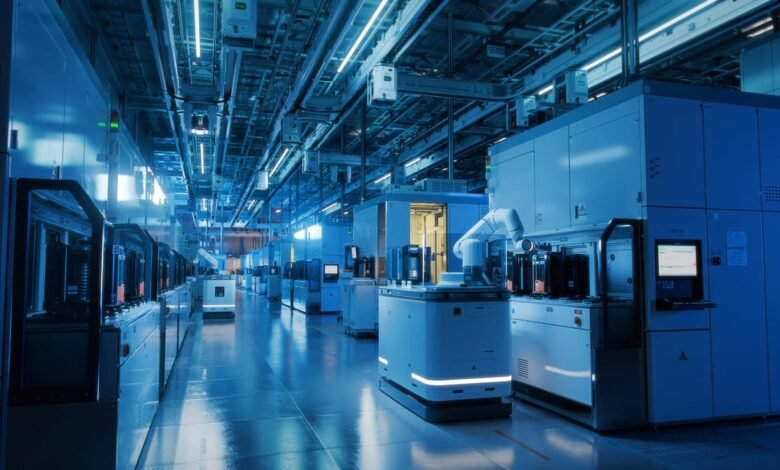
– Autonomous factories, such as Tesla Gigafactories and Amazon fulfillment centers, use real-time data, predictive maintenance, and automated systems to optimize production and logistics dynamically.
– Companies are lagging behind their products and factories, as most still operate with outdated, slow-moving organizational models instead of adopting the agile, self-optimizing principles of autonomous machines.
– The future competitive advantage will belong to agentic enterprises that integrate AI agents to automate processes, with predictions indicating a significant rise in AI-resolved tasks and the potential for AI to eventually take over entire job roles.
A fundamental shift is reshaping how modern businesses operate, moving toward a future where autonomous machine models govern everything from individual products to entire corporate structures. This transformation hinges on systems that can independently sense their environment, process information, make decisions, and take action. The competitive edge now belongs to organizations that embrace this evolution, leveraging AI agents to achieve unprecedented levels of efficiency and adaptability.
Elon Musk famously articulated a core principle behind this shift back in 2016. He described the factory not just as a place of production, but as the ultimate product itself. This perspective highlights a convergence in design philosophy, where successful products, manufacturing plants, and corporate entities all share a common architectural blueprint. They are increasingly built as integrated systems capable of operating with minimal human input.
This trend is far from accidental. In a world defined by complexity and rapid change, the ability to self-optimize is paramount. Consider the evolution of everyday products. A car from the 1990s was essentially a static mechanical object. In contrast, a modern vehicle is a dynamic cyber-physical system. It improves its own performance through over-the-air software updates, learns from data gathered across entire fleets, and can predict maintenance needs before a part fails. These systems function in several key modes: operating independently, coordinating with similar units for collective efficiency, or aligning with larger, centrally managed strategies.
Examples of this shift are everywhere. The Tesla Model 3 evolves through continuous software upgrades. A Roomba vacuum learns the layout of a home and refines its cleaning patterns over time. Even a smartphone becomes a personalized assistant, automating tasks based on user behavior. This principle has naturally extended to the factory floor. Modern manufacturing facilities are cyber-physical ecosystems. They use digital twins for simulation, predict equipment failures before they happen, and automatically reconfigure production lines in response to real-time demand.
However, a significant gap has emerged. While companies have successfully applied these autonomous principles to their products and factories, their internal organizational structures often remain stuck in the industrial age. Products can detect and correct anomalies in milliseconds. Factories adjust production in real-time. Yet many companies still rely on quarterly reviews and multi-month planning cycles to identify and address problems. The organizations that will lead in the coming years are those that bridge this divide, designing themselves as autonomous machines.
The journey begins with the adoption of AI agents, transforming a traditional company into an agentic enterprise. This type of organization uses autonomous AI to drive core business processes. These systems can act independently, adapt to new situations, and make decisions without constant human oversight. Industries like retail, travel, and financial services are already leading this charge, with the use of AI agents growing at a remarkable pace.
To make this leap, companies must embrace several core principles. They need to move toward software-defined processes, where policies and workflows are automated in code. Unified connectivity through real-time data dashboards and seamless integration with partners creates an agile enterprise. The organizational design itself must become adaptive, with teams forming rapidly around specific skills and resources reallocating instantly. Most importantly, these systems must be built for continuous learning, capturing best practices and allowing organizational intelligence to compound across the entire business.
The implications are profound. Research indicates that by 2027, half of all customer service cases could be resolved autonomously by AI. This isn’t merely a feature upgrade; it represents a fundamental change in how software behaves. Gartner predicts that by 2028, a significant portion of generative AI interactions will involve agents that don’t just respond but act and execute tasks independently.
The impact on the workforce will unfold in stages. Initially, AI will augment human capabilities, handling repetitive tasks and freeing people for more strategic work. Over time, it will begin to take over entire job roles, particularly those that are rules-based. Eventually, AI could manage whole teams and business units. The goal is a hybrid workforce where digital labor, powered by AI, learns, reasons, and improves continuously.
Companies that successfully transform into autonomous enterprises will gain incredible advantages. They will sense market shifts instantly, deploy resources with unparalleled speed, and deliver hyper-personalized customer experiences. While the momentum is building, adoption is not yet uniform. A surprisingly small percentage of organizations have established comprehensive policies or training for generative AI. The path forward requires careful experimentation, a balance between speed and deliberation, and a commitment to building with both intelligence and empathy. The technology and design principles are proven. The question is no longer if companies will make this transition, but which ones will do it first and reap the enormous strategic rewards.
(Source: ZDNET)