Ex-Google X Trio Raises $6M to Build Your AI Second Brain
▼ Summary
– TwinMind is an AI-powered app developed by former Google X scientists that captures ambient speech with user permission to create a personal knowledge graph, functioning as a “second brain.”
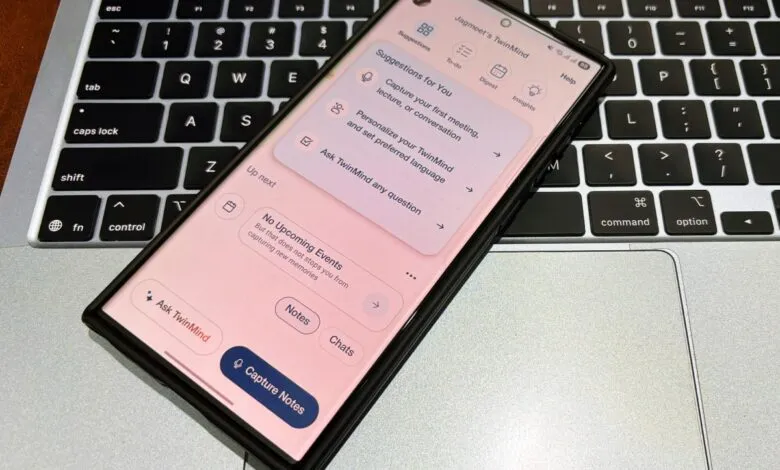
– The app transcribes audio on-device in real-time, works offline for up to 16–17 hours, and generates notes, to-dos, and answers while supporting real-time translation in over 100 languages.
– It differentiates from competitors by passively capturing audio all day using a native iOS service, avoiding cloud-based processing restrictions, and includes a Chrome extension for gathering context from browser activity.
– TwinMind prioritizes privacy by not training on user data, deleting audio recordings immediately, and storing only transcribed text locally, with over 30,000 users and a $5.7 million seed funding round.
– The startup introduced the Ear-3 AI speech model with improved language support and speaker recognition, offers a Pro subscription, and plans to expand its team and API sales.
Imagine having a personal assistant that quietly listens, learns, and organizes your life, all without ever needing to connect to the cloud. That’s the promise behind TwinMind, an AI-powered app developed by former Google X scientists that captures ambient speech to build a dynamic, personal knowledge base. The startup recently secured $5.7 million in seed funding and has launched versions for both Android and iOS.
Founded in March 2024 by Daniel George, Sunny Tang, and Mahi Karim, TwinMind operates unobtrusively in the background, recording spoken words, with explicit user consent, to create a structured memory of ideas, conversations, and tasks. The app works entirely offline, transcribing audio in real time directly on the device, and can run continuously for up to 17 hours without significantly draining battery life. It also offers real-time translation across more than 100 languages and includes a backup feature to recover data if a device is lost.
What sets TwinMind apart from competitors like Otter or Fireflies is its ability to capture audio passively throughout the day. While many rival apps rely on cloud processing and face restrictions from Apple on background activity, TwinMind uses a native Swift-based service that runs smoothly on iPhones. George explained that the team spent months refining this approach to work within Apple’s strict ecosystem.
The idea for TwinMind emerged when George, formerly Vice President and Applied AI Lead at JPMorgan, grew tired of juggling endless meetings. He built an early prototype that transcribed audio and fed it into ChatGPT, which soon began understanding his projects and even generating code. After sharing the concept online and receiving enthusiastic feedback, he decided to develop a dedicated mobile app that could operate discreetly on personal devices.
Beyond the mobile experience, TwinMind offers a Chrome extension that uses vision AI to scan open browser tabs, from email and Slack to LinkedIn and Notion, gathering even more contextual awareness. In fact, the startup used this very tool to sift through over 850 internship applications, successfully identifying their top candidates.
With over 30,000 users already on board, roughly half of whom are monthly actives, TwinMind is gaining traction not only in the U.S. but also in India, Brazil, the Philippines, and parts of Europe and Africa. While professionals make up more than half of its user base, students and personal users also find value in its capabilities. George shared that even his father uses the app to help write his autobiography.
Privacy remains a critical concern with always-listening AI, but TwinMind is designed with a privacy-first approach. The company does not train its models on user data, and audio recordings are deleted immediately after processing, only transcribed text is stored locally.
The founders’ background at Google X proved invaluable in accelerating TwinMind’s development. George worked on multiple cutting-edge projects during his time there, including the team behind AI-powered earbuds. That experience, he says, was like working at several startups simultaneously, ideal preparation for launching his own venture.
Before Google, George completed a PhD in AI for astrophysics by age 24 and contributed to Nobel Prize-winning research with the LIGO group. His early work caught the attention of Stephen Wolfram, who later became TwinMind’s first investor. The recent seed round was led by Streamlined Ventures, with participation from Sequoia Capital and Wolfram himself, valuing the startup at $60 million.
In addition to its core app, TwinMind recently unveiled the Ear-3 speech model, which supports over 140 languages and boasts a word error rate of just 5.26%. This new model can distinguish between different speakers in a conversation and will soon be available via API. While Ear-3 requires an internet connection, the app seamlessly falls back to the fully offline Ear-2 model when needed.
TwinMind now offers a Pro subscription tier priced at $15 per month, which includes extended context memory and priority support. The free version remains fully functional, offering unlimited transcription and on-device processing.
Currently employing 11 people, TwinMind plans to expand its team with UX designers and business development staff to further improve the product and promote its API offerings. User acquisition is also a key priority as the company continues to grow.
(Source: TechCrunch)