Cyborg Jellyfish: The Future of Deep Ocean Exploration
▼ Summary
– Climate change is warming and acidifying ocean waters, endangering marine species and making deep-sea monitoring vital but challenging.
– Moon jellyfish can swim to deep ocean depths, making them potential allies for studying these hard-to-reach environments.
– Researchers at CU Boulder have built “cyborg” jellyfish equipped with microelectronics to gather data on temperature, acidity, and other properties.
– The team is studying jellyfish biomechanics and water flow patterns to improve their hybrid creations, as detailed in a recent paper.
– Creating biohybrid creatures is an established field, with past examples including cyborg cockroaches used for search-and-rescue applications.
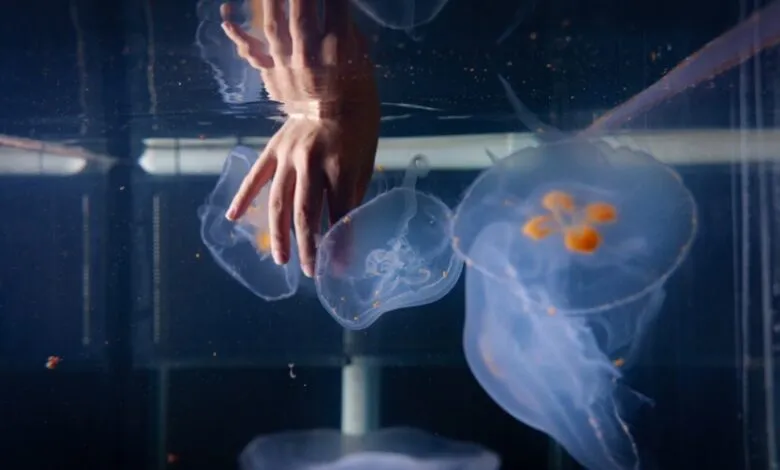
The profound changes occurring in our oceans demand innovative solutions for monitoring and understanding these critical environments. As climate change accelerates, ocean temperatures rise and acidity levels increase due to carbon dioxide absorption, creating urgent challenges for marine ecosystems. Traditional deep-sea exploration relies on costly and complex equipment, but nature may offer a more elegant alternative. Moon jellyfish, capable of navigating extreme depths, have emerged as unexpected partners in scientific efforts to gather essential data from the abyss.
Researchers at the University of Colorado at Boulder have pioneered the development of cyborg jellyfish enhanced with microelectronics to measure temperature, acidity, and other vital ocean properties. To refine these biohybrid systems, the team has conducted detailed studies of jellyfish swimming mechanics. Their recent work, published in Physical Review Fluids, involved analyzing water flow patterns generated by jellyfish movement using biodegradable starchy particles suspended in water.
This approach builds upon a broader scientific interest in combining biological organisms with electronic components. For decades, researchers have explored the potential of cyborg insects, beginning in the 1990s with experiments involving electrode implants in cockroach antennae. By applying electrical stimuli, scientists could influence the insects’ movements, envisioning applications such as search-and-rescue operations in hazardous environments.
In 2015, a team from Texas A&M achieved a significant breakthrough by implanting electrodes directly into the ganglion controlling cockroaches’ front legs. This method proved highly effective, enabling researchers to steer the insects successfully in 60 percent of trials. The roaches were equipped with miniature electronic backpacks synchronized to a remote control, delivering precisely timed shocks to disrupt their balance and guide them along predetermined paths.
(Source: Ars Technica)