Governing Multi-Agent AI: Is It Possible?
▼ Summary
– Single copilots are outdated, with competitive differentiation now coming from networks of specialized AI agents that collaborate and self-critique.
– SAP and Agilent emphasize deploying multi-agent AI systems within cost, latency, and compliance guardrails, requiring monitoring and checkpoints for safe scaling.
– Agilent integrates AI across three strategic pillars: embedding AI into products, enhancing customer-facing capabilities, and improving internal operations like self-healing networks.
– Integration challenges are addressed by migrating legacy systems to the cloud, using unified data platforms like SAP’s Business Data Cloud for end-to-end business processes.
– Successful agentic deployments depend on three critical layers: a unified data layer, an orchestration layer for managing agent connections, and robust security and privacy measures.
The era of single AI copilots has passed, today’s competitive edge lies in deploying interconnected networks of specialized agents that collaborate, self-critique, and dynamically select the best model for each task. Governing these multi-agent AI systems presents both immense opportunity and significant challenges, particularly around scaling safely within cost, latency, and compliance boundaries.
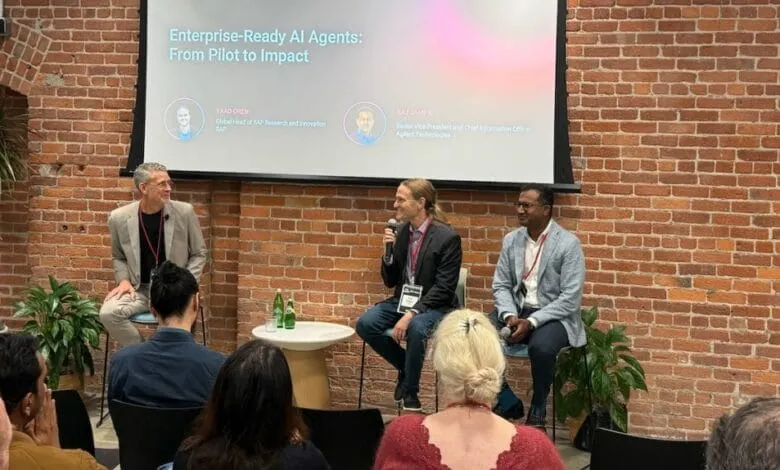
During a recent industry discussion, experts from SAP and Agilent emphasized that while autonomy is achievable, robust monitoring and governance frameworks are non-negotiable. Yaad Oren of SAP stressed that although the technology isn’t yet perfect, continuous oversight ensures vulnerabilities are minimized as systems grow. Agilent’s Raj Jampa echoed this, noting that his organization is moving beyond exploration into actively managing AI deployment challenges like cost optimization and enhanced monitoring.
Agilent has structured its AI integration around three core pillars: embedding intelligence into product instruments, identifying high-value customer-facing capabilities, and applying AI internally to boost operational efficiency. A strong governance framework underpins all these efforts, ensuring policy-based boundaries are in place without stifling innovation. Jampa shared a telling example: an unchecked config update by an agent caused immediate disruption, but robust auditing mechanisms allowed the system to quickly detect and trace the issue.
Human oversight remains essential, especially for high-stakes decisions involving complex models or natural language processing. In these cases, agents are designed to request human intervention before proceeding. This balance between automation and human judgment is critical, as latency and accuracy directly impact operational costs. A well-designed governance layer helps monitor these variables, enabling continuous refinement of AI strategies.
Integration remains a major hurdle, particularly when connecting AI agents with legacy on-premise systems. Oren highlighted that cloud frameworks simplify these connections, making it easier to maintain data flow and update cycles. SAP assists enterprises in migrating to cloud environments, where unified data platforms like the Business Data Cloud provide semantic context and enable end-to-end business process automation.
Three elements are indispensable for successful agentic activation: a unified data layer, a sophisticated orchestration tier, and rigorous privacy and security protocols. Clean, well-structured data is the foundation, while orchestration blends both science and art to manage agent interactions without causing systemic failures. Security cannot be compromised, especially when multiple agents operate across sensitive databases. Identity and access management become increasingly critical as AI agents take on roles resembling human team members.
Looking ahead, organizations must treat agents not as isolated tools but as integral components of the workforce, complete with onboarding, authorization protocols, and ongoing performance management. Continuous monitoring and improvement cycles ensure these digital colleagues operate effectively and ethically within broader business ecosystems.
(Source: VentureBeat)