Nvidia Transforms OpenClaw Into Enterprise AI Platform NemoClaw

▼ Summary
– OpenClaw is a fast-growing, open-source AI agent platform launched in January 2026 that runs locally and can perform tasks like organizing files and browsing the web without cloud routing.
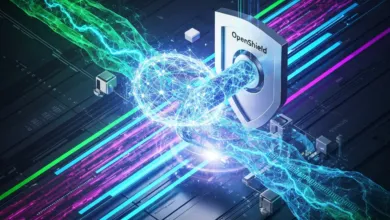
– Nvidia introduced NemoClaw, a software stack that installs onto OpenClaw to add enterprise-grade privacy and security infrastructure via a new open-source runtime called OpenShell.
– OpenShell sandboxes AI agents at the process level, enforcing policy-based controls on file access and network connections to keep agents productive within strict boundaries.
– NemoClaw can run various AI models locally on Nvidia hardware or connect to cloud models via a privacy router, addressing the core tension between agent autonomy and enterprise security needs.
– While NemoClaw addresses runtime security, analysts caution it is not a complete governance solution, as security must be embedded throughout the entire AI development lifecycle.
A single command can now equip the world’s most rapidly expanding open-source AI agent platform with enterprise-grade security, privacy controls, and local model deployment. This transformation addresses a critical need for businesses, allowing them to harness the power of autonomous AI assistants without compromising sensitive data. The platform, OpenClaw, initially captivated developers with its ability to perform tasks like file organization and web browsing entirely on a local machine, eliminating cloud dependency. However, this very capability presented a significant challenge for corporate IT departments concerned with governance and data exposure.
Nvidia’s response, unveiled at its GTC conference, is NemoClaw. This new stack integrates directly with OpenClaw, providing the essential infrastructure that makes the agent viable for professional use. The cornerstone of this offering is OpenShell, an open-source runtime that creates a secure sandbox for AI agents at the process level. It enforces granular, policy-driven controls over file access, network activity, and data management. This means an agent can be genuinely useful without being granted unrestricted freedom within a company’s digital environment.
Administrators define these security policies using straightforward YAML configuration files. A team could, for instance, allow an agent to connect only to an approved cloud-based AI service while blocking all other network traffic. OpenShell is part of Nvidia’s broader Agent Toolkit, which includes open models, additional runtimes, and architectural blueprints for constructing persistent autonomous agents.
The NemoClaw installation also deploys Nvidia’s family of Nemotron open models to run locally on available hardware, from GeForce RTX laptops to high-performance DGX systems. A built-in privacy router provides controlled, guarded access to more powerful cloud-based models when necessary, ensuring all interactions remain within the established security perimeter. This architecture is designed to let AI assistants learn and develop new capabilities while strictly adhering to their configured boundaries.
Nvidia’s founder and CEO, Jensen Huang, framed the development as a watershed moment. “OpenClaw is the operating system for personal AI,” he stated during the announcement. “This is the beginning of a new renaissance in software.” He compared its impact to foundational technologies like Linux and HTML, suggesting business leaders will soon need to define their own OpenClaw strategy.
Peter Steinberger, the Austrian developer who created OpenClaw and now works at OpenAI, endorsed the partnership. “With Nvidia and the broader ecosystem, we’re building the claws and guardrails that let anyone create powerful, secure AI assistants,” he said.
Critically, NemoClaw is not restricted to Nvidia’s models. It supports coding agents and can work with models from various providers, including OpenAI and Anthropic, alongside the local Nemotron options for those requiring complete cloud isolation.
The security layer is vital. Earlier versions of OpenClaw had publicized vulnerabilities, such as susceptibility to prompt injection attacks. While many issues have been patched, a fundamental conflict remains: an agent needs broad access to be effective, but a business cannot allow it to operate unchecked. OpenShell tackles this tension at the infrastructure level rather than relying solely on application-level fixes.
Nvidia is collaborating with major security firms like Cisco, CrowdStrike, and Microsoft to integrate OpenShell compatibility into their toolsets, weaving these guardrails directly into existing enterprise security frameworks. The company also opened orders for its DGX Station desktop supercomputer on the same day, highlighting the synergy between local hardware and the new software stack.
Industry analysts acknowledge that NemoClaw and OpenShell effectively address the deployment and runtime aspects of agent governance. However, they caution that security and accountability must be embedded throughout the entire AI development lifecycle, not just applied at the final execution stage. Nvidia’s Agent Toolkit hints at this broader view by including AI-Q, a reference blueprint for how agents should break down and route tasks.
Currently available as an early-access preview, NemoClaw is in an alpha stage. Nvidia is transparent about its developmental status, with the clear goal of evolving into a production-ready orchestration platform. The stunning rise of OpenClaw from a one-hour project to an enterprise AI foundation in under two months underscores the breakneck pace of innovation. Having established itself as the indispensable hardware layer for AI, Nvidia is now making a concerted play to become equally essential in the software stack. The ultimate question for businesses is whether they will entrust their autonomous agents to Nvidia’s ecosystem as completely as they have their AI training workloads.
(Source: The Next Web)