Nvidia’s Autonomous Driving Chief Reveals Plan to Beat Tesla and Waymo
▼ Summary
– Nvidia’s CEO and automotive head recently tested the company’s hands-free driver-assist system in a Mercedes, navigating complex urban traffic without disengagement.
– Nvidia is moving from a behind-the-scenes chip supplier to a leader in autonomous driving, offering its own AI platform, Alpamayo, which it calls a “ChatGPT moment for physical AI.”
– The company’s approach combines an end-to-end AI model with a traditional “classical” safety stack, aiming for human-like driving within a verifiable safety framework.
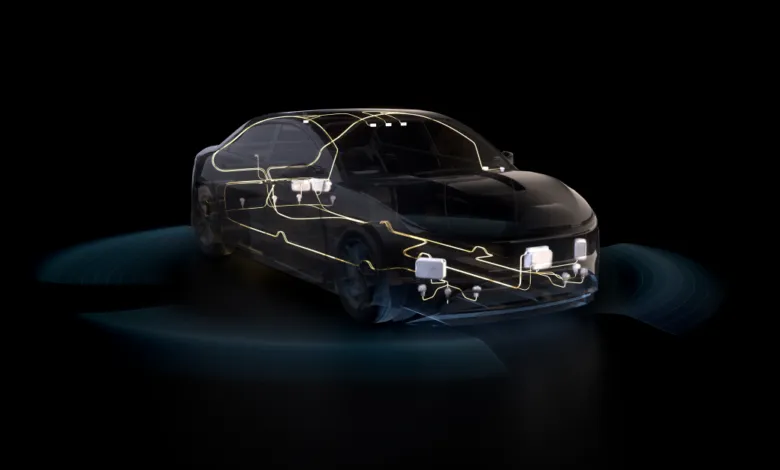
– Nvidia differentiates itself from Tesla by using multiple sensor types (cameras, radar, lidar) for redundancy, believing this is critical for safety, though it increases cost.
– To compensate for less real-world driving data than rivals, Nvidia heavily relies on simulation, using reconstructed and augmented scenarios to train its systems for edge cases.
Nvidia is making a bold and public push to become a dominant force in autonomous driving, moving beyond its role as a chip supplier to directly challenge leaders like Tesla and Waymo with its own integrated AI platform. The company’s strategy hinges on a unique combination of advanced AI and traditional safety engineering, aiming to deliver a system that drives with human-like confidence while meeting rigorous safety standards.
Recently, CEO Jensen Huang joined the company’s automotive chief, Xinzhou Wu, for a demonstration drive from Woodside to downtown San Francisco. They used a Mercedes equipped with a hands-free driver-assist system powered by Nvidia technology. Throughout the journey, the vehicle navigated typical urban challenges like construction zones and double-parked cars. While the presented video was edited, the company confirmed the system operated without requiring human intervention during the trip. The capability mirrors experiences reported by others, showcasing the system’s adept handling of complex city driving scenarios from traffic signals to unprotected turns.
This public demonstration signals a shift for Nvidia. After years as a behind-the-scenes powerhouse providing chips to automakers, the company is now aggressively marketing its complete autonomous driving solution. At a recent industry event, Huang introduced a platform called Alpamayo, a suite of AI models and tools designed to enable high-level self-driving. He dramatically framed this development as a transformative “ChatGPT moment” for artificial intelligence in the physical world.
Central to Nvidia’s claimed advantage is its hybrid technical approach. Huang emphasizes that the system merges an end-to-end AI model, which learns to drive from data, with a classical, rule-based software stack engineered by humans. The company argues that while pure AI models can be unpredictable, the classical component provides a verifiable safety foundation. This combination, they say, allows for natural, adaptive driving without sacrificing rigorous safety protocols. Industry observers note that other companies also blend AI with explicit rules, but Nvidia is betting heavily on the sophistication of its integrated platform.
A key point of differentiation from Tesla is Nvidia’s commitment to a multi-sensor strategy. While Tesla relies solely on cameras, Nvidia’s platform incorporates cameras, radar, ultrasonic sensors, and, for higher capability versions, lidar. Wu argues this sensor diversity and redundancy is crucial for managing difficult and rare situations, ultimately leading to a safer system. He acknowledges that adding sensors like lidar increases cost but contends that economies of scale and Nvidia’s integrated design will make advanced systems feasible for vehicles in a broader price range.
Facing a significant data disadvantage compared to Tesla’s billions of real-world miles, Nvidia is investing heavily in simulation. The company uses two primary techniques: neural reconstruction to digitally recreate real driving scenarios, and data augmentation to alter elements within those scenes. This allows engineers to test the AI against countless variations, including rare “edge cases” like the recent San Francisco blackout that confused other autonomous vehicles. By simulating these events, Nvidia can train its systems to respond appropriately without needing to encounter them on real roads.
Looking ahead, Wu’s team is developing what they call a Vision Language Action model. This ambitious project aims to create an AI that can understand driving rules and scenarios in a more generalized, reasoning way, similar to how a human learns from a driver’s manual and limited practice. The goal is a system that requires far less specific training data, learning core driving principles that can be applied safely to nearly any situation on the road.
(Source: The Verge)