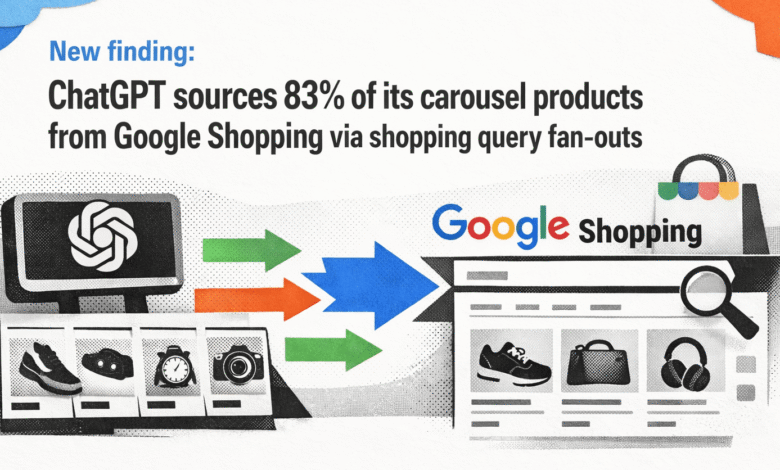
83% of ChatGPT’s Shopping Results Come From Google
▼ Summary
– A study analyzing over 43,000 ChatGPT carousel products found that over 83% were strong matches to products in Google’s top 40 organic shopping results.
– In contrast, only about 11% of ChatGPT carousel products were strong matches to Bing shopping results, with Bing exclusively finding just 0.16% of the products.
– The research shows ChatGPT uses a distinct process for shopping queries, which are shorter and used less frequently per prompt than queries for gathering general contextual information.
– ChatGPT displays a clear positional bias, sourcing most carousel products from higher-ranking Google Shopping results, with 60% of matches coming from the top 10 positions.
– The consistent patterns across diverse product categories and prompt types indicate this reliance on Google Shopping is a systematic architectural feature of ChatGPT.
A recent analysis reveals a significant reliance on Google’s shopping ecosystem within ChatGPT’s product recommendation feature. While OpenAI has charted a more independent course from Microsoft and its Bing search engine, new evidence suggests a strong, perhaps dominant, partnership with Google for sourcing commercial product data. This investigation, which compared thousands of shopping query results, provides compelling data on where ChatGPT finds the items it displays to users.
The discovery began when researchers examining ChatGPT’s source code identified an unusual field labeled `idtotoken_map`. This field contained data encoded in a format known as base64. Upon decoding it, the data revealed parameters that looked strikingly familiar: product identifiers, offer IDs, and locale information that strongly resembled those used by Google Shopping. Most tellingly, the field also contained the specific search query used to look up a product.
To confirm the connection, the team attempted to reconstruct a full Google Shopping URL using only the parameters extracted from ChatGPT. For instance, when a user asked for “best smartphones under $500,” the decoded data from the resulting product carousel allowed them to build a link. That link, when tested, directed them to the exact product shown in ChatGPT’s interface. This was a strong initial indicator, but it raised broader questions about the scale and consistency of this sourcing method.
To move beyond a single example, researchers utilized a large dataset to analyze over 40,000 products from ChatGPT carousels and compared them against 200,000 organic listings from both Google and Bing Shopping. The goal was to determine if this was a systematic process or an isolated occurrence. The analysis employed a sophisticated three-step matching algorithm to compare product titles, counting a product as a match only if it showed a very high degree of similarity, effectively meaning it was the same brand and item.
The results were decisive. A remarkable 83% of products featured in ChatGPT’s carousels were found to be strong matches within the top 40 organic results on Google Shopping. In stark contrast, the match rate for Bing Shopping was just under 11%. Even more revealing, of the small number of products that did match on Bing, only 70 across the entire dataset, a mere 0.16%, were not also found on Google. This strongly suggests that when a product appears on both platforms, ChatGPT is almost certainly pulling it from Google.
The study also uncovered clear differences in how ChatGPT retrieves information for shopping versus general knowledge. So-called “shopping query fan-outs” are distinct from standard search queries 98.3% of the time. They are notably shorter, averaging seven words compared to twelve for contextual searches, and ChatGPT uses far fewer of them per prompt. This aligns with the different objectives: retrieving specific product listings from a structured index versus gathering broad contextual information from the web to formulate a written answer.
Further analysis showed that ChatGPT exhibits a clear preference for products that rank higher in Google’s own shopping results. Approximately 60% of all matched products came from the top ten positions on Google Shopping, and nearly 84% originated from the top twenty. The data indicates a sloping trend where products appearing earlier in the ChatGPT carousel typically correspond to higher-ranking items on Google. This pattern held true across both branded queries (like “Nike running shoes”) and non-branded queries (like “comfortable sneakers”), as well as across ten different retail categories, indicating a systemic architectural behavior.
For businesses and marketers, the implication is direct: visibility in ChatGPT’s shopping carousels is heavily influenced by a product’s ranking in Google Shopping. Optimizing for Google’s shopping algorithms appears to be a primary pathway for appearing in these AI-powered recommendations. However, ranking is likely not the only factor. It is plausible that ChatGPT also considers broader contextual signals, such as product sentiment and mentions within the web pages it retrieves through its standard search processes, to make final selections and adjustments to the carousel order.
For the AI community, this research offers large-scale validation that ChatGPT operates separate retrieval pipelines for different types of information. The system uses one process to gather contextual web data for generating text and a distinct, specialized process to populate its product carousels, which currently leans heavily on Google’s shopping index. It is important to view these findings as a snapshot of current functionality, as the underlying systems and partnerships are subject to change. However, this behavior has been consistently observed for a significant period.
Methodology Note: The study compared 43,000 products from ChatGPT carousels against the top 40 organic results from Google and Bing Shopping, excluding paid ads. A conservative matching algorithm used a cascade of exact, near-exact, and hybrid matching techniques, with a similarity score threshold of 0.8 required to declare a product match. This threshold reliably corresponds to the same brand and product name.
(Source: Search Engine Land)